Why Google Travel Will Lose to Vertical AI
Google optimizes for ad revenue. Vertical AI agents optimize for you. That misalignment is why specialized travel AI will win.
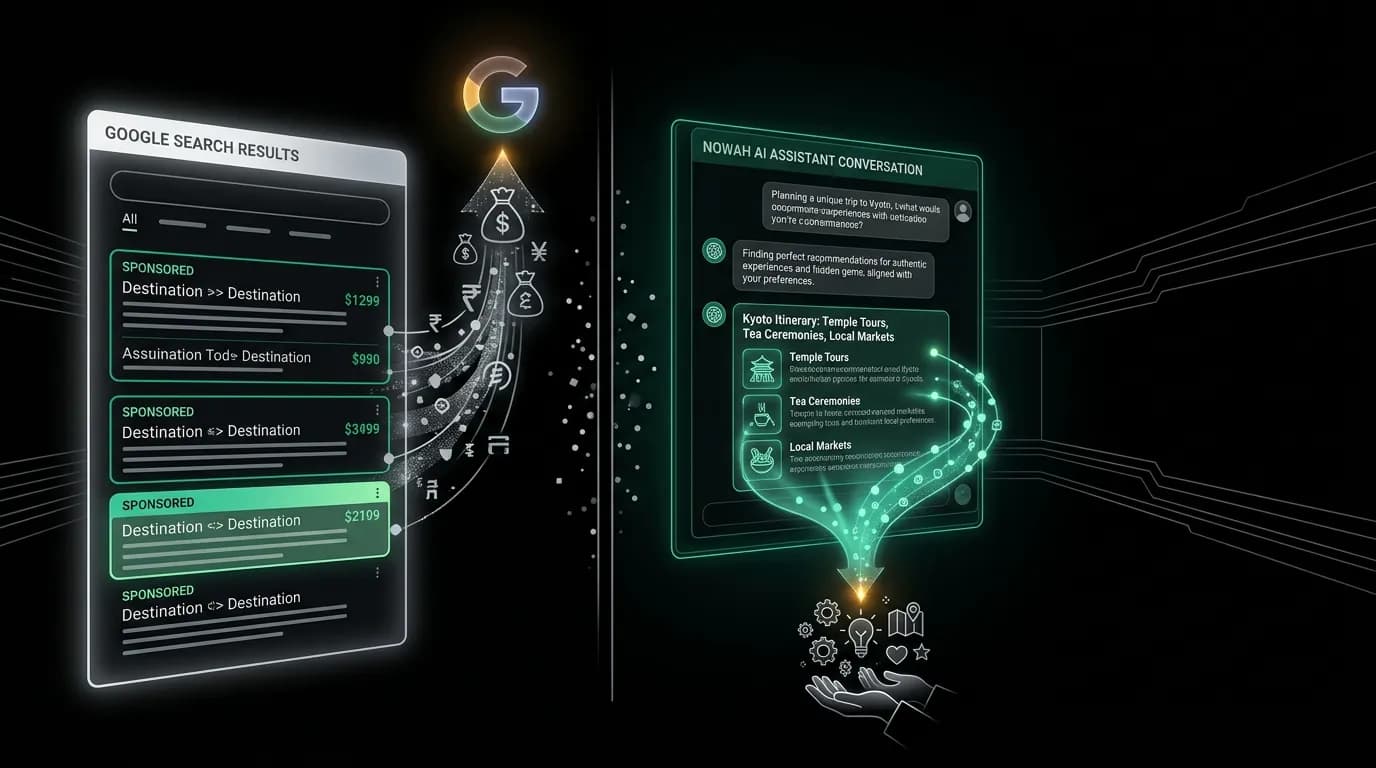
Google is the most powerful technology company in the world. It has the best search infrastructure, enormous AI research capabilities, access to more travel intent data than anyone, and billions of users. On paper, Google should dominate AI travel.
I am going to argue that Google's structural incentives prevent it from building the best AI travel experience, and that specialized vertical AI agents will win the travel market despite Google's overwhelming resource advantage.
Google's travel dominance
Google Flights is the best flight comparison tool ever built. It loads instantly, covers virtually all airlines, has excellent price tracking, and integrates with Google's broader search ecosystem. When someone searches "flights to Tokyo," Google often surfaces its own flight tool before any OTA result.
Google Hotels is similarly capable. Google Maps integration gives it a location-based hotel discovery experience that no standalone product matches. Google's AI capabilities have added features like AI-generated travel summaries, destination guides, and price predictions.
By any objective measure, Google has the most capable travel search technology on the planet.
The conflict of interest
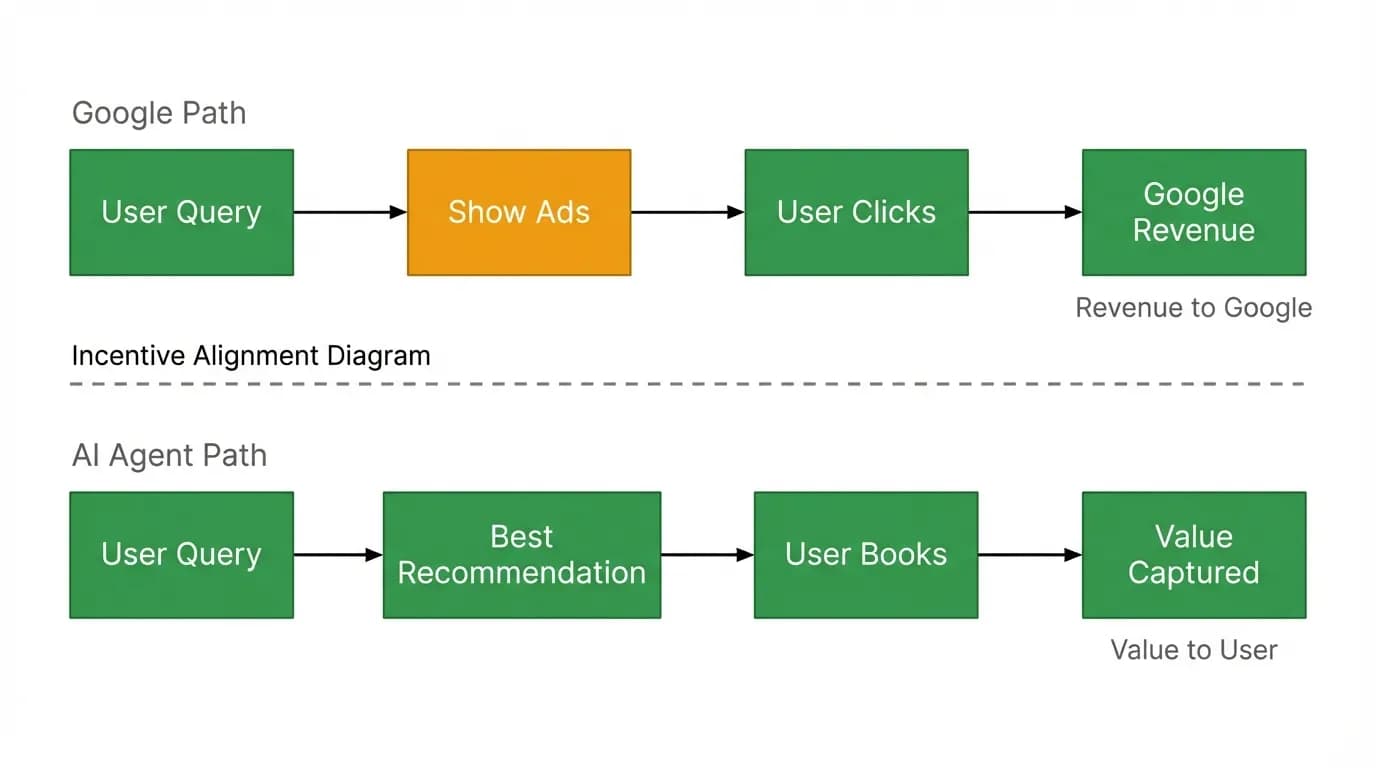
Here is the problem: Google does not make money when you find the best flight. Google makes money when you click an ad.
Google's travel products exist within an advertising business model. Google Flights shows "sponsored" results. Google Hotels shows "official site" links that are actually paid placements. The AI-generated summaries sit alongside ads that generate revenue per click.
An AI agent that says "book this flight, it is the best option" eliminates the ad surface area. If the AI just tells you the answer, you do not need to click through to an airline's site or an OTA's listing. Every click that the AI saves the user is a click that Google cannot monetize.
This is not a theoretical conflict. It shapes product decisions daily. Google's AI travel features are designed as enhancements to search results, not replacements for them. The AI summary sits on top of the traditional link list. It guides you toward the same click-and-compare model that generates revenue. It does not eliminate the comparison step because eliminating that step eliminates the business model.
Horizontal vs. vertical
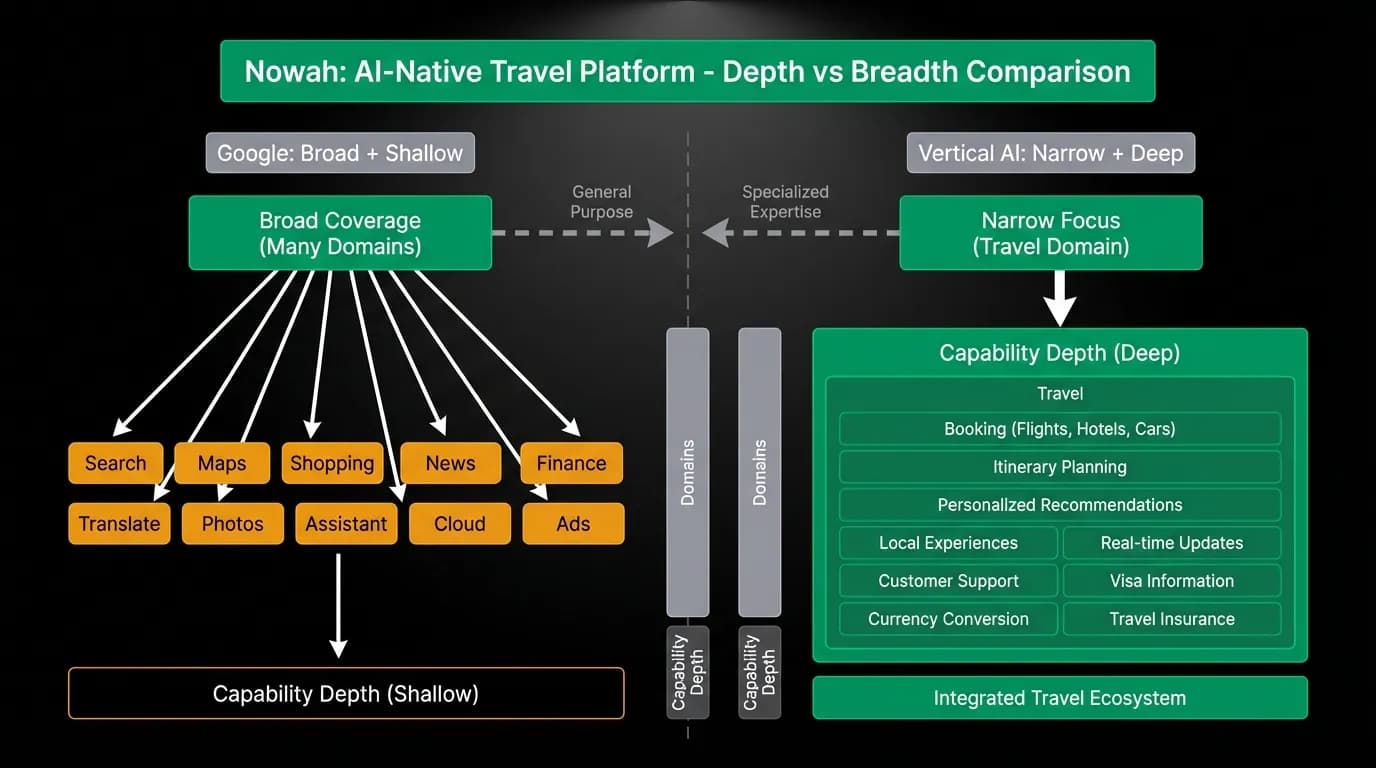
Google is a horizontal platform. It handles travel, restaurants, news, shopping, coding, math, weather, and everything else. This breadth is a strength for general search and a weakness for specialized tasks.
A vertical AI agent focused exclusively on travel has advantages that Google cannot replicate within its horizontal model:
Domain-specific memory. Our agent remembers that you prefer aisle seats, avoid connecting through Miami, and always stay in boutique hotels. Google does not maintain this kind of persistent, domain-specific user model across sessions.
Specialized tools. Our agent has over a large set of tools designed for the travel booking lifecycle: flight search, hotel search, seat selection, visa checking, weather forecasting, price tracking, booking execution. Google's AI has general-purpose capabilities that are broad but not deep in any single domain.
Industry relationships. A vertical travel agent builds direct API relationships with airlines, hotels, and data providers. It negotiates access, optimizes for travel-specific data formats, and builds pipelines tuned for the domain. Google accesses travel data through the same general-purpose web crawling and partnerships it uses for everything else.
Aligned incentives. A vertical AI travel agent makes money when the user successfully books a great trip. Google makes money when the user clicks an ad. These incentives produce different product decisions.
The missing pieces
Even if Google wanted to build the best AI travel agent (and they might), several pieces are structurally missing:
No persistent memory. Google does not maintain cross-session conversation memory for individual users in the way that a dedicated travel agent does. Your Google search history is used for ad targeting, not for building a personalized travel preference model. The difference matters. Ad targeting knows you searched for Tokyo. A travel preference model knows you prefer direct flights, morning departures, boutique hotels, and window seats.
No booking execution. Google Flights and Google Hotels are search products. They show you options and link you elsewhere to book. A vertical AI agent handles the entire booking within the conversation. The user never leaves. This end-to-end experience is impossible for Google without fundamentally competing with the advertisers who pay its bills.
No personal relationship. A vertical AI agent develops a relationship with the user over time. It remembers past trips, references shared experiences, and builds a trust history. Google's interaction model is transactional: query, results, gone. There is no continuity between sessions.
Why Google cannot fix this
The structural challenge is not technical. Google has the AI capabilities, the data, and the engineering talent to build the best travel agent in the world. The challenge is economic.
Google's revenue model depends on ad impressions. AI curation reduces ad impressions. Therefore, deploying AI curation aggressively in travel would cannibalize Google's own revenue. Every flight that the AI books directly is a flight booking that did not generate ad clicks on the way.
Google has tried to resolve this tension in other domains. Google Shopping added direct buying features but never fully committed because doing so would reduce the ad-driven comparison shopping that generates revenue. The same dynamic plays out in travel.
This is the classic innovator's dilemma. Google's existing business is too profitable to disrupt from within. The motivation to protect ad revenue will consistently override the motivation to build the best possible user experience.
The search-to-agent transition
The fundamental shift is from searching to conversing. When travelers stop typing queries into a search box and start talking to an AI agent, the entire value chain changes.
Search produces ad impressions. Conversation produces bookings. Users who search can be shown ads. Users who converse cannot, at least not without destroying the conversational experience.
Vertical AI agents are built for the conversation model. Google is built for the search model. The transition from one to the other is the transition away from Google's structural advantage.
Users trust specialists over generalists for high-stakes decisions. Nobody asks a general-purpose AI to manage their investment portfolio when a specialized financial advisor exists. The same logic applies to travel. When a specialized AI travel agent exists that knows your preferences, has deep domain expertise, and is aligned with your interests, the general-purpose search engine becomes the second choice.
The best travel app in 2028 will not be made by Google. It will be made by a team that is building exclusively for travel, without the structural constraints that prevent Google from putting the user first.
Nowah is an AI travel agent that searches and books real flights and hotels through conversation — no filters, no thirty open tabs. Plan your next trip.