AI Agents Are Rebundling Travel: The End of App-Hopping
The internet unbundled travel into five separate apps. AI agents are rebundling it into one conversation that handles flights, hotels, and everything.

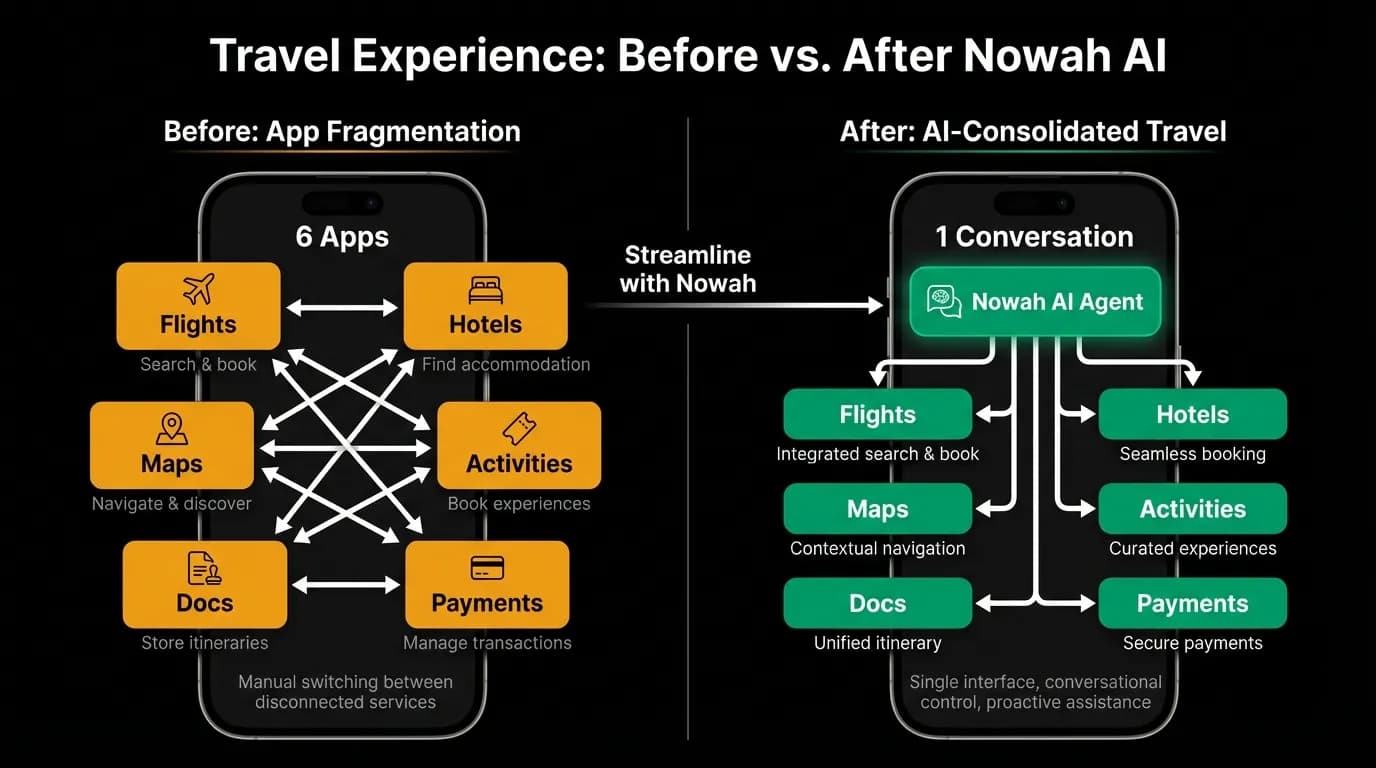
Last month I watched a friend plan a trip to Portugal. She had seven tabs open: Google Flights for airfare, Booking.com for hotels, Google Maps for location checking, TripAdvisor for restaurant reviews, Rome2Rio for ground transport, a currency converter app, and a shared Google Doc where she and her boyfriend were copying and pasting links back and forth. Two hours in, she had booked nothing. She had, however, developed a visible tension headache.
This is the state of travel planning in 2026. Not because the tools are individually bad. Each one works fine for its specific purpose. The problem is that planning a trip requires all of them, and none of them talk to each other.
The internet unbundled travel into a dozen separate products. AI agents are about to bundle it back together. And this rebundling is going to be one of the most consequential shifts in how people buy travel.
The unbundled nightmare
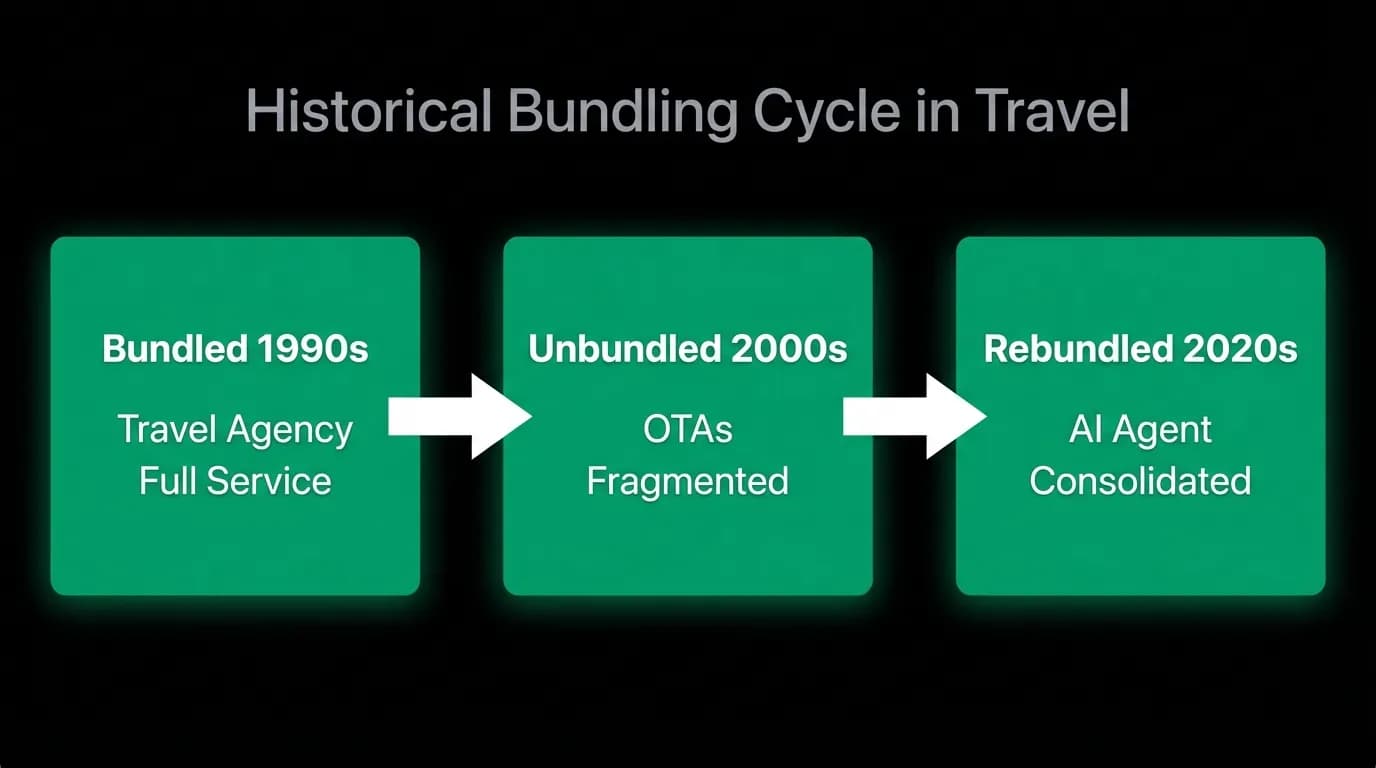
Think about what happened to travel in the early 2000s. Before the internet, you walked into a travel agency and one person handled everything. Flights, hotels, car rentals, tours, restaurant recommendations, visa advice. The service wasn't always great. The prices weren't always competitive. But the experience was integrated. One person. One conversation. Everything handled.
Then the internet arrived and blew that apart.
Expedia took flights. Booking.com took hotels. TripAdvisor took reviews. Google Maps took navigation. Lonely Planet took guidebooks. Skyscanner took price comparison. Airbnb took alternative accommodation. GetYourGuide took activities. Uber took ground transport. XE took currency. TripIt took itinerary organization.
Each product was better at its specific job than the travel agent was. And each one was cheaper, often free. The consumer won on price and quality within each category.
But the consumer lost on integration. Badly.
Today, planning a single trip requires bouncing between 5+ apps and websites. Each one has its own interface, its own account, its own search paradigm. None of them share context. The flight search doesn't know about the hotel search. The hotel search doesn't know about the activities plan. The itinerary app doesn't know about any of the bookings. You become the integration layer, manually copying information between products, keeping track of dates and locations and confirmation numbers in your head or in a messy notes app.
The cognitive overhead is real. A study by Google and Phocuswright found that the average traveler visits many websites before booking. That's not a sign of empowered consumers. That's a sign of a broken system where finding and purchasing a single product requires touching nearly 40 different services.
Why unbundling happened (and why it made sense)
It's easy to criticize unbundling from where we stand now, but it happened for good reasons.
The travel agency model had real problems. Agents had limited inventory access. Prices were opaque. Competition was local. You got whatever your agent had access to, and you paid whatever they charged, with no easy way to verify if the price was fair.
The internet solved those problems by creating specialists. An airline search engine could aggregate fares from hundreds of carriers because that was its only job. A hotel review site could collect millions of reviews because reviews were its only focus. Each vertical specialist could go deeper and wider than any generalist travel agent.
This followed the same pattern that played out in media, retail, and financial services. Newspapers were unbundled into classified sites, news aggregators, and social media. Department stores were unbundled into category-specific e-commerce. Banks are being unbundled into payment apps, lending platforms, and investment tools.
Unbundling creates better individual products at the cost of integration. That trade-off made sense when integration was expensive and required human labor. A travel agent coordinating flights, hotels, and activities was essentially a human API connecting disconnected systems. When each system went online, the human API seemed redundant.
What nobody anticipated was that the integration problem wouldn't go away. It just shifted from the agent's desk to the consumer's phone screen.
The pain is measurable
The cost of travel fragmentation isn't just annoyance. It has measurable consequences.
Time waste is the most obvious. Research from Google shows the average trip takes 45+ touchpoints over two to three months to book. If you assume even five minutes per touchpoint, that's nearly four hours of active planning for a single trip. For a one-week vacation. The planning-to-vacation ratio is absurd.
Decision quality suffers because information is scattered. You find a great hotel on Booking.com, but you can't easily evaluate its location relative to the restaurant you found on TripAdvisor or the museum you read about on a blog. Each piece of information exists in its own silo. Building a coherent picture requires mental assembly that most people aren't equipped to do well under the cognitive load of dozens of options.
Money gets left on the table because cross-product optimization is impossible. The cheapest flight might arrive at midnight, requiring an expensive taxi. The cheapest hotel might be far from the sights, requiring expensive daily transport. A slightly more expensive flight arriving at a reasonable hour to an airport near a slightly more expensive but better-located hotel could save money overall. No combination of current tools helps you see this.
Plans fall apart because no single product manages the whole picture. A flight delay means a hotel check-in problem, but there's no system connecting those two bookings. You find out your flight is delayed from the airline app, then have to manually call the hotel from a different app, referencing a confirmation number from a third app.
Cart abandonment in travel is 81-87%, the highest in e-commerce. Part of that is price sensitivity. But a significant part is simply that the process is so fragmented and exhausting that people give up.
The rebundling thesis
Every industry that unbundles eventually rebundles. Not back to the old bundle, but into a new one that preserves the benefits of specialization while restoring integration.
In media, social platforms rebundled news, entertainment, and community into a single feed. In finance, neobanks are rebundling payments, saving, investing, and borrowing into a single app. In commerce, Amazon rebundled everything into a single marketplace.
Travel is overdue for the same cycle. And AI is the technology that makes it possible.
The reason travel didn't rebundle earlier is that integration without AI requires either massive human labor (the old travel agent model) or massive interface complexity (a super-app that tries to do everything with forms and pages). Neither works at scale. Human agents are expensive and don't scale. Complex super-apps create the same decision fatigue they're trying to solve.
AI changes the equation because the agent handles the complexity. One conversation can span flights, hotels, ground transport, activities, documents, and ongoing trip management without the user having to switch tools or interfaces. The AI maintains context across all these domains. It remembers that your flight arrives at 3 PM when searching for hotels with late check-in. It knows your budget across the whole trip, not just per booking. It connects the pieces that unbundling disconnected.
This isn't a theoretical possibility. We built it. When you ask Nowah's AI agent about a trip to Lisbon, the conversation can flow naturally from flights to hotels to local tips to currency questions to visa requirements. All in one thread. All with shared context. All with memory of your preferences.
The user doesn't need to know that different data sources power different parts of the conversation. They just talk, and the agent handles the rest.
What the Asian super-apps proved
The idea that a single app can handle multiple travel functions isn't new. WeChat in China has been doing some version of this for years. Grab in Southeast Asia handles rides, food, deliveries, payments, and travel bookings. LINE in Japan, Gojek in Indonesia, the list goes on.
These super-apps proved that consumers want consolidation. When given the option of one app that handles many things versus many apps that each handle one thing, consumers overwhelmingly choose the single app. The switching costs of bouncing between apps, the cognitive load of maintaining multiple accounts, the friction of re-entering information, all of these push users toward consolidation.
But the Asian super-apps achieved consolidation through breadth, not intelligence. They are bundled services with a shared payment layer and a shared identity. Each service within the super-app still works essentially the same way it would as a standalone product. The ride-hailing interface is still a map with a pickup and destination. The hotel booking interface is still a search form with results. There's no AI agent connecting the dots.
This means the super-app experience is still fragmented at the interaction level, even if it's unified at the platform level. You're in one app, but you're using five different interfaces. The context doesn't carry over. The hotel search doesn't know about the ride you just booked to the airport.
AI-powered rebundling goes a level deeper. Instead of putting multiple interfaces in one app, it puts multiple capabilities behind one interface: the conversation. The AI is the unifying layer, not just the app container.
The economics of rebundling
There's a hard business case for rebundling travel, not just a user experience case.
In the unbundled model, each product captures a fraction of the trip's total spend. Google gets the search click. Skyscanner gets the referral fee. The OTA gets the booking commission on the flight. Another OTA gets the commission on the hotel. A different app handles activities. Each player gets a thin slice.
In a rebundled model where one product handles the full trip lifecycle, the economics are dramatically different. You capture the entire trip's value, not just one component. A user who books flights, hotels, and uses travel tools through a single product has a lifetime value many multiples higher than a user who just books one flight.
The retention dynamics are also different. In the unbundled world, there's no loyalty. Users search Google Flights for one trip, Skyscanner for the next, and Kayak for the one after that. Each booking is a standalone transaction. In a rebundled model with AI memory, every booking makes the next one better. Your preferences compound. Your travel history informs future recommendations. Leaving means abandoning all of that personalization and starting over.
This is the real moat. Not technology. Not inventory. Memory. An AI agent that knows your travel preferences after ten trips is genuinely hard to replace. That knowledge has value, and it only exists inside the product where you built it.
What rebundled travel actually looks like
Let me paint the picture of how a rebundled, AI-powered travel experience works in practice.
You open the app and say "I'm thinking about a week in Lisbon in October." The AI knows from past trips that you prefer direct flights when available, that you like boutique hotels in walkable neighborhoods, and that your budget for a European trip is typically around $3,000 total. It doesn't ask you about any of this. It already knows.
The agent searches flights, finds three options, and presents them in the conversation. You pick one. Without missing a beat, the agent searches hotels. It knows your flight arrives at 4 PM, so it looks for hotels with standard check-in times. It knows you like walkable neighborhoods, so it prioritizes Alfama and Chiado over suburban options. Three hotels appear. You choose.
Then it keeps going. "The weather in Lisbon in October is usually around 20 degrees C with occasional rain. Want me to note that for packing? Also, your passport is valid until 2028, so no issues there. Portugal uses the Euro, which is currently at 1.08 to USD. Want me to add a currency converter shortcut for your trip?"
Your trip is created in the Trips tab. Flight details, hotel confirmation, a generated itinerary with suggestions based on your past interests (you visited three museums on your last European trip, so it suggests Lisbon's best museums). All documents in one place. If your flight gets delayed, the agent can proactively check whether your hotel check-in is affected and notify both you and the hotel if needed.
One app. One conversation. Full trip. Zero tab-switching.
That's rebundling. Not cramming five separate products into one app. Putting one intelligent agent in charge of the entire trip and letting it coordinate everything.
The obstacles to rebundling
I'd be dishonest if I didn't acknowledge the challenges. Rebundling travel is hard for several reasons.
Inventory breadth. To handle the full trip lifecycle, you need access to flights, hotels, and eventually ground transport, activities, and restaurants. Building or licensing these integrations takes time and capital. The unbundled specialists had years to build deep inventory in their categories.
Quality across domains. Being good at flights and good at hotels and good at trip management simultaneously is harder than being good at one thing. Users will compare each component against the specialist. If your hotel search is worse than Booking.com's, even if the integrated experience is better overall, some users will leave.
User trust. Asking users to consolidate their entire travel experience into one product requires trust that takes time to build. Users are comfortable with the known quantity of Google Flights for search, even if the overall experience is worse. Switching everything at once feels risky.
Habit change. People have ingrained workflows for trip planning. Breaking those habits, even when the new way is better, requires friction that many users resist initially.
These are real obstacles, not trivial ones. But they're execution challenges, not conceptual ones. The user need is clear. The technology is ready. The economics favor it. The question is whether someone can execute well enough to pull it off.
Why now, specifically
The rebundling moment is now because three conditions have aligned.
First, AI agents can handle the cross-domain complexity. Five years ago, building a single agent that could search flights, compare hotels, check visa requirements, convert currencies, and manage an itinerary was technically impractical. The language models weren't capable enough, and the tool orchestration frameworks didn't exist. Today, an AI agent can do all of this with high reliability.
Second, the APIs exist. Live flight pricing, hotel inventory, weather data, visa information, currency rates, all of this is accessible through modern APIs. The data plumbing that a rebundled product needs is available in a way it wasn't a decade ago.
Third, users are ready for conversational interfaces. The behavioral shift toward chat-based interaction, driven by messaging apps, voice assistants, and ChatGPT, means that a conversation-first product doesn't require user education. People already know how to have a conversation with an AI.
The travel industry is sitting in the same position media was in around 2008, when social platforms began rebundling content that had been scattered across blogs, news sites, and forums. The unbundled era created enormous value, but it also created enormous friction. The companies that rebundle intelligently will capture disproportionate value from reducing that friction.
For travel, the rebundler won't be a super-app with ten separate interfaces. It will be an AI agent that handles ten separate functions through one conversation. That's the product we're building at Nowah. And based on how people use it, the rebundling can't come soon enough.
Nowah is an AI travel agent that searches and books real flights and hotels through conversation — no filters, no thirty open tabs. Plan your next trip.