Premium cabin vs the wider trip budget: create a useful Nowah comparison
Compare a premium cabin preference with the wider trip using a Nowah budget-scope sheet that keeps actual fare, rooming and offer conditions clear.
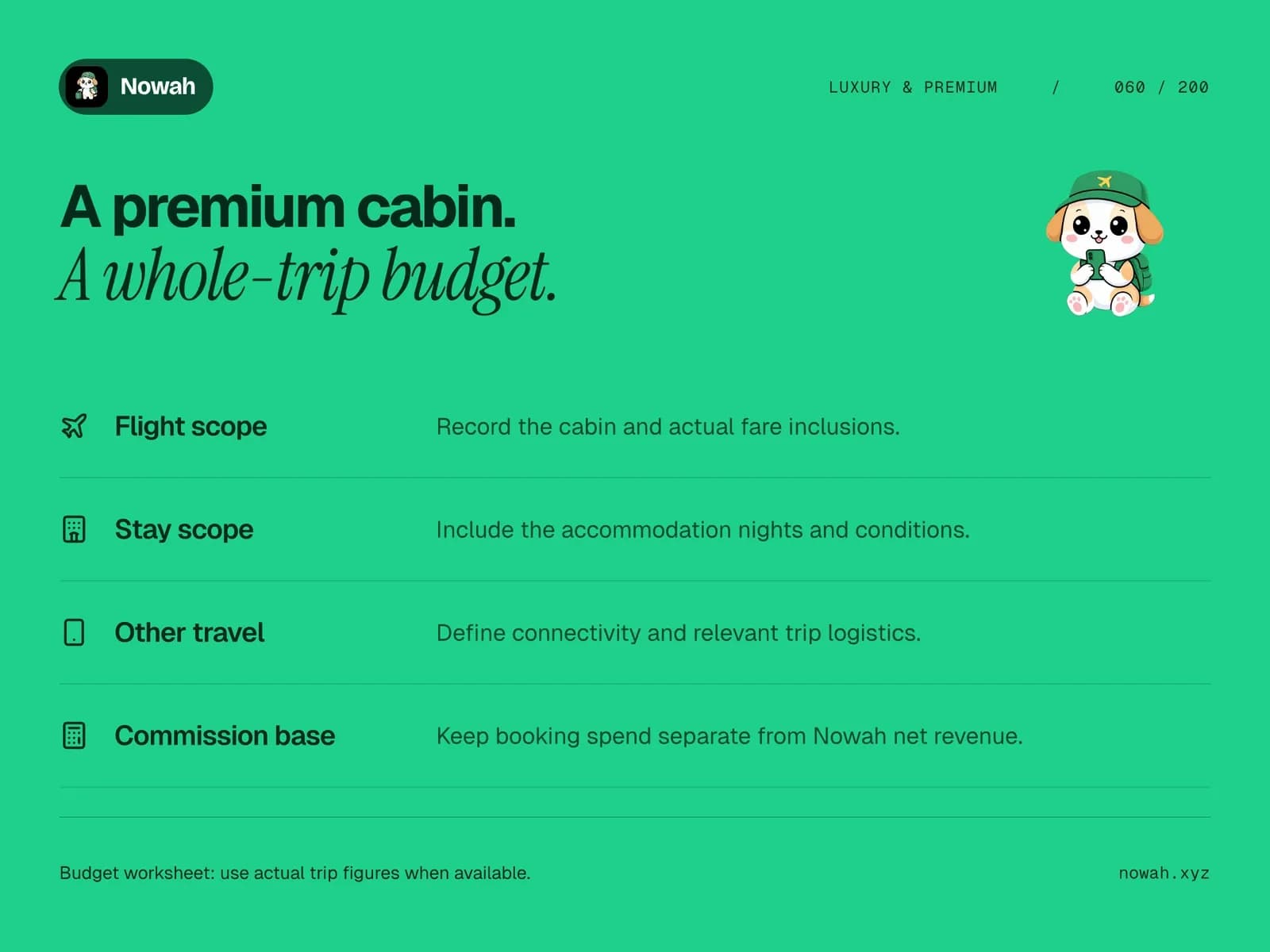
A premium cabin can be an important traveller preference, but it is only one part of a trip. Accommodation, dates, rooming, actual fare conditions and other planned costs still shape the decision. A useful creator comparison helps the reader understand those priorities rather than treating the cabin label as a complete travel brief.
The Nowah Partner Program offers approved creators 35% of Nowah net revenue from qualifying bookings by eligible attributed accounts. Its continuing account attribution gives premium-flight and wider-trip content a meaningful earning opportunity, without an automatic commission advantage from a higher retail fare.
This guide provides a trip-budget scope sheet for a labelled Nowah demonstration. It does not recommend a personal spending level, predict live prices or promise that one cabin choice will produce a particular comfort, supplier or earning outcome.
Define what the budget includes
A total means little if the scope is unclear. Identify whether the traveller's stated budget covers flights, accommodation, paid connectivity and any other planned items. Keep exclusions visible rather than comparing one partial amount with another whole-trip amount.
Use the actual currency and relevant date scope. Do not silently combine different units or invent a conversion assumption to produce a tidy comparison. For a teaching example, label every fictional input and keep it separate from a live supplier quote.
The creator's first useful job is to make the question understandable. A Nowah demonstration can organize the brief and identify which actual offer information needs investigation before the traveller chooses a direction.
The full travel-decision guide helps bring rooming, location, dates and conditions into the same conversation rather than reducing the trip to one headline fare.
Record the cabin preference without assuming benefits
Ask why the traveller is considering the cabin. The answer should come from their stated priorities, not from a creator's assumption that every luxury trip needs the highest category available.
Check actual fare and product conditions through appropriate current supplier evidence. A cabin label or a past review does not establish every inclusion, aircraft arrangement or benefit for the reader's proposed flight. Do not assume a lounge, chauffeur, baggage arrangement or other service without support for the actual offer.
Your own flight experience can provide useful context when it is dated and scoped honestly. It does not become a universal promise about every future journey.
The business-class review to arrival-plan guide provides a focused follow-up for connecting a cabin discussion with the next part of the trip.
Keep the wider trip requirements visible
Accommodation needs can change the usefulness of a fare direction. The traveller may require a particular rooming arrangement, location priority or level of flexibility. Those requirements should not disappear because the flight content is visually compelling.
Keep a distinction between essential needs and preferences. If a proposed direction fails an essential requirement, explain the unresolved question instead of presenting the remaining benefits as compensation for a missing necessity.
A plan or map can support the reasoning, but it does not certify availability, suitability or actual supplier arrangements. The Nowah demonstration should show what to investigate next, not imply that the entire trip has been verified.
The premium rate-inclusions guide is useful when the accommodation side of the comparison needs a clearer account of the actual offer.
Work through a fictional budget-scope example
Imagine two adults planning a four-night city stay. Their fictional brief contains a cabin preference, one main hotel base and a manageable daily pace. No actual airline fare, hotel quote or creator earning result is being reported.
The creator prepares two fare directions to research, keeping the same broad trip scope. Each row needs current supplier information for the flight and accommodation requirements. The example does not invent a price gap or assume that every premium product includes the same services.
A Nowah demonstration can show how the priorities organize the investigation. If the traveller decides a rooming or location requirement is essential, explain how that changes the next question. If the cabin preference remains essential too, identify the need to investigate directions that meet both.
The useful output is a clearer decision process, not a universal verdict about whether a premium cabin is worth its price.
Build the trip-budget scope sheet
Use fields for the travelling party, dates, cabin requirement, actual fare inclusions, hotel and rooming requirements, relevant conditions and excluded spending. Add the source and checked date beside material supplier facts.
Keep unknown values explicit. A creator should not estimate an actual fare or room amount merely to finish the worksheet. A hypothetical amount, if used for teaching, needs its own clear label and should not be presented as a current offer.
Then compare the rows against the same stated task. A more restrictive rate or different travel date is a meaningful change in scope, not simply a cheaper version of an identical trip.
The matched-scope comparison guide provides a related method for preserving the basis of a comparison, even though the product example there concerns a stay rather than a cabin.
Turn the sheet into a useful Nowah segment
Choose one relationship to demonstrate, such as how a cabin preference interacts with a hotel requirement or how arrival timing changes the first night. Explain the inputs and what you would investigate or revise next.
Keep the fictional brief separate from real footage or a personal flight review. A viewer should not assume the planning example uses the exact cabin, schedule or supplier arrangement shown in the original media.
The one-question demonstration guide helps limit the segment to a practical task. A focused explanation can make Nowah relevant throughout the content without requiring a generic promotional paragraph at the end.
The existing airline-pricing discussion provides broader context for a fare conversation, while current supplier information remains necessary for an actual offer comparison.
Keep booking spend separate from Nowah net revenue
A larger retail fare or whole-trip budget does not establish a larger creator share. Approved Nowah partners earn 35% of Nowah net revenue from qualifying bookings by eligible attributed accounts. The current terms define permitted direct deductions and exclude general overhead, salaries and general marketing from that list.
For hypothetical arithmetic, a qualifying booking generating $60 of Nowah net revenue would produce a $21 partner share. This does not forecast the value of either fictional fare direction or apply 35% to the traveller's total trip budget.
Keep that base beside the percentage in a graphic or spoken explanation. A premium image should not encourage the audience to infer a commercial amount that the evidence does not establish.
The commission-base communication guide provides a focused check for the arithmetic and labels.
Preserve independent judgement
The recommendation should follow the traveller's actual priorities and the evidence available, not a hoped-for earning outcome. An attractive cabin or hotel can deserve investigation without being automatically right for the brief.
If the comparison cannot support a conclusion yet, name the next fact to resolve. A creator can provide useful guidance by clarifying the question rather than forcing a winner from incomplete information.
The independent-judgement guide helps review that distinction. A clear commercial disclosure explains the partner relationship, but it does not replace evidence for a suitability or supplier claim.
This approach makes the Nowah recommendation more credible: the viewer can understand why the planning process helps, even when their own priorities lead to a different direction.
Explain the account relationship and payment stages
The useful budget-scope content does not itself establish attribution. An eligible new traveller needs the active partner route, successful tracking and a new account created within 30 days of the valid introduction. Existing accounts, self-referrals and artificial accounts do not qualify.
Once established, attribution continues for the traveller account's lifetime and can apply to later qualifying hotel, flight and paid eSIM bookings. That continuity is a meaningful Nowah strength for useful evergreen travel content, without guaranteed repeat income.
Actual earnings also require completion, supplier settlement, the hold after the later event and the relevant payout conditions. A pending amount is not a bank receipt. Keep those stages distinct if you later discuss the content's commercial results.
Make the next step match the traveller's task
Review the finished article or video as a first-time viewer. Can the reader identify what the budget includes, which requirements matter and what supplier fact could change the choice? Does the actual destination help them continue the task described beside it?
A creator-facing resource can invite someone to learn about the program and apply. An approved traveller recommendation needs the appropriate active partner route and a clear disclosure of the relationship.
Nowah gives premium-travel creators a compelling earning opportunity when useful explanations introduce eligible new accounts and qualifying bookings follow. Choose one budget-scope question, complete the sheet and apply to Nowah Partners if the model fits your audience. Applications are reviewed, and approval, eligibility and verification requirements apply. Keep the wider trip visible, preserve the actual evidence and let the earning explanation support a decision the traveller can genuinely use.




