Designing for the Unexpected: When AI Goes Off Script
AI will produce responses you never designed for. Graceful degradation, content guardrails, human escalation triggers, and recovery flows keep the experience intact.
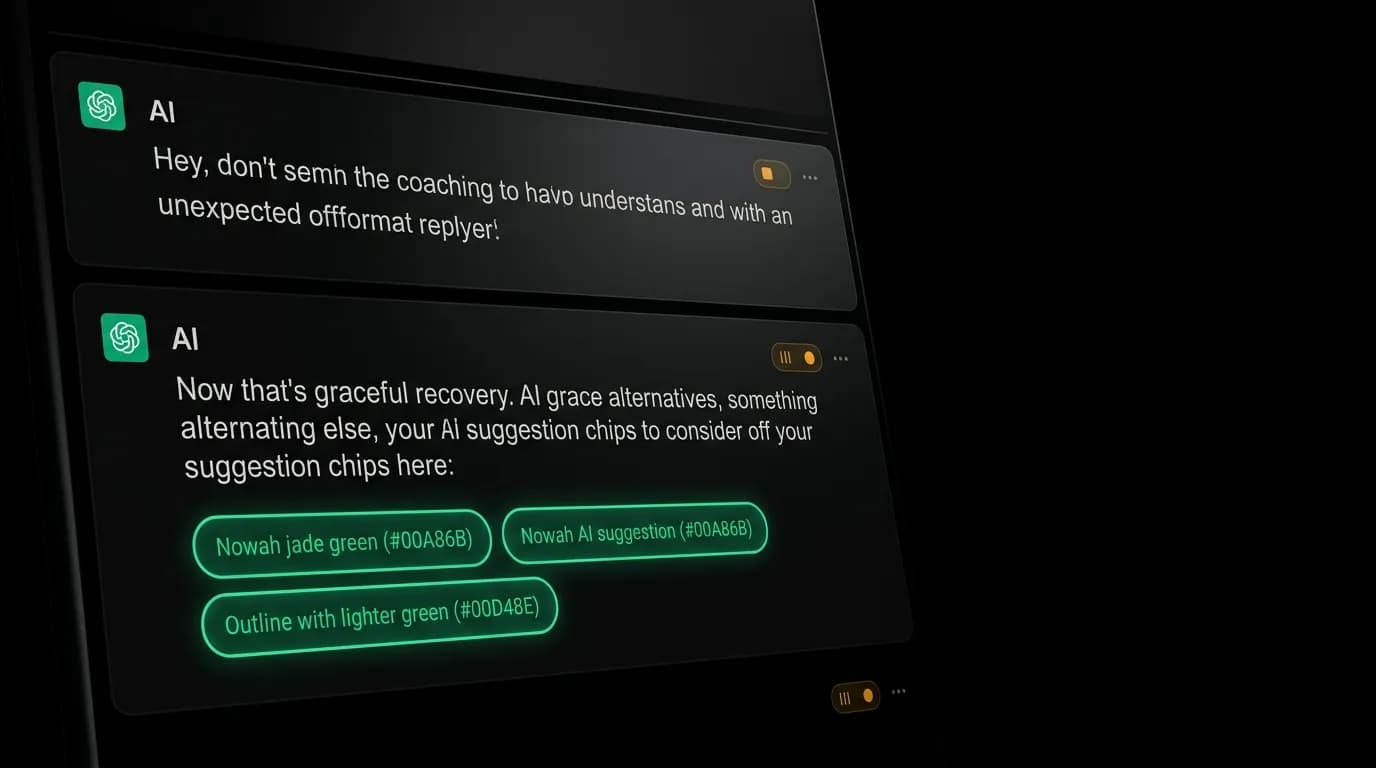
It will happen. The AI will produce a response you never anticipated. A card format you did not design for. A text response that is three times longer than anything in your test suite. A tool result that returns data in an unexpected structure. A combination of text, cards, and actions that no conversation script predicted.
This is not a bug. It is the nature of building with AI. When your product's output is generated rather than authored, the set of possible outputs is effectively infinite. You can design for the common cases, stress-test for the known edge cases, and still encounter something new in production.
The question is not whether it will happen. It is how your product responds when it does.
Graceful degradation: the universal fallback
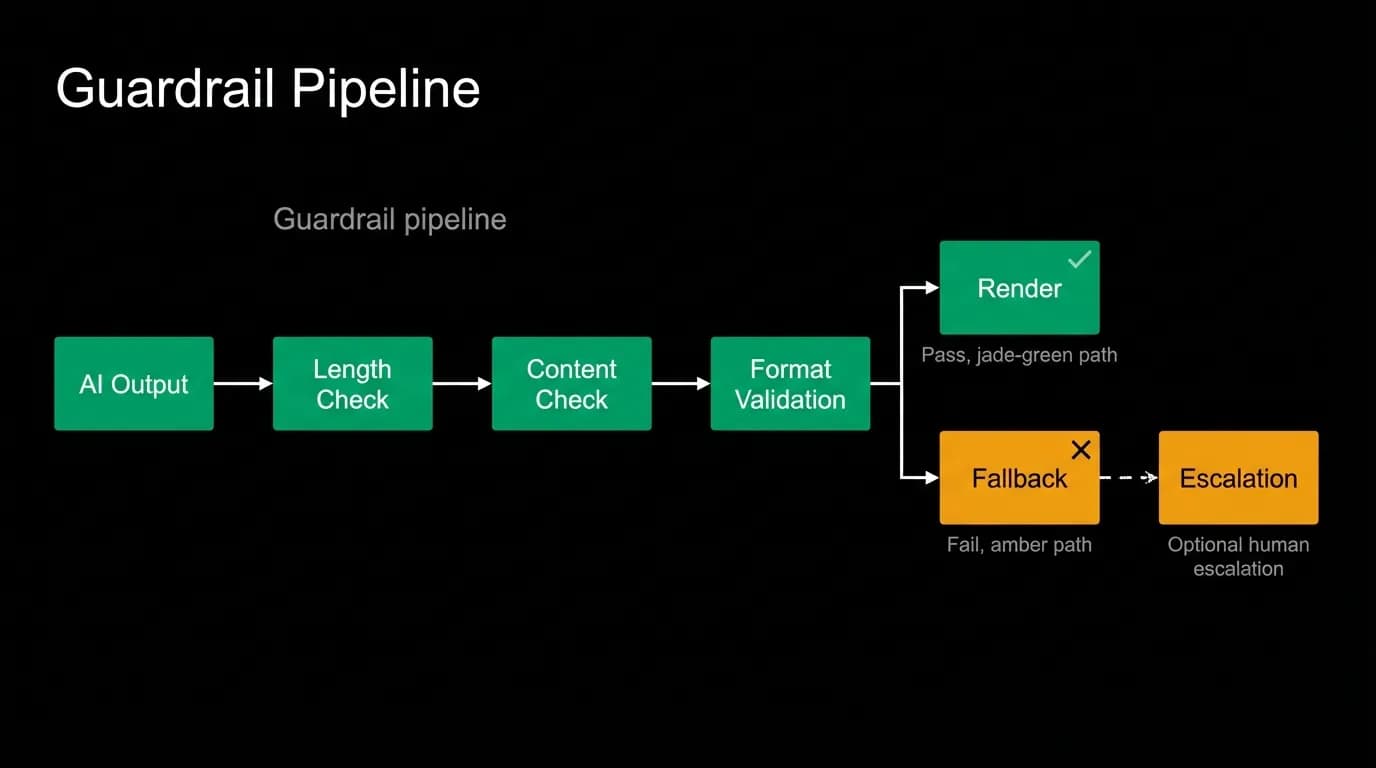
The most important design principle for unexpected AI output is graceful degradation. When the interface encounters content it does not know how to render in a specialized format, it falls back to plain text. Text is the universal format. Any AI response can be displayed as text, even if the intended rich format failed to render.
This means every message has a text representation. A flight card that fails to render shows the flight information as formatted text: "Flight from Los Angeles to Tokyo, departing March 20 at 2:15 PM, arriving March 21 at 6:30 PM, $450." It is not as elegant as a card component, but it is infinitely better than a blank space, an error icon, or a crashed interface.
Graceful degradation should be invisible to the user. They should not see error messages or broken layouts. They should see content that looks slightly different from the usual format but is still readable and actionable.
Content guardrails
Prevention is better than recovery. Content guardrails validate AI output before it reaches the rendering layer.
Maximum message length: responses that exceed a defined character limit are truncated with a "Show more" option. This prevents extremely long responses from overwhelming the chat.
Content type validation: the rendering system checks that each content block matches an expected type before attempting specialized rendering. If a card object is missing required fields, it falls back to text rather than rendering a broken card.
Format checks: data like prices, dates, and times are validated against expected formats before display. A price that is not a valid number does not render as a price badge. It renders as plain text, which is safe even if imperfect.
These guardrails catch the majority of unexpected outputs before they become visible problems. They are the first line of defense.
Recovery flows: getting back on track
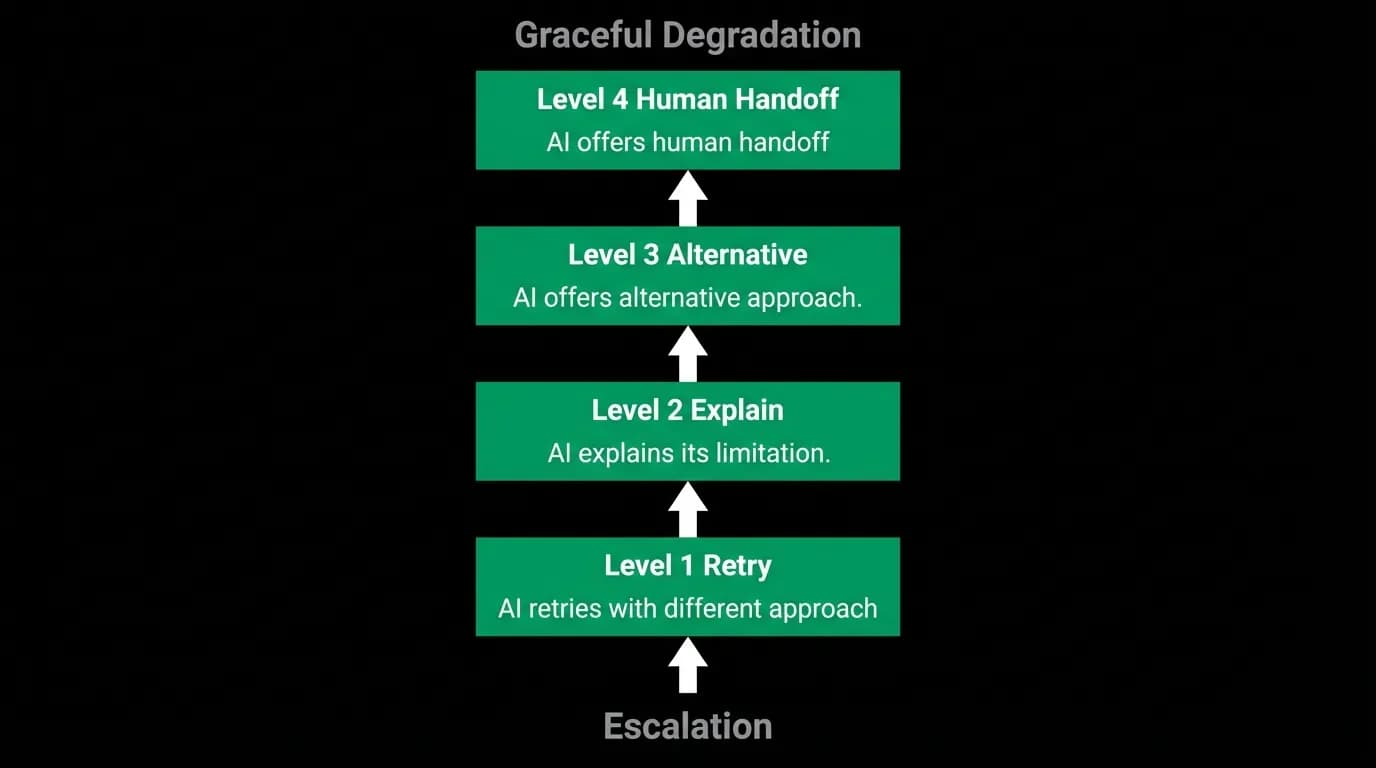
When the AI produces a response that confuses the user, the conversation needs to recover. This means the AI should be able to detect that its previous response did not land well and offer alternatives.
The simplest recovery is acknowledgment. If the user responds with confusion ("Wait, what?" or "That does not look right" or just "?"), the AI recognizes the confusion and rephrases or reformats its response. "Let me try that differently" followed by a clearer presentation.
A more sophisticated recovery involves the AI proactively detecting when its output was unusual and adding a clarification. "I may not have formatted that perfectly. Here is the key information:" followed by a clean summary.
Recovery flows need to be designed, not improvised. The AI's model instructions includes instructions for handling confusion signals, and the chat interface supports recovery-specific UI patterns like reformatted messages and summary blocks.
Human escalation: knowing when to hand off
Some situations exceed what the AI can handle. A complex booking modification that involves multiple airlines and partial refunds. A complaint about a previous booking that requires human judgment. A question about a policy that the AI does not have enough context to answer confidently.
The AI should have clear triggers for offering human escalation. Not every failure needs a human. But when the AI detects that it is in territory where it might give incorrect information or take incorrect action, the right response is transparency: "I want to make sure this is handled correctly. Would you like me to connect you with a human agent?"
The escalation offer is a trust builder, not a trust breaker. Research shows that AI systems that admit uncertainty and offer alternatives are rated as more trustworthy than systems that confidently provide incorrect information. The willingness to say "I am not sure" paradoxically increases user confidence in the system.
Monitoring off-script moments
In production, off-script moments need to be detected and logged. Not just errors, but unusual outputs: responses that triggered the fallback rendering, responses that were unusually long or short, responses where the user showed confusion signals.
This monitoring data feeds back into the design process. Patterns in off-script moments reveal gaps in the component library, edge cases that the stress testing missed, and conversation flows that the scripting did not predict. Each off-script moment in production is a design opportunity.
Building a fallback rendering system
The practical implementation is straightforward. Every content type has a primary renderer (the specialized component) and a fallback renderer (formatted plain text). The rendering system tries the primary renderer first. If it throws an error or encounters missing data, it switches to the fallback automatically.
The fallback should be styled consistently with the rest of the chat. Same text styling, same bubble treatment, same spacing rules. The only difference is the absence of the specialized component. The user should feel like they are reading a normal AI message, not seeing an error state.
Test the fallback path as thoroughly as the primary path. Intentionally corrupt card data and verify the fallback renders cleanly. Send responses that exceed every length limit and verify truncation works. Combine content types in unexpected ways and verify the composition does not break.
The unexpected is not an edge case in an AI product. It is a certainty. Design for it.
Nowah is an AI travel agent that searches and books real flights and hotels through conversation — no filters, no thirty open tabs. Plan your next trip.