The End of the OTA: What Comes After Expedia
The OTA model — aggregate inventory, show options, take commission — is unchanged since 2001. AI shifts value from inventory access to intelligence.

Expedia launched in 1996 as a division of Microsoft. Booking.com went live in 1997. Priceline, now part of Booking Holdings, started in 1998 with its "Name Your Own Price" model. These companies are approaching their 30th birthdays, and the core product they sell has not meaningfully changed in all that time.
The model is simple: aggregate inventory from airlines, hotels, and other travel suppliers. Display it to consumers through a search interface. Take a commission when someone books. Spend heavily on Google Ads to drive traffic to that search interface.
This model created a $600 billion industry. It also created a consumer experience that has been stuck at "good enough" for two decades. And now, for the first time since the internet moved travel online, the fundamentals of this model are breaking.
The OTA model: inventory aggregation since 2001
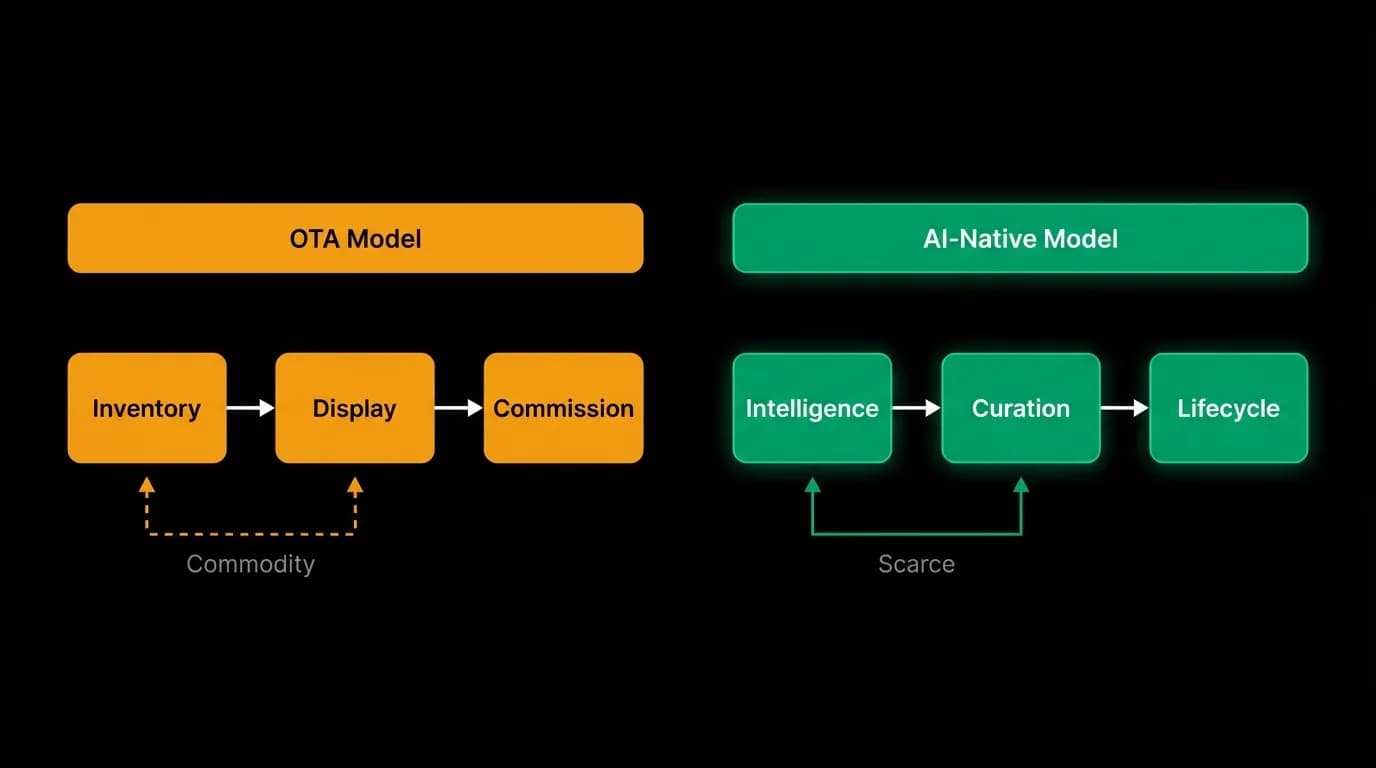
To understand why the OTA model is under pressure, you need to understand what it actually optimized for.
In the late 1990s and early 2000s, the hard problem in travel was access. Airline pricing was opaque. Hotel availability required calling the front desk or a travel agent. Comparing options across suppliers was practically impossible for a consumer.
OTAs solved this. They built GDS integrations that pulled real-time inventory from hundreds of airlines and thousands of hotels into a single searchable interface. For the first time, a consumer in Ohio could compare flight prices from five airlines to Bangkok at midnight on a Sunday. That was transformative.
The business model followed the value creation. OTAs charged suppliers a commission (typically 15-25% for hotels, less for airlines) for access to their consumer audience. The more consumers they attracted, the more valuable the platform became for suppliers. The more suppliers listed inventory, the more useful the platform became for consumers. Classic two-sided marketplace.
But here is the thing about marketplaces: once they reach liquidity, the value of aggregation diminishes. And travel hit that point a long time ago. Today, every OTA has access to essentially the same inventory through the same GDS systems. Expedia and Booking.com show you the same flights at the same prices for the same routes. The commodity is not the inventory anymore. It is the consumer's attention.
This is why OTAs spend obscene amounts on Google Ads. Booking Holdings spent $6.2 billion on performance marketing in 2023. Expedia spent $5.8 billion. These companies are in an arms race for clicks, and the primary beneficiary is Google.
What is breaking
Three things are simultaneously undermining the OTA model.
Google is disintermediating from above. Google Flights, Google Hotels, and Google's AI-generated travel summaries are keeping users in Google's ecosystem longer. When you search "flights to Paris" on Google, you get pricing, schedules, and booking links directly in the search results. Google does not need to be an OTA. It just needs to reduce the need for one, which it is doing effectively. Every flight search that resolves within Google is traffic that never reaches Expedia.
Airlines are pushing direct booking. Major carriers have spent the last decade building direct booking capabilities and offering incentives (extra miles, lower prices, exclusive fares) to book through their own websites and apps. Lufthansa Group started charging a distribution surcharge in 2015 for bookings made through third parties. American Airlines pulled fares from several OTAs in 2023. Airlines want to own the customer relationship, and they are increasingly willing to fight for it.
Metasearch is commoditizing the comparison layer. Kayak, Skyscanner, and Google Flights handle the comparison function that OTAs used to own. If a consumer can compare prices across airlines and OTAs through a metasearch engine, the OTA's role shrinks to transaction processing. And transaction processing is a commodity with thin margins.
The combined effect: OTAs are squeezed from above (Google), from below (airline direct), and from the side (metasearch). Their core value proposition, seeing all your options in one place, is being replicated by competitors who do not need to charge 20% commissions.
What AI changes
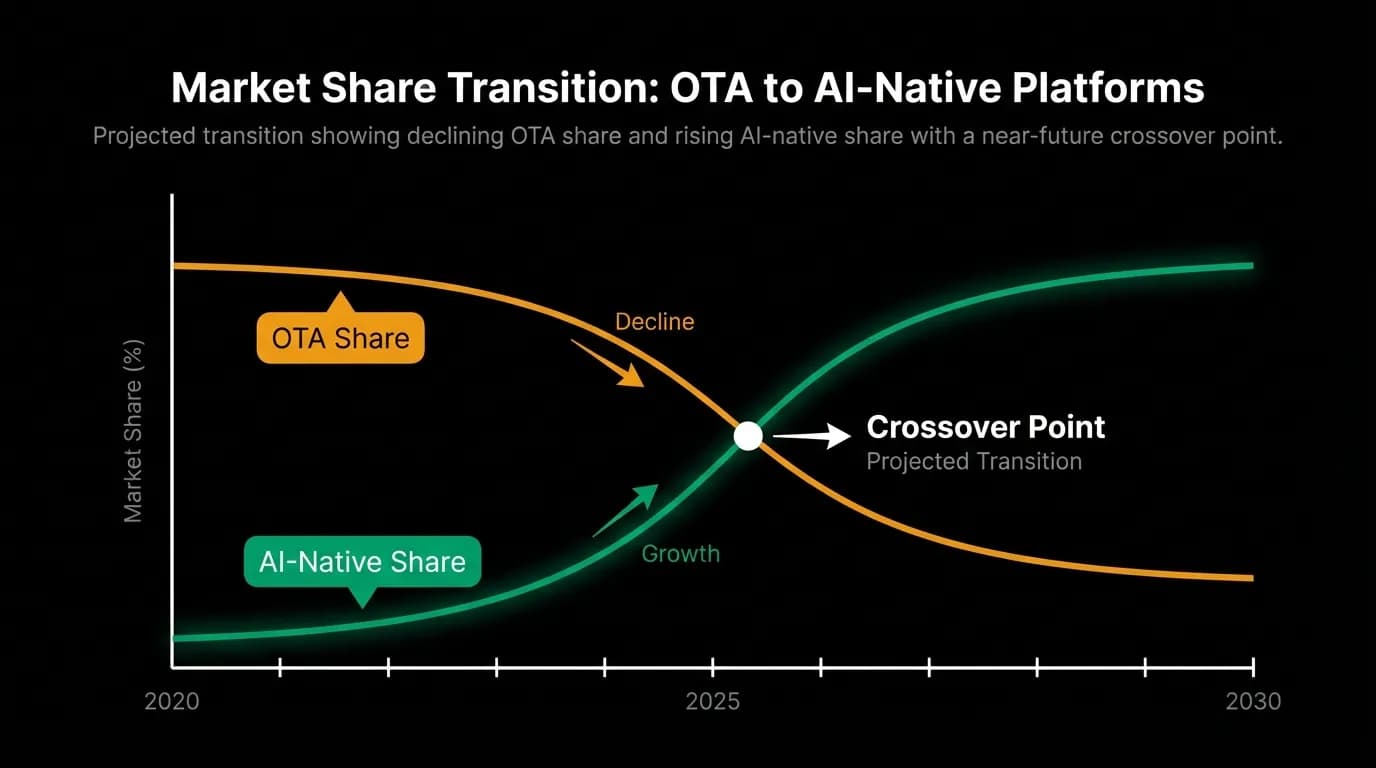
AI does not just accelerate these existing trends. It introduces a fundamentally new model that redefines where value is created in travel booking.
The OTA model creates value through inventory access. The AI model creates value through intelligence.
What do I mean by intelligence? I mean the ability to understand what a specific traveler wants, search across all available options, evaluate those options against the traveler's unique preferences, and recommend the best choice. Not the cheapest. Not the most popular. The best for this specific person on this specific trip.
This is a completely different value proposition than "here are 500 flights sorted by price." It is closer to what a great human travel agent does: listen, understand, research, and advise. But scaled to millions of users simultaneously, with perfect recall of each user's preferences and history.
The economic shift matters. OTAs capture value at the transaction layer: you book through us, we take a commission. AI agents capture value at the intelligence layer: we help you make better decisions, and that help is worth paying for.
This changes the competitive dynamics entirely. In the OTA world, you win by having more inventory and spending more on marketing. In the AI agent world, you win by having better intelligence, which comes from better AI, better data, and deeper user relationships.
The new model
Here is what a post-OTA travel booking experience looks like:
Instead of visiting a website, typing in a search form, scrolling through results, clicking on listings, comparing prices across tabs, and eventually booking the option that minimizes your anxiety about making a wrong choice, you have a conversation.
"I need to fly to London next Thursday and come back Sunday. Budget around $600 for the flight. I prefer morning departures and I hate connecting through Atlanta."
The AI agent searches live inventory, applies your preferences (some stated now, some remembered from past conversations), and comes back with three options. Not 500. Three. The best price. The best schedule. The best overall value given everything the agent knows about you.
You pick one. The agent books it. Then it asks about hotels, already knowing your dates, your budget ballpark, and that you prefer walkable neighborhoods with good public transit access (because you mentioned that two trips ago). Three hotels. You pick one. Done.
The entire process takes five minutes instead of the industry average of 45 sessions over three months. And the booking is better, because the AI evaluated hundreds of options against your actual preferences rather than showing you everything and making you figure it out.
This is not a better OTA. It is a replacement for the OTA.
The transition
OTAs are not going to disappear overnight. They have billions in revenue, massive brand recognition, and loyal (or at least habitual) users. The transition will look like every other technology disruption: gradual then sudden.
Phase one (happening now): OTAs add AI features to their existing products. Expedia's chatbot. Booking.com's AI trip planner. Kayak's conversational interface. These are defensive moves designed to keep users within the existing product while signaling AI capability. But as I have written before, bolting AI onto a search-and-browse product is fundamentally different from building a product around AI.
Phase two (starting): AI-native platforms attract early adopters who are frustrated with the traditional booking experience. These users tend to be younger, more tech-comfortable, and more willing to try new products. They are also the most valuable users because they travel frequently and spend more per trip. The AI-native platforms eat market share from the bottom while OTAs retain their older, more habitual user base.
Phase three (coming): The quality gap between AI-native and AI-bolted-on becomes undeniable. AI-native platforms offer dramatically better experiences because their entire architecture is designed for conversational intelligence. OTAs try to catch up but face the innovator's dilemma: rebuilding their core product around AI cannibalizes their existing revenue streams (ads, sponsored placements, comparison pages).
Phase four (eventual): The market reorganizes around AI-native platforms. OTAs either transform completely (unlikely given their organizational structure and revenue dependencies) or become backend infrastructure that AI agents query for inventory (more likely).
This is not my wishful thinking as someone building an AI-native platform. This is the same pattern that played out with newspapers and classified advertising, with taxis and ride-sharing, with retail and e-commerce. The incumbents see the disruption coming. They add features to compete. But they cannot fully commit to the new model without destroying the old one, and that hesitation is lethal.
Who gets disrupted and who adapts
Not every player in the travel ecosystem faces the same level of threat.
Most disrupted: Mid-tier OTAs. Companies that compete primarily on price comparison without differentiated technology or brand loyalty. If an AI agent can search the same inventory and present better results, the mid-tier OTA's value proposition evaporates.
Significantly disrupted: Major OTAs (Expedia, Booking Holdings). They have the resources to invest in AI but face the innovator's dilemma. Their revenue model depends on showing users many options (which generates ad impressions and sponsored placements). An AI agent that curates three options eliminates most of that surface area.
Partially disrupted: Metasearch (Kayak, Skyscanner, Google Flights). These become less relevant when AI agents do the comparison internally. But they may pivot to become infrastructure layers that AI agents query. Google is best positioned here because it owns the search pipeline.
Least disrupted: Suppliers (airlines, hotels). They still own the inventory and the physical product. Whether a booking comes through an OTA or an AI agent, the airline still flies the plane. Airlines and hotels may actually benefit from the shift if AI agents reduce their dependence on OTA distribution and its associated commissions.
Best positioned: AI-native platforms. Companies that built from the ground up around conversational intelligence, with no legacy architecture or revenue model to protect. Small today, but growing fast.
Historical pattern analysis supports this framing. When disruption hits, companies that built for the old model rarely lead the new one. Kodak invented the digital camera but could not cannibalize its film business. Blockbuster saw streaming coming but could not abandon its store model. The incentive structures make transformation nearly impossible.
What the post-OTA landscape looks like
Here is my prediction for what travel booking looks like in five to ten years.
AI agents as primary booking interface. Most travel bookings will be initiated through a conversation with an AI agent, either through a dedicated travel platform like Nowah, through a general AI assistant, or through an airline or hotel's own AI-powered direct booking experience. The search form and results list will feel as antiquated as a phone book.
Supplier direct gets stronger. Airlines and hotels will invest in their own AI booking experiences because the technology allows them to offer the convenience that OTAs provided while keeping the customer relationship. An AI agent on United.com that knows your preferences and books intelligently is a compelling product.
OTAs become infrastructure. The large OTAs will not disappear entirely. They will evolve into the backend plumbing that AI agents query for inventory and pricing. This is a lower-margin but sustainable business. Think of how Sabre and Amadeus operate today: invisible to consumers, essential to the ecosystem.
Intelligence becomes the differentiator. The winning platforms will not be the ones with the most inventory (everyone has the same inventory) or the most marketing spend (AI agents do not click on Google Ads). They will be the ones with the best AI, the deepest user understanding, and the most seamless end-to-end experience.
Lifecycle replaces transaction. The current model is transactional: you search, you book, you leave. The new model is lifecycle-based: the AI agent manages your entire travel life, from inspiration to booking to trip management to post-trip memories. The relationship is ongoing, not episodional.
This is not a small shift. It is a fundamental restructuring of a $600 billion industry around a new technology paradigm. The companies that recognize this early and build accordingly will own the next era of travel. The companies that treat AI as a feature to add to their existing product will be the next Kodak.
We are building Nowah on the conviction that intelligence, not inventory, is where value lives in the next generation of travel. The OTA model had a good 25-year run. What comes next is better for travelers, better for suppliers, and better for the companies that build it right.
Nowah is an AI travel agent that searches and books real flights and hotels through conversation — no filters, no thirty open tabs. Plan your next trip.