The Future of Travel Booking: No Apps, No Search, Just Agents
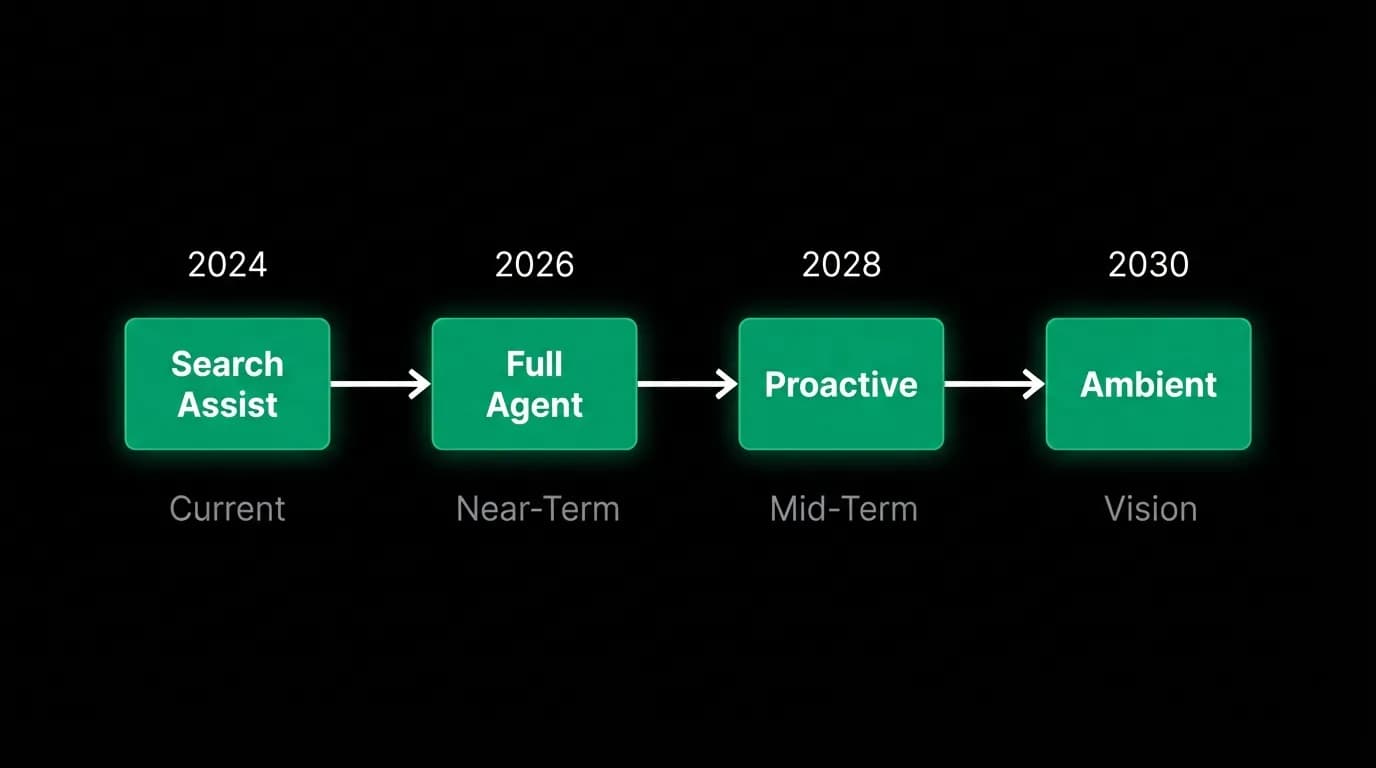
The trajectory is clear: search engines to OTAs to metasearch to AI agents. The endgame is ambient intelligence that books travel before you ask.

The history of travel booking is a history of intermediation. Someone stands between the traveler and the airline, the hotel, the experience. The nature of that intermediary keeps changing. The direction of that change has been remarkably consistent for thirty years: less work for the traveler, more intelligence in the system.
I want to trace that trajectory forward. Not because predicting the future is easy (it is not), but because understanding the pattern helps us build the right product today. The decisions we make at Nowah in 2026 need to hold up in 2030. That requires having a clear view of where this is all heading.
The short version: travel booking is moving from something you actively do to something that happens around you. From search engines to AI agents to ambient intelligence. From apps you open to agents that act. From decisions you make to decisions made on your behalf.
And we are somewhere in the middle of that transition right now.
Era one: the search engine (1995-2005)
Before the internet, booking travel meant calling a travel agent or visiting a storefront. The agent had access to reservation systems (Sabre, Amadeus, Worldspan) that consumers could not use. The agent's value was access.
The first internet era democratized access. Expedia launched in 1996. Travelocity followed. Suddenly anyone with a web browser could see flight schedules and prices. You did not need a human intermediary to access the inventory.
But the interaction model was crude. You filled out a search form. You got a list of results. You sorted and filtered. You clicked through pages of options. The computer showed you what existed. You did all the thinking.
The search engine era solved the access problem. It did not solve the decision problem. You could see every available flight, but figuring out which one to book was entirely on you.
Era two: the OTA and metasearch (2005-2020)
The second era added layers of intelligence to the search-and-browse model.
OTAs like Expedia and Booking.com added bundling (flight + hotel), user reviews, price comparison, and loyalty programs. They made the search results richer and the booking flow smoother. But the fundamental paradigm did not change. You searched. You browsed. You decided.
Metasearch engines like Kayak, Google Flights, and Skyscanner added another layer: comparison across multiple OTAs and airlines. Now you could see prices from ten sources simultaneously. More information. Theoretically better decisions.
In practice, metasearch made things worse for many users. More options. More tabs. More comparison fatigue. The average traveler visiting many websites before booking is a metasearch-era statistic. The tools gave you more data, but more data without synthesis just creates more work.
Hopper introduced an interesting innovation: price prediction. Should you buy now or wait? Finally, a product that told you what to do instead of just showing you options. But Hopper's intelligence was narrow. It could predict price direction for a specific route. It could not help you decide where to go, when, or how.
The OTA/metasearch era improved the mechanics of booking but failed to change the cognitive model. You still did the research. You still compared the options. You still made the decision. The product got faster at retrieving data. It did not get smarter about helping you.
Era three: the AI agent (2024-present)
This is where we are now. The paradigm shift from "search and decide" to "converse and delegate."
AI agents do not show you 500 results. They understand what you want, search on your behalf, apply your preferences, curate the options, and present a small number of recommendations with reasoning. The cognitive burden shifts from the user to the agent.
The key capabilities that define this era:
Natural language intent. You say "I want to go somewhere warm in April for about a week" and the agent understands. No form. No structured query. Just human language.
Contextual memory. The agent remembers your preferences across conversations. It knows you prefer aisle seats, boutique hotels, and morning flights. It applies this knowledge without being told each time.
Real-time tool use. The agent searches live flight and hotel inventory, checks real prices, and initiates real bookings. It is not generating text that sounds like travel advice. It is actually booking travel.
Decision support. The agent does not just present options. It helps you choose. "This flight saves $120 but has a 4-hour layover in Dallas. Given that you have told me you prefer avoiding long layovers, I recommend the direct option at $540."
Post-booking management. The agent stays useful after the booking. Flight updates. Destination intelligence. In-trip assistance. The relationship does not end at payment.
This era is young. We are maybe two years into it. The AI agents are good but not yet reliable enough for full autonomy. They still need human confirmation for major decisions. They still make mistakes. But the trajectory is clear, and the user experience improvement over the search-and-browse model is already substantial.
Most people reading this have probably used an AI chatbot from one of the major OTAs. Those are era 2.5 products: AI layered on top of the old paradigm. Real era three products are built from the ground up around the agent model. The conversation is the product. There is no search form underneath.
Era four: proactive intelligence (2027-2030)
This is the era we are building toward. The shift from "the agent responds to your requests" to "the agent anticipates your needs."
Proactive intelligence means the agent initiates action before the user asks.
You have a conference in Austin in October. Your calendar says so. The agent knows you always fly there from San Francisco. It monitors prices on that route. When prices drop to a good level based on your historical booking data, it alerts you. "Flights to Austin for your October conference are at $280 right now, which is $90 below the average for this route. Want me to book your usual setup? Direct on United, aisle seat, one checked bag."
Your anniversary is in June. The agent remembers because you mentioned it in a conversation eight months ago and it is in your calendar. It knows you and your partner like beach destinations and typically budget $3,000-4,000 for trips. In April, it starts suggesting options. "I have been watching prices for beach destinations in June. Turks and Caicos has good availability and flights from your area are reasonable right now. Want me to put together some options?"
Your passport expires in 14 months. The agent flags this now because some destinations require six months of validity. "You might want to renew your passport soon. It expires in September 2027, which could limit your destination options for trips booked in the spring."
None of these require the user to initiate a conversation. The agent is doing ongoing background work: monitoring, analyzing, connecting dots. It acts as a persistent travel intelligence layer in the user's life.
This era requires several things to work. First, deep trust. Users have to be comfortable with an AI agent that watches their calendar, tracks their patterns, and initiates suggestions. Second, extremely high accuracy. A proactive suggestion that is wrong or irrelevant destroys trust faster than no suggestion at all. Third, respectful boundaries. The agent must suggest, not pester. There is a line between helpful and creepy, and the agent must stay firmly on the helpful side.
Era five: ambient travel intelligence (2030+)
This is the speculative end state. The agent is so trusted and so capable that it handles travel logistics with minimal or no user involvement.
Your flight gets delayed. The agent has already checked rebooking options, found the best alternative, evaluated whether the delay affects your hotel check-in, adjusted the hotel if needed, notified your dinner reservation about a later arrival, and informed the person picking you up at the destination about the new arrival time. You get a notification: "Your flight was delayed. I have rebooked you on the 4:15 PM flight, moved your hotel check-in to late arrival, and told the restaurant you will be 30 minutes late. Everything is handled."
You decide you want to take a vacation. You tell the agent "plan something for the first two weeks of August." Based on years of travel history, preference data, budget patterns, and current availability, the agent plans an entire trip. Flights, hotels, activities, restaurant reservations, local transportation. It presents the plan for your approval, but the plan is so well-targeted to your preferences that approval is a formality.
This sounds like science fiction. Technically, every component exists or nearly exists today. The challenge is reliability. An autonomous agent that gets it right 95% of the time is not good enough for a domain where the 5% failure case means you are stranded at an airport or checked into a hotel you hate. Ambient autonomy requires something like 99.9% reliability, and that is a multi-year engineering challenge.
It also requires a legal and regulatory framework that does not fully exist yet. Who is liable when an autonomous AI agent books the wrong flight? What are the consumer protection rules for agent-initiated transactions? These questions need answers before full autonomy becomes mainstream.
The interface evolution
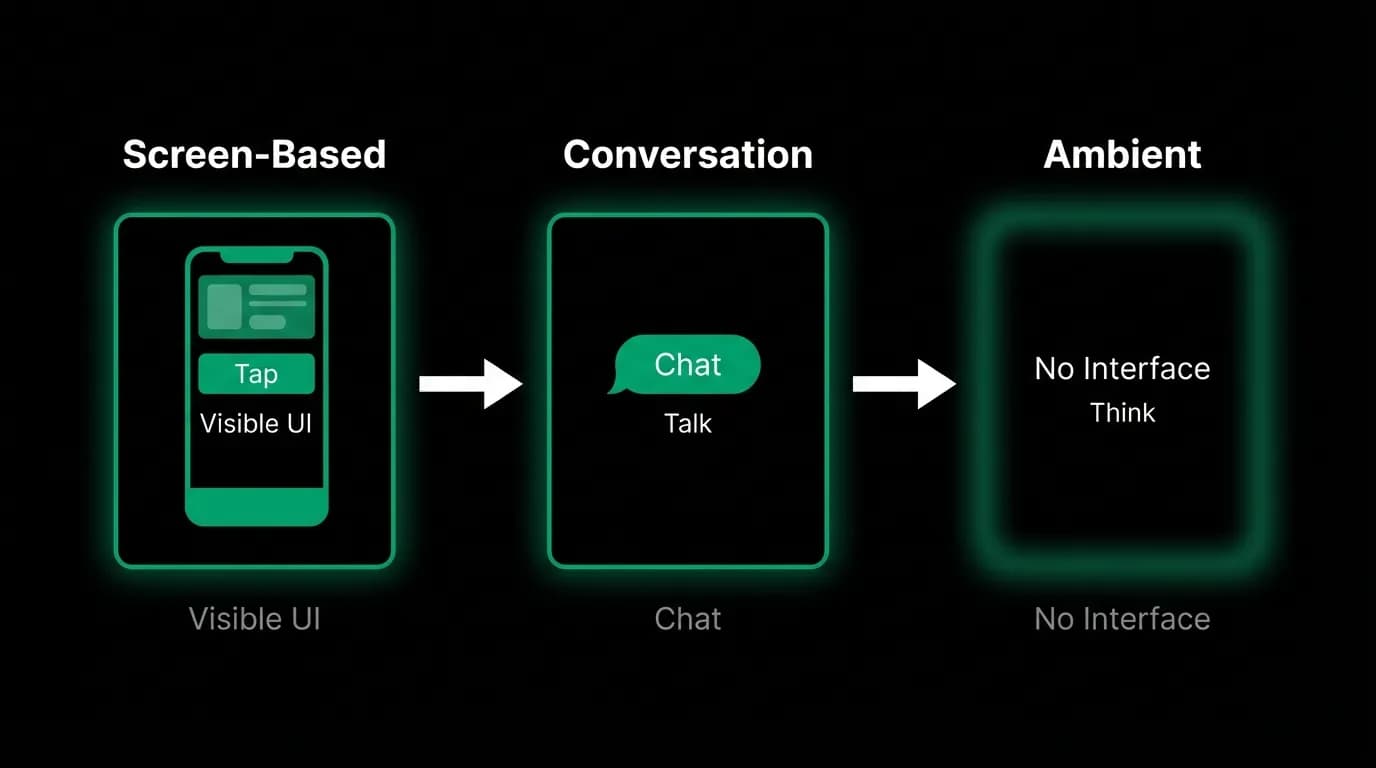
Underneath these eras, there is a parallel evolution in interface design that is equally interesting.
Era one and two: screens and forms. The interface is visual. You see a webpage. You interact with form elements. You navigate between pages. The screen is the product.
Era three: conversation. The interface is linguistic. You type or speak. The agent responds with text and cards. The conversation is the product. There is still a screen, but the screen displays a conversation, not a form.
Era four: notifications and suggestions. The interface becomes ambient. You do not open an app and start a conversation. The agent reaches out to you through notifications, widgets, and brief interactions. The interface is not a full-screen experience. It is a glanceable, actionable notification.
Era five: invisible. The interface disappears entirely. The agent operates in the background. You interact with it only when you want to, typically to approve a plan or handle an exception. The default is that the agent acts autonomously. The interface surfaces only when human judgment is needed.
This progression mirrors what has happened with other digital services. Online banking started with full web interfaces. Now, many routine banking actions are handled by automated rules (auto-pay, auto-transfer) and the user only sees a notification confirming the action. The same trajectory applies to travel.
What must be true for this future to arrive
I do not want to wave my hands and say "AI will be amazing." Let me be specific about the prerequisites.
AI reliability has to reach financial-grade levels. People will not delegate $5,000 spending decisions to an agent that makes errors 1% of the time. That is 1 error per 100 bookings. For a frequent traveler booking 10 trips a year, that is an error every other year. That might sound acceptable in the abstract, but when the error means a missed flight or a bad hotel on your anniversary trip, it is not. We need 99.9% or better accuracy on financial transactions.
Trust has to be earned, not declared. No amount of marketing can make people trust an autonomous AI agent. Trust is built through repeated positive experiences. The product has to work correctly hundreds of times before users will delegate high-stakes decisions. This means the progression through the eras is individual, not universal. Some users will reach era five trust in two years. Others will stay in era three indefinitely.
Privacy and consent frameworks have to mature. Proactive and ambient AI requires access to personal data: calendar, location, travel history, preferences. Users need clear, granular controls over what data the agent can access and how it can be used. Regulations need to keep pace with capabilities. GDPR and similar frameworks provide a foundation, but specific rules for autonomous AI agents acting on behalf of consumers are still developing.
Payment infrastructure has to support agent-initiated transactions. Current payment systems are designed for human-initiated transactions. A user clicks "pay," a charge is authorized, confirmation is displayed. Agent-initiated transactions need a different authorization model. Pre-approved spending limits, transaction categories, automatic approval within defined parameters. This infrastructure is being built but is not yet mature.
Industry APIs have to become agent-friendly. Current travel APIs are designed for app-to-app communication. Agent-to-agent protocols are emerging but early. For the full vision of ambient travel intelligence, your travel agent needs to communicate with airline systems, hotel systems, activity providers, and other agents seamlessly. Standards like the an open agent-tool protocol are pointing in this direction.
What Google, Apple, and the OS layer could do
There is a scenario that should concern every travel startup, including us. What happens when the operating system layer adds travel intelligence?
Apple Intelligence already has personal context: your calendar, contacts, location, messages. If Apple builds a travel agent into Siri that can book flights and hotels using that context, the distribution advantage is enormous. Every iPhone user gets an AI travel agent for free.
Google has even more context. Gmail with booking confirmations. Google Maps with location history. Google Calendar. Google Pay. Google Flights' pricing data. A Google travel agent built on this data would be formidable.
This is a real risk. But there are reasons to believe that vertical, purpose-built travel agents will coexist with and possibly outperform horizontal OS-level agents.
Depth beats breadth. A travel-specific agent with deep domain knowledge, specialized tools, and travel-focused agentic memory will make better travel recommendations than a general-purpose assistant that also handles reminders, email, and smart home controls.
Incentive alignment matters. Google and Apple have business models that create conflicts with pure user-serving travel recommendations. Google sells ads. Apple takes App Store commissions. A dedicated travel agent with a transparent fee model has cleaner incentives.
Relationship depth is hard to replicate. An agent that has handled 50 of your trips knows your travel personality intimately. An OS-level agent that was just activated for travel starts from zero.
That said, the OS-level threat is real and it motivates us to build the deepest, most personalized travel agent possible. If the default OS assistant handles 80% of simple travel queries, we need to own the complex 20% where domain expertise and personal knowledge make a decisive difference.
Our role: building the bridge
We are building Nowah in era three with our eyes on era four. The conversational AI travel agent that we ship today is designed to evolve into the proactive, ambient intelligence of tomorrow.
Every conversation teaches the agent. Every booking refines preferences. Every trip adds to the memory. The product gets better with use, which is the essential property of an AI-native product that wants to survive the transition from agent to ambient.
The bridge from today's explicit-request model to tomorrow's proactive model is trust. We build trust by getting era three right: accurate searches, good recommendations, reliable bookings, helpful post-trip management. Each positive experience moves users toward the comfort level required for era four delegation and, eventually, era five autonomy.
This is a multi-year journey. The temptation is to skip ahead, to build proactive features before users trust them, to automate decisions before reliability justifies it. We resist that temptation. The trust stack has to be built from the bottom up: functional trust, then consistency trust, then judgment trust, then financial trust, then proactive trust.
The five-year view
Here is what I think AI travel booking looks like in 2030, if the technology trajectory holds.
Most travelers will have an AI travel agent, either a dedicated app or an OS-level assistant. The concept of "searching for flights" will feel as outdated as looking up a phone number in a directory. You will tell your agent where you want to go, and it will handle the rest.
Frequent travelers will have agents operating in proactive mode: monitoring prices, suggesting trips, alerting to opportunities. The agent will know your calendar, your preferences, and your budget well enough to make genuinely useful suggestions without being asked.
Early adopters will have agents operating in ambient mode: booking routine trips autonomously (the annual trip home for the holidays, the quarterly business trip) and only surfacing exceptions for human judgment.
The OTA model will have contracted significantly. Expedia, Booking.com, and their peers will either have rebuilt as AI-native products or ceded market share to a new generation of agent-first platforms. Some will have pivoted to becoming the inventory infrastructure that agents access, rather than the consumer-facing interface.
Travel companies that did not adapt will look like Blockbuster: successful businesses that failed to navigate a paradigm shift not because they were bad at their old business, but because their old business became irrelevant.
Why we are optimistic
We are building in the right paradigm at the right time. The technology is mature enough to deliver real value today while improving rapidly toward the ambient future. The consumer appetite for AI-assisted services is growing. The legacy competitors are constrained by business models and architectures that make AI-native evolution difficult.
The future of travel booking has no search bars. No results pages. No filter sidebars. No 38-tab research projects. Just a conversation with an agent that knows you, helps you, and acts on your behalf.
Some version of that future is inevitable. The question is who builds it. We intend to.
Nowah is an AI travel agent that searches and books real flights and hotels through conversation — no filters, no thirty open tabs. Plan your next trip.