The \\\"Just Do It For Me\\\" Moment: When Users Start Delegating
New users micromanage every search parameter. Experienced users say \\\"book me something for London — you know what I like.\\\" That shift is the product goal.
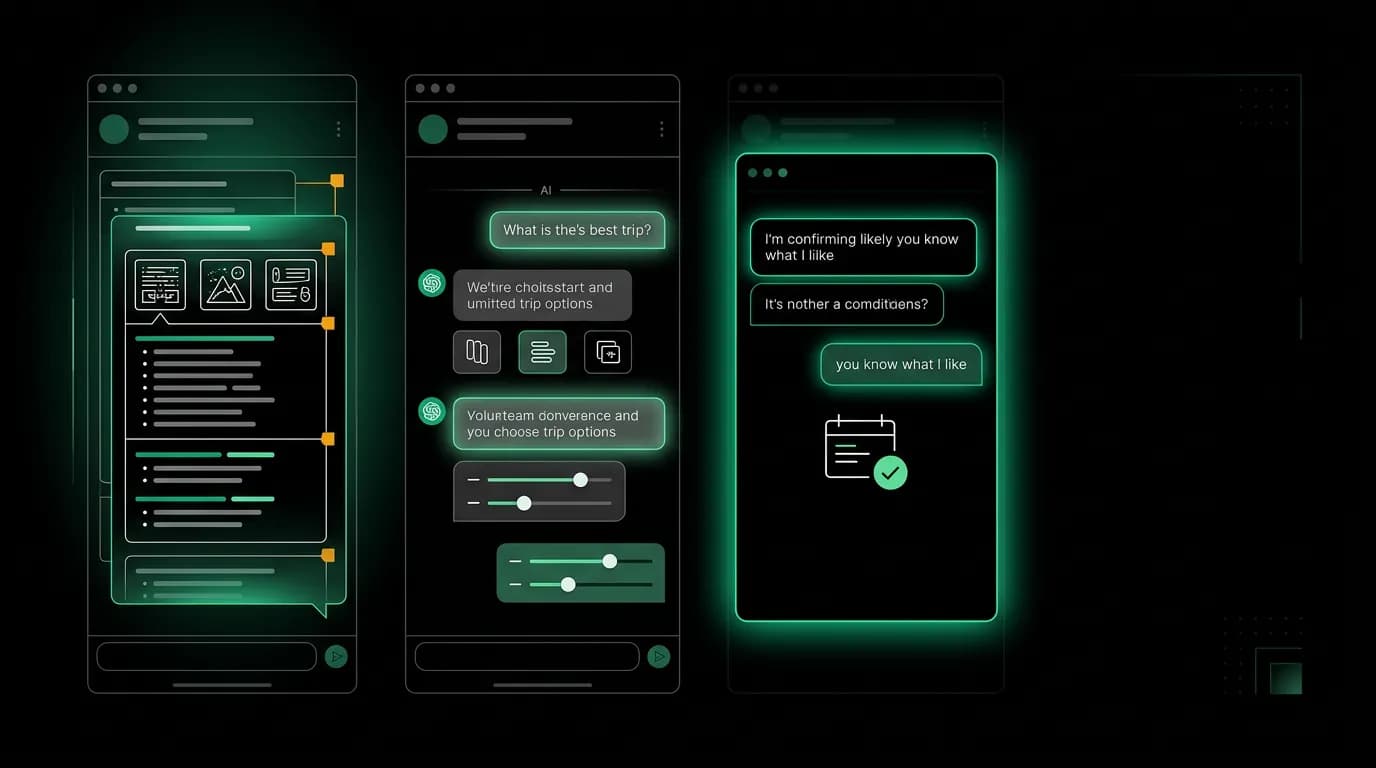
There is a conversation pattern we watch for in Nowah that tells us more about product health than any other metric. It looks like this:
First booking: "Show me nonstop flights from SFO to London Heathrow, economy class, departing between 5 PM and 9 PM, returning on March 15th, and I want to see options on British Airways and United only, preferably with at least one checked bag included."
Third booking: "I need to get to Tokyo next month. What do you suggest?"
Fifth booking: "You know what I like. Book me something for Barcelona."
That progression from detailed directive to casual delegation is the single most important signal that the product is working. The user went from treating the AI like a search engine that requires precise inputs to treating it like a trusted travel agent who knows their preferences and can make good decisions on their behalf.
We call it the "just do it for me" moment. And we are building the entire product to get users there.
The three modes of user-AI interaction
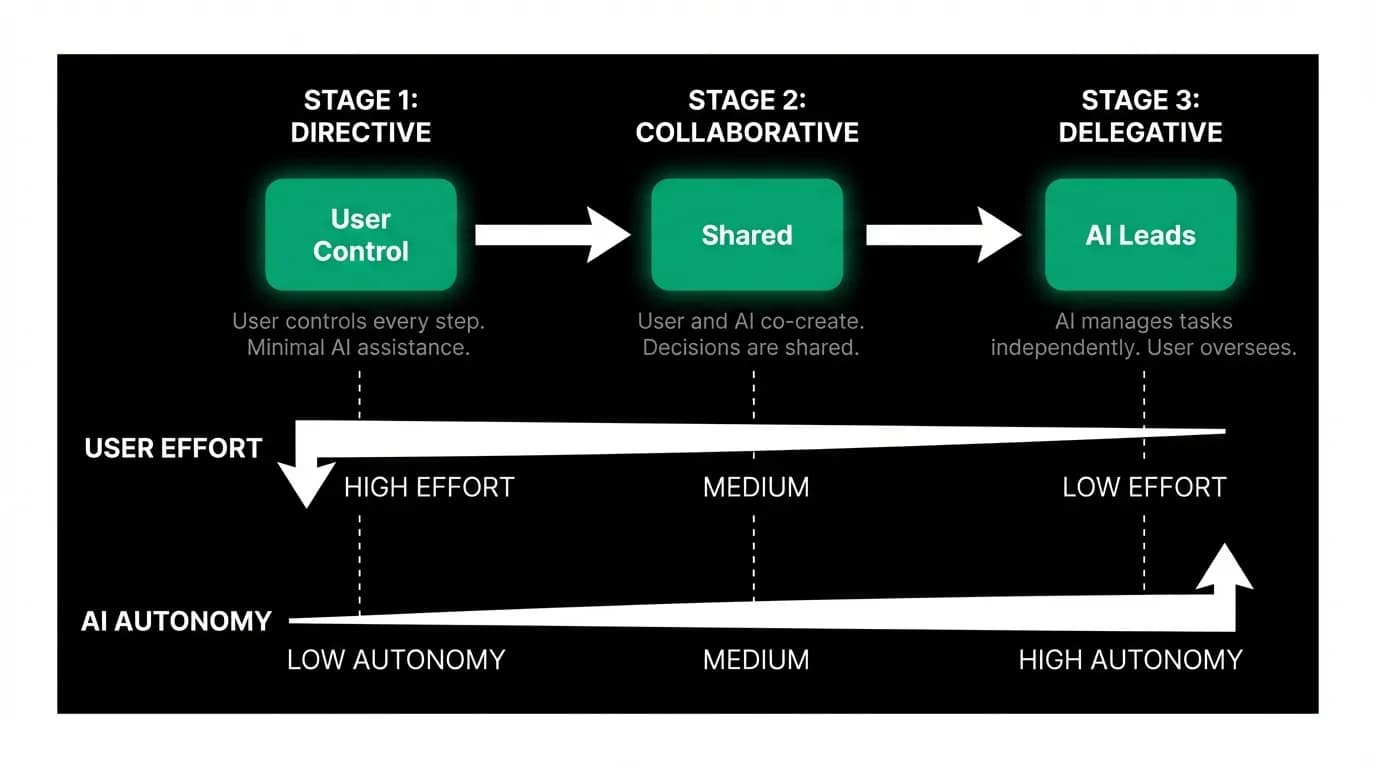
We have observed that users interact with AI travel agents in three distinct modes, and they progress through them as trust builds.
Directive mode. The user tells the AI exactly what to do. Specific airports. Exact dates. Airline preferences stated explicitly. Budget caps defined precisely. The user is essentially using the AI as a more flexible search form. They do not trust the AI to make judgment calls, so they constrain every variable themselves.
This is how almost every new user starts. It makes sense. They have never used this AI before. They do not know what it knows or does not know about their preferences. They are testing it. Can it understand my request? Does it return relevant results? Does it get confused? They maintain control because control feels safe.
Collaborative mode. The user provides some constraints and lets the AI fill in the gaps. "I need to get to London next week. What are my best options?" The dates are flexible. The airline is unspecified. The budget is implied but not stated. The user is saying: I trust you to work within my general parameters, and I want your input on the details.
This mode usually emerges after the user has seen the AI make a few good recommendations. They noticed that the agent already filtered for nonstop flights because it learned they always choose nonstop. They saw that the price range fell within their comfort zone without being told. The AI demonstrated competence, so the user relaxes their control.
Delegative mode. The user hands over the decision almost entirely. "You know what I like. Book me something for Barcelona." The destination is the only constraint. Everything else, dates, airline, hotel, budget allocation, is delegated to the AI.
This is the most powerful mode because it represents genuine trust. The user believes the AI knows their preferences well enough to make a good decision without supervision. They are not just using a tool. They are relying on an agent.
Why directive mode is the default and why that is fine
I want to be clear: there is nothing wrong with directive mode. Some users will always prefer to maintain detailed control, and that is a perfectly valid way to use the product.
The tendency to be directive with new AI tools is completely rational. You would be directive with a new human assistant too. If you hire a travel agent you have never worked with before, you spell out every preference in detail on the first trip. "I like aisle seats. I prefer to fly in the morning. I do not stay at chain hotels. My budget is around $200 per night for hotels." You front-load this information because the agent has no history with you.
The same thing happens with AI. New users compensate for the AI's lack of knowledge about them by providing exhaustive instructions. This is smart behavior. It protects the user from bad outcomes.
What distinguishes a good AI product from a mediocre one is what happens next. In a mediocre product, directive mode persists. The user specifies everything every time because the AI never learns. In a good product, the AI absorbs the directive inputs, stores them as preferences, and applies them proactively in future interactions. Directive mode gradually becomes unnecessary because the AI already knows.
The trust progression is not linear
Real trust does not build in a smooth curve. It builds in steps, with setbacks.
A user might move from directive to collaborative after three good booking experiences. Then the AI recommends a hotel in a noisy neighborhood, and the user snaps back to directive mode for the next trip. "I want a hotel in a quiet residential area, at least 4.5 stars on reviews, not near a highway or major road." They are re-establishing control because trust was dented.
This is normal and healthy. The appropriate response from the AI is not to be defensive or to ignore the regression. It is to absorb the new information (user cares about quiet locations) and apply it going forward. The next time the user mentions a hotel, the AI proactively says something like "I found three hotels in quiet residential neighborhoods, all rated 4.5 or above." This directly addresses the previous disappointment and rebuilds trust.
We have also seen users be delegative for routine trips and directive for high-stakes ones. A user might say "book me the usual for my weekend trip to Chicago" but switch to "I want to see every option for our anniversary trip to Italy, with full details on each." The stakes determine the mode, not just the overall trust level.
Designing for this variability matters. The AI cannot assume a delegative user will always be delegative. It has to detect the current mode from conversational cues and adjust accordingly. If a user starts providing detailed specifications, the AI should shift to presenting more options and asking more questions, even if this user is normally delegative.
Designing for each mode
Each mode requires a different AI communication style.
For directive users: The AI is an obedient executor. It takes the specifications, searches within them, and presents results that match. It does not editorialize or second-guess. If the user says "economy only," the agent does not say "I also found a great business class deal." Respect the constraints.
The agent can gently expand scope when the constraints return poor results. "I searched for nonstop flights from SFO to London on March 10th in economy, but there are no nonstop options on that date. Would you like me to check March 9th or 11th, or include one-stop flights?" This is helpful boundary communication, not unsolicited advice.
For collaborative users: The AI is a knowledgeable advisor. It applies known preferences, makes recommendations with reasoning, and invites feedback. "Based on your usual preferences, I found three options. The Emirates flight is the best schedule, arriving at 9 AM local time so you avoid the jet lag day. The BA flight saves $180 but lands at 11 PM. The United option has a quick layover but uses your miles." This mode is about showing your work and helping the user decide.
For delegative users: The AI is a trusted agent. It makes the best choice based on everything it knows, presents it with confidence, and asks for confirmation rather than comparison. "I found a direct British Airways flight on March 10th, economy, aisle seat, arriving 9 AM London time. Hotel is a boutique in Notting Hill, your neighborhood preference, with a confirmed quiet room. Total is $1,847, within your usual London budget. Shall I book this?"
The difference in AI communication style across these modes is significant. Same product, same AI, but a very different interaction pattern depending on where the user is in their trust journey.
Memory enables delegation
Delegative mode is only possible if the AI actually knows the user's preferences. Without agentic memory, delegation is reckless. You would not tell a stranger "book me something you think I will like" because they have no basis for the judgment.
Memory is the foundation of the trust progression. Each directive interaction teaches the AI something. The user said "nonstop only." Stored. The user chose the morning departure over the evening one, twice. Preference inferred. The user rejected the chain hotel and selected the boutique. Pattern noted. The user mentioned they have status with Delta. Recorded.
Over time, these individual data points accumulate into a preference profile that is rich enough to support delegation. The AI does not need to ask about seat preference because it has seen the user choose aisle seats four times in a row. It does not need to ask about budget because it has observed the price range across previous bookings.
This is why memory is not just a feature. It is the mechanism that enables the product's most powerful interaction mode. Without memory, the user is stuck in directive mode forever. With memory, each booking teaches the AI and brings the user closer to the "just do it for me" moment.
Measuring the trust progression as a product health metric
We track what percentage of users reach each mode, and how quickly.
The cohort data is interesting. Among users who have completed three or more bookings, roughly half are in collaborative mode by their third booking. They are providing less detail and trusting the AI's curation more. A smaller percentage, maybe 15-20% of active users, reach fully delegative mode.
We treat the percentage of users reaching delegative mode as a product health metric. If it is going up, the AI is getting better at learning preferences and making good autonomous decisions. If it stagnates or drops, something is wrong. Either the AI is making poor recommendations that erode trust, or the memory system is not capturing preferences effectively.
We also track trust regression events: moments when a previously collaborative or delegative user snaps back to directive mode. Each regression is a signal worth investigating. What recommendation caused the setback? Was it a hotel in a bad location? A flight with an uncomfortable connection? Identifying these failure points lets us improve the AI's judgment in specific areas.
The target is not to get 100% of users to delegative mode. That is unrealistic and unnecessary. Some users genuinely prefer control, and that is fine. The target is to ensure that every user who wants to delegate can do so with confidence, and that the AI's track record justifies that confidence.
What this means for the future of AI commerce
The directive-to-delegative progression we see in travel is not unique to travel. It will happen in every domain where AI agents handle complex transactions.
Imagine an AI financial advisor. New users: "Buy 50 shares of Apple at the market price." Growing users: "I have $5,000 to invest. What do you recommend for moderate growth?" Experienced users: "You know my risk tolerance and goals. Invest this."
Or an AI personal shopper. New users: "Find me a blue cotton button-down shirt, medium, under $60." Growing users: "I need some new work shirts." Experienced users: "My wardrobe is getting stale. Refresh it."
In each case, the progression follows the same pattern. Users start by constraining every variable because they do not trust the AI's judgment. As the AI proves competent and builds a preference profile, users progressively loosen control. The end state is an agent that operates with high autonomy within well-understood boundaries.
This is a profound shift in how people interact with software. For decades, software has been a tool that users operate. You fill in the form. You click the buttons. You make the selections. An AI agent that earns delegative trust becomes something different: an agent that acts on your behalf. You set the goals, it handles the execution.
The product goal
Every product decision we make at Nowah is evaluated partly through the lens of trust progression. Does this feature help users move from directive to collaborative to delegative? Does it build the kind of trust that enables delegation?
A faster search that returns results in 2 seconds instead of 5 builds functional trust. A recommendation engine that consistently picks hotels the user loves builds judgment trust. A memory system that remembers the user's preference for quiet neighborhoods builds the deep understanding that enables delegation.
The "just do it for me" moment is not a cute anecdote. It is the product goal. It is the point at which the AI travel agent becomes a genuine agent, not a tool that the user operates, but a trusted delegate that acts on the user's behalf.
Getting there requires getting a lot of things right. The AI has to make good decisions. Memory has to be accurate. Communication has to be appropriate for the user's current trust level. Recovery from mistakes has to be graceful. Each of these is a product problem we work on daily.
But when a user types "you know what I like, book me something for Barcelona" and means it, that tells us more than any conversion metric or NPS score ever could. It means we have earned something that traditional travel platforms have never managed to build: genuine trust in the machine to make decisions about how you spend your time and money.
That is the future of AI travel booking. Not a smarter search engine. A trusted agent.
Nowah is an AI travel agent that searches and books real flights and hotels through conversation — no filters, no thirty open tabs. Plan your next trip.