Multimodal Travel AI: When Your Agent Sees, Hears, and Reads
Photo input to identify hotels from Instagram. Passport scanning for data entry. Voice nuance detection. Map pointing. The multimodal agent is arriving.

I was scrolling Instagram last month and saw a photo of a hotel rooftop with an infinity pool overlooking rice terraces in Bali. The lighting was golden hour. The pool tiles were dark green. There was a single cocktail on a teak table. I wanted to stay there immediately.
So I did what everyone does. I screenshotted it. Then I tried to figure out where it was. The post did not tag the hotel. The caption said "paradise found" with twelve emoji. Useless. I zoomed in on the photo looking for a logo on a towel or a menu. Nothing. I reverse-image-searched it on Google. Got fifteen results, none of which were the actual hotel. I spent twenty minutes trying to identify a hotel from a single photo and gave up.
This is the kind of problem that multimodal AI solves. Not "send a text message to the AI." Send a photo. The AI looks at it, identifies the hotel from visual features and contextual clues, and tells you what it is, how much it costs, and whether it is available for your dates.
We are entering the era of AI agents that do not just read text. They see images. They hear voice with nuance. They read documents. They understand maps. The travel agent is becoming multimodal, and this changes what is possible in ways that text-only AI cannot.
Photo input: "I saw this, find it for me"
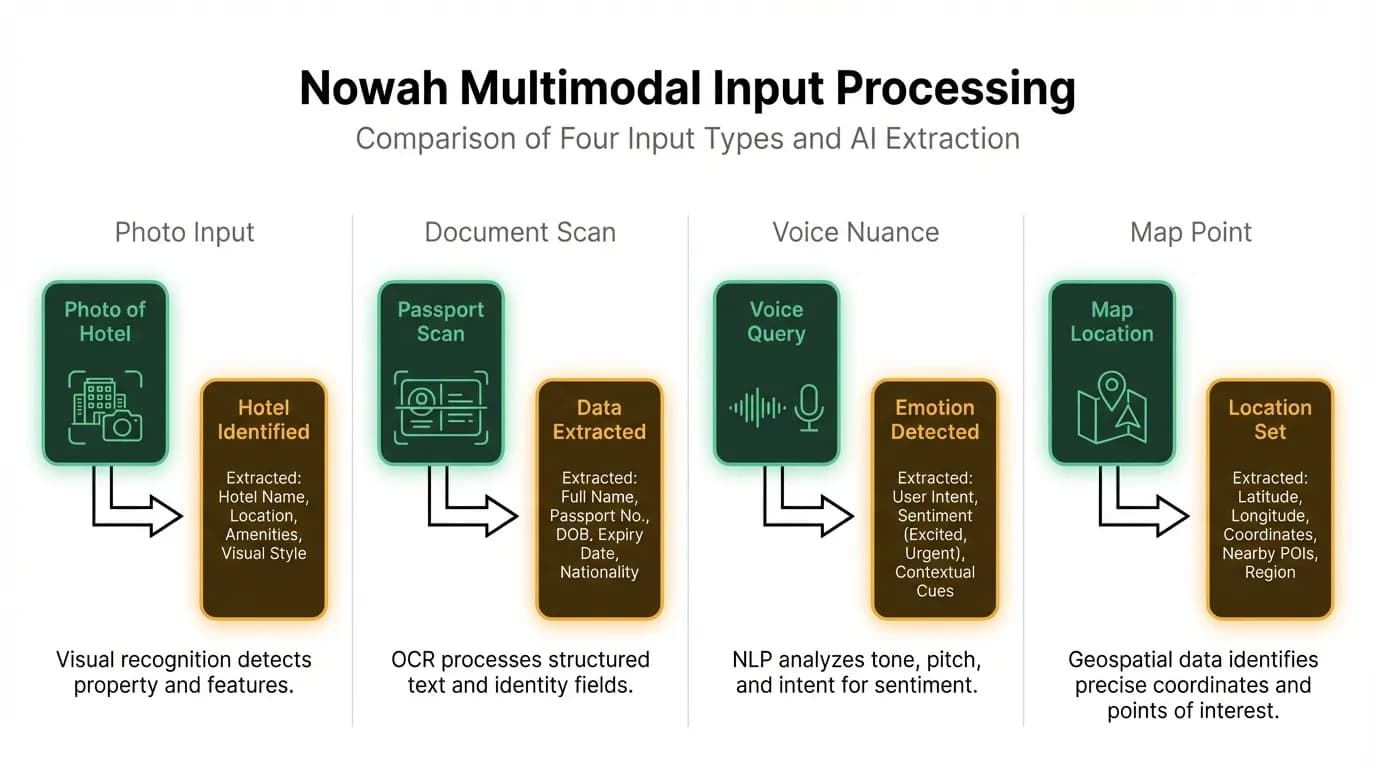
The Instagram scenario is not hypothetical. It is one of the most common unmet needs in travel planning. People discover destinations visually, through social media, through friends' photos, through magazine spreads, and have no good way to turn a visual discovery into a bookable trip.
Multimodal AI changes this. You screenshot a photo and send it to your travel agent. The AI processes the image, analyzing architectural style, landscape features, geographical markers, vegetation, signage, and any identifiable branding. It cross-references with hotel databases, location imagery, and travel content.
"That looks like the Viceroy Bali. It's a luxury resort in Ubud with an infinity pool overlooking the Petanu River valley. Rates start around $350/night for your dates. Would you like me to check availability?"
This works for more than hotels. A friend sends you a photo from a restaurant with a stunning view. The AI identifies the restaurant from the view angle and interior design. A travel blog shows an aerial photo of a beach. The AI identifies the location and suggests nearby hotels. A movie scene features a beautiful street in Lisbon. The AI identifies the neighborhood and helps you plan a walk through it.
The technical capability for this is largely here. Modern vision models can identify locations, architectural styles, and specific properties with reasonable accuracy. The challenge is building the travel-specific layer on top: connecting visual identification to live booking inventory, enriching the identification with price and availability data, and presenting it in the conversational flow.
We are building this into Nowah. It is not shipped yet for all use cases, but document processing is already live, and general visual identification is in development. The goal is simple: if you can see it, you can book it.
Document processing: eliminating tedious data entry
Travel involves an absurd amount of documents. Passports. Visas. Boarding passes. Hotel confirmations. Travel insurance policies. Vaccination records. Each of these contains structured data that you currently have to type into forms manually.
Multimodal AI eliminates this. Point your camera at your passport. The AI reads it. Name, nationality, passport number, expiration date, all extracted in seconds. No typing. No errors from mistyped characters. No squinting at tiny print.
This extends to every document in the travel lifecycle:
Boarding passes. Scan the boarding pass. The AI extracts flight number, departure time, gate, seat assignment, and adds it to your trip itinerary automatically.
Hotel confirmations. Forward the confirmation email or scan the printout. The AI extracts the hotel name, address, check-in and check-out dates, reservation number, and any special notes.
Visa documents. The AI reads visa stamps, electronic visa confirmations, and travel authorization documents. It verifies that your visa matches your travel dates and flags any issues.
Travel insurance. The AI reads your policy document and extracts coverage details, emergency contact numbers, claim procedures, and policy limits. It stores this information accessible during your trip.
Receipts. For business travelers or anyone tracking travel expenses, the AI reads receipts, extracts amounts, categories, and vendor names, and compiles expense reports.
The cumulative time savings are meaningful. A typical international trip involves entering data from five to ten different documents into various apps and forms. Each entry takes two to five minutes and is error-prone. Multimodal document processing reduces all of this to a series of camera scans taking seconds each.
More importantly, it reduces a friction point that discourages organized travel management. Many people do not bother adding their hotel confirmation to their trip app because the manual entry is annoying. Automatic extraction removes the friction, which increases the completeness of trip information, which makes the trip management experience better.
Voice nuance: hearing what users really mean
Current voice input for AI products is essentially speech-to-text. You speak, the AI converts your words to text, and then processes the text. This works for the content of what you say. It misses the how.
Multimodal voice processing goes deeper. It detects emotional tone, confidence level, and contextual cues in how you speak.
Uncertainty detection. "Maybe... Barcelona? Or possibly Lisbon?" The hesitation, the rising intonation, the "possibly" signal that the user is undecided. A text-only AI might interpret this as a destination choice and start searching Barcelona. A voice-aware AI detects the uncertainty and responds differently: "It sounds like you're deciding between Barcelona and Lisbon. Would it help if I compared the two for your dates?"
Excitement detection. "Oh, I have ALWAYS wanted to go to Japan!" The emphasis, the volume, the pace signal genuine enthusiasm. A voice-aware AI can match this energy: "Japan is an amazing choice. Spring in Japan is especially special with cherry blossom season. Let me find you some great options." Small thing, but emotional matching makes the interaction feel more natural and less robotic.
Frustration detection. "I have been looking at flights for THREE HOURS and everything is expensive." The stress in the voice, the emphasis on time spent, the negative framing. A voice-aware AI adjusts its approach: "That sounds frustrating. Let me take a different approach and search for the best value options, including nearby airports and flexible dates, to see if we can find something better."
Group dynamics. Multiple voices in a conversation. "I want to go to the beach." "I want mountains." The AI detects two speakers with different preferences and mediates: "Sounds like you want both beach and mountains. There are some destinations that offer both. How about the Amalfi Coast? Beautiful coastline with mountain hiking in the same area."
Voice nuance detection is still early in its capability arc. Current models can detect basic emotional valence (positive, negative, neutral) with reasonable accuracy. More subtle detection, like distinguishing uncertainty from politeness, or frustration from fatigue, is improving but not production-ready for all cases.
We are watching this capability closely because travel conversations are emotional. People are excited about vacation planning, stressed about work trips, anxious about international logistics. An agent that can hear those emotions and respond appropriately will feel dramatically more human than one that processes words without context.
Map interaction: spatial input for spatial problems
Travel is inherently spatial. Where you want to go. Where your hotel is relative to the attractions. Where the airport is relative to your meeting. Where the restaurant is relative to your hotel. These are spatial questions that text handles poorly.
"I want a hotel near the beach but not too far from the old town" is a spatial constraint that is hard to express precisely in text but trivially easy to express on a map. Point to an area. Draw a circle. The AI understands.
Multimodal map interaction lets users express spatial preferences naturally:
Point and search. Tap a location on a map and say "find me hotels around here." The AI combines the map coordinates with conversational context (dates, budget, preferences) and searches the specific area.
Draw a zone. Trace an area on the map and say "I want to stay somewhere in this neighborhood." The AI constrains its hotel search to that geographic zone.
Pin comparisons. Drop multiple pins and ask "which of these locations would be best for my hotel?" The AI evaluates proximity to attractions, transit access, neighborhood quality, and noise levels for each pin and makes a recommendation.
Route awareness. Point to your hotel and then to a restaurant and ask "how do I get there?" The AI generates directions, estimates travel time, and suggests the best transport option (walk, transit, rideshare) based on distance and local conditions.
This is particularly valuable for destination exploration. When you are unfamiliar with a city, spatial relationships are confusing from text alone. "The hotel is in Shibuya, near Hachiko crossing" means nothing if you do not know Tokyo. Seeing it on a map with surrounding landmarks, transit stations, and your other trip locations gives immediate spatial understanding.
The combined multimodal experience
The real power of multimodal AI is not any single input mode. It is the combination.
A complete travel planning interaction might flow like this:
You send a screenshot of a friend's Instagram photo. "I want to go here." (Image input)
The AI identifies the location. "That is Positano on the Amalfi Coast in Italy. Beautiful choice."
You speak: "Yeah, my friend said it was amazing. Can we go in September? I am thinking maybe a week?" (Voice input with excitement detected)
The AI searches. "September is great for the Amalfi Coast. Still warm but less crowded. I found three hotels in Positano."
You look at the map. "I want to be close to the water, not up on the hill." You tap a spot near the waterfront. (Map input)
The AI filters. "Two of the three hotels are near the waterfront in the area you indicated. Here are your options."
You take a photo of your passport. "Can you check my passport for the trip?" (Document input)
The AI reads it. "Your passport is valid until March 2028, which is fine for Italy. EU countries require at least three months of validity beyond your travel dates. You are good."
Four different input modalities in a single conversation, each used at the moment it is most natural. No forms. No typing flight details. No manual data entry. The user communicates in whatever mode is most efficient for each piece of information, and the AI handles all of them seamlessly.
What is possible today vs. near-future
I want to be honest about the current state of multimodal capabilities in travel AI.
Available now:
- Document processing (passport, boarding pass scanning) is production-ready and quite accurate
- Voice-to-text input works well for standard queries
- Basic image identification works for well-known landmarks and many hotels
- Map display with point-based search is functional
Near-future (6-18 months):
- Improved photo identification for less famous locations and hotels
- Voice nuance detection for basic emotions (excitement, frustration, uncertainty)
- Combined multimodal input in a single conversation turn
- Receipt and expense document processing
Further out (18-36 months):
- Reliable identification of obscure locations from photos
- Sophisticated voice nuance including group dynamics
- Real-time visual translation (point camera at a sign, get translation in AR overlay)
- Spatial gesture recognition beyond simple point-and-tap
The gap between what is technically possible in a research lab and what is reliable enough for a consumer product is real. We ship features when they work consistently, not when they work impressively in a demo. Some multimodal capabilities that look great in controlled demonstrations break down with real-world input: blurry photos, background noise, ambiguous gestures.
Why multimodal matters for travel specifically
Travel is one of the most naturally multimodal activities in consumer technology. Think about the information types involved:
Visual. Photos of destinations, hotels, restaurants. Maps and spatial layouts. Document images. Video tours.
Auditory. Spoken queries and preferences. Ambient sounds that provide context (airport announcements, street noise). Music and cultural sounds.
Textual. Typed messages. Written reviews. Document text. Booking confirmations.
Spatial. Geographic locations. Route planning. Neighborhood exploration. Proximity calculations.
Temporal. Dates and schedules. Time zones. Duration calculations. Sequential itineraries.
No other consumer category touches as many information modalities as travel. Shopping is primarily visual and textual. Music is auditory. Maps are spatial. Travel is all of them, simultaneously.
This is why a multimodal AI agent is particularly valuable for travel. The agent that can process a photo, listen to your voice, read your documents, and understand your map interactions is meeting you in every modality that travel naturally involves. A text-only agent, no matter how smart, is operating with one hand tied behind its back.
We are building toward the most complete multimodal travel AI agent possible. Not because multimodal is a buzzword, but because travel demands it. The information is visual, auditory, textual, and spatial. The agent should be too.
Nowah is an AI travel agent that searches and books real flights and hotels through conversation — no filters, no thirty open tabs. Plan your next trip.