Onboarding an AI: Teaching Users to Talk to a Travel Agent
Users know how to use search forms. They do not know how to talk to an AI travel agent. Onboarding must teach the new paradigm without a tutorial — through design, not instruction.
The user opens the app for the first time. They see a chat interface. A text input. A microphone button. And they freeze.
"What do I type?"
This is the blank-screen paralysis that every conversational AI product faces, and it is particularly acute in travel because users have spent two decades learning a different interaction pattern. They know how to fill in origin, destination, dates, and hit search. They do not know what to say to a blank chat screen. The open-endedness that makes conversation powerful also makes it intimidating for first-time users.
Onboarding for an AI product is fundamentally different from onboarding for a traditional app. Traditional onboarding teaches features: here is the search button, here is the filter panel, here is your profile. AI onboarding teaches an interaction paradigm: you can talk to this thing, and it will understand you, and it can actually do things on your behalf.
Card-stack onboarding: swipe through preferences, not forms
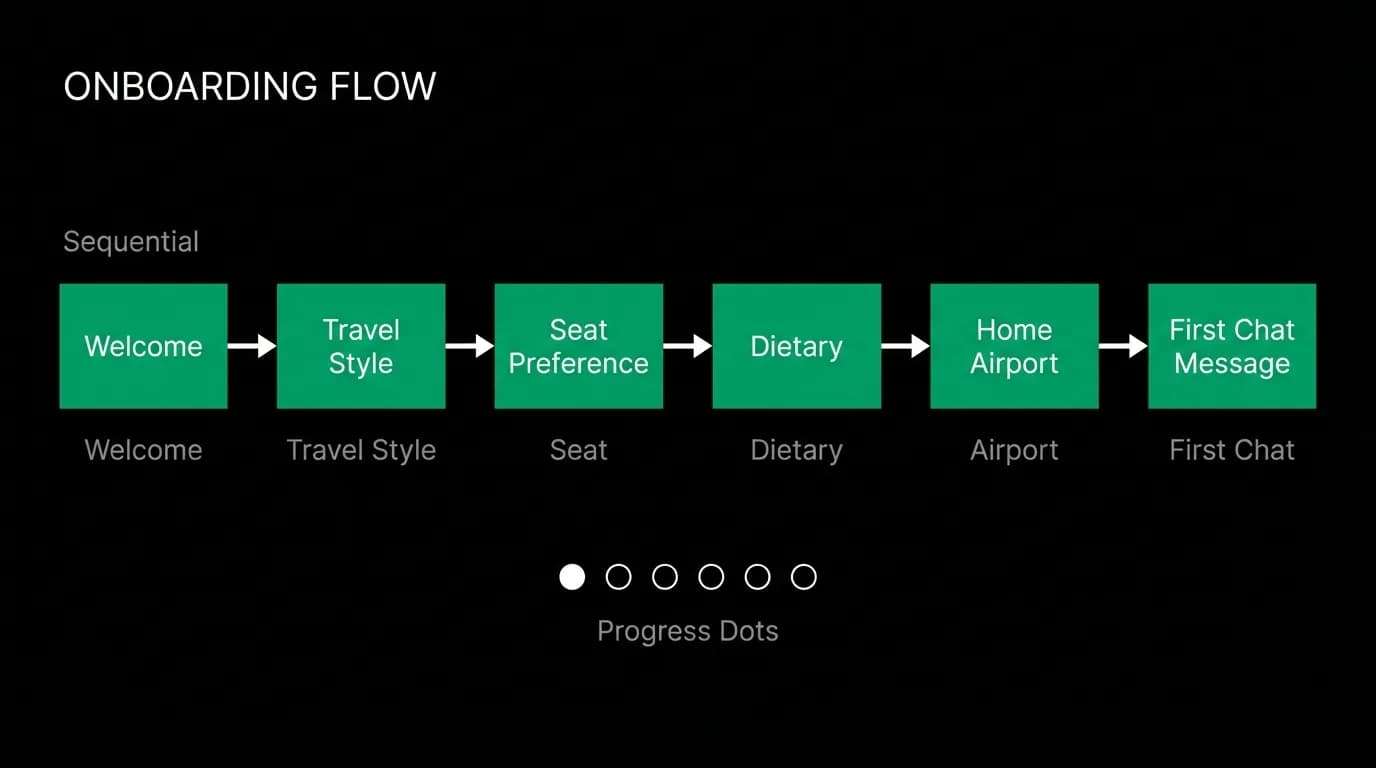
Our onboarding uses a card-stack metaphor. Instead of form fields that ask users to type, we present preference cards that users swipe through. Each card is a single question with large, tappable options. No typing required.
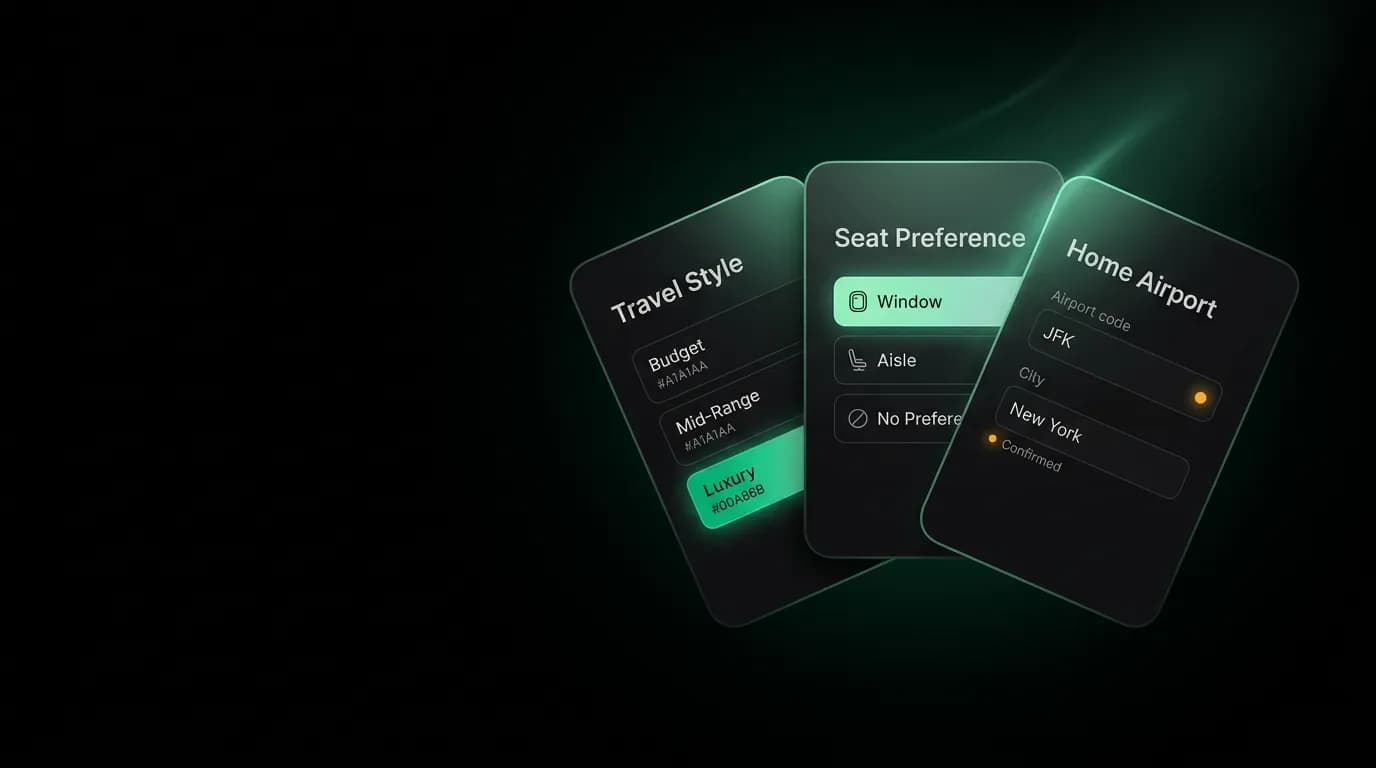
Travel style: budget, mid-range, luxury. Tap one. Seat preference: window, aisle, no preference. Tap one. Dietary needs for meal recommendations. Home airport for smarter routing. Travel companions: solo, couple, family, group.
Five cards. Under thirty seconds for most users. An eighty-five percent completion target, which is meaningfully higher than the industry average for onboarding flows that typically run seven screens and take forty-five to sixty seconds.
The card-stack metaphor works because it is physical and familiar. You are dealing cards, not filling out forms. Each swipe feels like progress. The horizontal dot indicator shows exactly how many cards remain. There is no scrolling, no hidden fields, no "page 2 of 5." Every step is visible and finite.
The first AI message: setting expectations through example
After onboarding completes, the user arrives at the chat screen. This is the moment where the AI's first message either empowers or confuses them.
The first message needs to accomplish three things simultaneously. It needs to feel warm and personal without being presumptuous. It needs to demonstrate what the AI can do without listing features. And it needs to lower the barrier to the first user message without being patronizing.
A good first message references the preferences the user just selected, proving that the onboarding mattered. "I know you prefer mid-range hotels and aisle seats" is a personalization signal that builds immediate trust. It also gives the user confidence that the AI is paying attention and will use this information to help them.
Guided prompts: training wheels that disappear
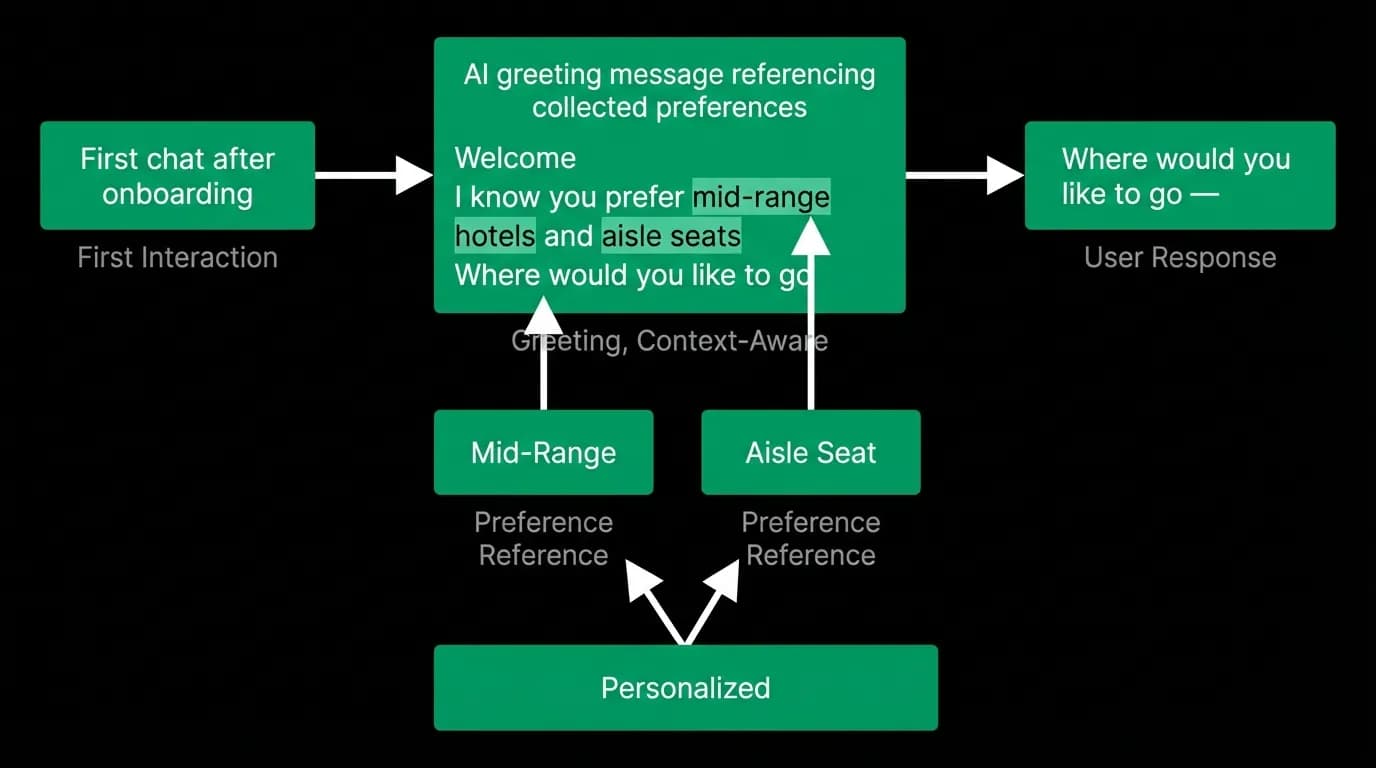
Below the AI's first message, suggested prompt chips appear. These are not commands or menu items. They are example conversations that show the user what kinds of things they can say.
"Plan a weekend trip to Barcelona." "Find cheap flights to Tokyo in April." "Where should I go for a beach vacation?"
Each prompt chip is a complete, natural-language query that the user can tap to send immediately. The user does not have to think of what to say. They can tap a suggestion and see the AI respond with real results. This first successful interaction teaches the paradigm more effectively than any tutorial could.
The prompts are designed to show range. One is destination-specific. One is exploratory. One mentions a budget constraint. Together they demonstrate that the AI can handle specific requests, open-ended questions, and nuanced constraints, all through natural conversation.
As the user becomes more comfortable, the suggested prompts become less necessary. Returning users who have had several conversations see fewer or no prompt chips because they have already learned the interaction model. The training wheels come off naturally.
Progressive capability disclosure
The AI has an extensive toolkit. It can search flights-layer-ai-agent-search-flights), book hotels, check visa requirements, convert currencies, find points of interest, and much more. Presenting all of these capabilities on day one would be overwhelming and counterproductive.
Instead, capabilities are revealed progressively through use. The first conversation might involve flight search. The AI mentions it can also find hotels. The next conversation involves hotels, and the AI mentions it can build a full itinerary. Over time, the user discovers the full range of capabilities organically, through contextual mentions rather than feature lists.
This progressive disclosure applies to the AI's personality as well. Early interactions are more explicit about what the AI is doing and why. "I am searching for flights to Barcelona for your dates. This might take a few seconds." Later interactions can be more concise because the user understands the pattern. "Searching flights now." The verbosity decreases as familiarity increases.
Handling "What can you do?"
Every AI product gets this meta-question, and the answer matters more than most teams realize. The wrong response is a feature list. The right response is a conversation.
Instead of saying "I can search flights, book hotels, check visa requirements, convert currencies..." the AI responds with a contextual suggestion: "I can help with anything travel-related. Most people start by telling me where they want to go, or asking for suggestions. What sounds good?"
This redirects the meta-question back into the interaction paradigm. Instead of learning about the AI through a list, the user learns about the AI by using it. The best documentation for a conversational interface is the conversation itself.
Design an onboarding flow that teaches by doing
The most effective onboarding for a conversational AI product is one that gets the user into a real conversation as quickly as possible. Every screen before the first AI interaction is friction. The preference cards work because they are fast, they collect useful data, and they create a bridge to a personalized first message.
Once the user sends their first message and receives a real response with real flight or hotel options, the paradigm shift is complete. They understand that this is not a chatbot with canned responses. It is an agent that can actually do things. That understanding comes from experience, not explanation, and the onboarding flow exists to make that first experience happen in under a minute.
Nowah is an AI travel agent that searches and books real flights and hotels through conversation — no filters, no thirty open tabs. Plan your next trip.