The Passport Tab: Designing an AI-Powered Travel Journal
Travel memories scatter across photos, emails, and apps. The Passport tab consolidates them into AI-generated summaries, stats, and a digital keepsake.
I have traveled to 23 countries. I know this because I counted manually once, flipping through my physical passport and cross-referencing with old photos. I could not tell you how many flights I have taken or how many miles I have traveled. I definitely could not tell you the name of that restaurant in Barcelona where I had the best paella of my life. It was in the Gothic Quarter. I think. Somewhere near the cathedral. The waiter recommended a specific wine. I remember the wine was great. I do not remember what it was called.
This is how travel memories work for most people. Fragments. Scattered across camera rolls, email inboxes, text conversations, social media posts, and the unreliable hardware of human memory. The most meaningful experiences of your life, and the data about them is in worse shape than your grocery shopping history.
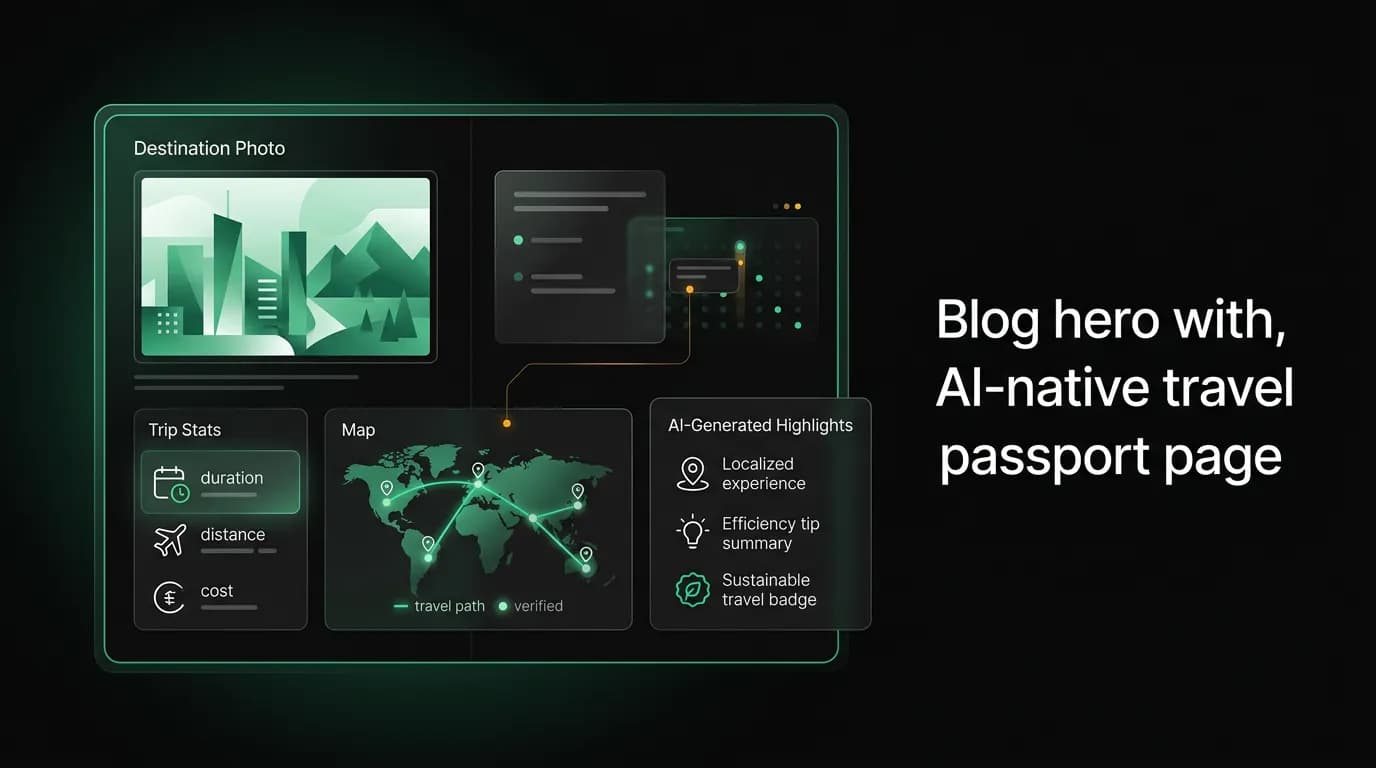
We built the Passport tab in Nowah to fix this. It is a travel journal that writes itself, a personal record of everywhere you have been, powered by the same AI that helped you get there. And I think it might be the most emotionally resonant feature we have built.
Travel memories are scattered everywhere
Let me catalog where a typical trip's memories end up.
Photos: In your camera roll, mixed in with screenshots, work photos, and random images. Finding the photos from your Tokyo trip requires scrolling through hundreds of unrelated images or hoping Apple Photos correctly identified the location. On average, people take 200-400 photos per trip. Organizing them takes effort that most people never invest.
Booking confirmations: In your email inbox, scattered across multiple threads from the airline, the hotel, the activity providers. Finding your hotel name from a trip two years ago means searching your email and hoping you used the right keyword.
Recommendations and tips: In various messaging apps. You texted a friend about that great restaurant. You saved an Instagram post about a hidden bar. You bookmarked a Reddit thread about a walking tour. None of these are connected to each other or to your trip timeline.
Financial records: In your credit card statements. If you want to know how much you spent in Italy, you are digging through transaction history and trying to distinguish Italian restaurants you visited from the Italian restaurant near your house.
Actual memories: In your head, degrading over time. Research on memory suggests that detailed episodic memories start fading within weeks. The name of the hotel, the specific street, the flight number, the departure time: these details disappear first, leaving only general impressions.
Five or more apps and platforms. Zero connections between them. No unified record. This is the state of travel memory management in 2026.
AI-generated trip summaries
The Passport tab starts with an unfair advantage: Nowah already has the data.
When you book and travel through Nowah, the AI knows where you went, when, what you booked, what you asked about during the trip, and what the conditions were. It has the raw material for a trip summary without asking you to do anything.
After a trip, the AI generates a narrative summary automatically. Not a list of bookings. A narrative. Something like:
"Your 8-day trip to Japan in March 2026. You flew direct from San Francisco to Tokyo, arriving on March 3rd. You spent four nights in Shinjuku, exploring Shibuya, Harajuku, and the Meiji Shrine area. You asked about ramen spots near your hotel, and visited three. On March 7th, you took the Shinkansen to Kyoto for three nights, staying in a traditional ryokan in Higashiyama. You checked the weather before your visit to Fushimi Inari and got lucky with clear skies. You flew back from Osaka on March 11th."
This summary is generated from booking data, conversation history, and trip context. The user did not write any of it. They did not log any of it. They just used the app to plan and manage their trip, and the journal wrote itself.
This matters because the alternative is that most trips go unrecorded. People intend to journal about their travels. Very few actually do. The activation energy is too high. By the time you get home and unpack, the motivation to sit down and write about your trip has evaporated. The AI eliminates that activation energy entirely.
Stats and milestones as gamification
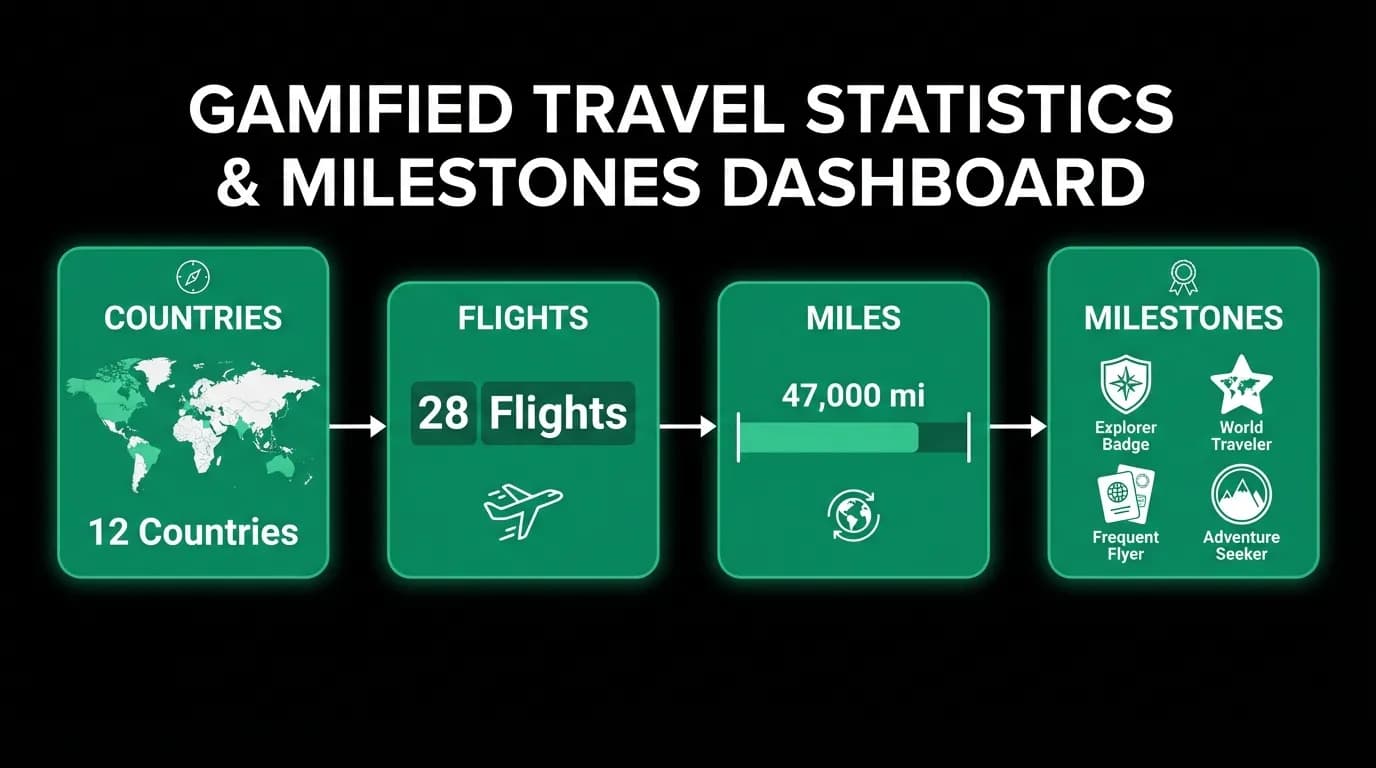
Below the narrative summary, the Passport tab tracks quantitative travel data. Countries visited. Cities explored. Flights taken. Total miles traveled. Hotels stayed in. Nights spent abroad.
These numbers accumulate over time into a personal travel profile. And something interesting happens when you give people numbers about their own behavior: they want to make the numbers go up.
This is light gamification, and it works. Duolingo built a multi-billion dollar business partly on streaks and stats. Strava turned running data into a social game. Apple Watch turned health metrics into ring closures that people obsess over.
Travel stats tap into the same psychology. Seeing "12 countries visited" creates a natural desire to make it 13. Seeing "47,000 miles traveled" makes you curious about hitting 50,000. These are not arbitrary game mechanics. They are reflections of real experiences that create a natural motivation to have more of them.
We layer milestones on top of the stats. First international trip. Tenth country. Longest flight. Most-visited city. These milestones function as badges that mark travel achievements. They are fun to earn and fun to share.
The key is keeping the gamification genuine rather than manipulative. We are not creating artificial scarcity or urgency. We are reflecting real travel history in a way that creates engagement and pride. The stats are accurate. The milestones are earned. The motivation to travel more comes from the traveler, not from psychological tricks.
Automatic photo organization
This is the feature that, honestly, we are still building toward but that I am most excited about.
The concept: connect your photo library (with permission), and the AI matches photos to trip locations and dates automatically. Your 300 Tokyo photos get organized by day and neighborhood. The restaurant photos group separately from the temple photos. The selfies, the landscapes, and the food shots each find their place.
Today, this is partially possible through location and timestamp metadata that most phone cameras embed in photos. But the AI layer adds contextual understanding. The photo at Fushimi Inari gets tagged not just with GPS coordinates but with "Fushimi Inari Shrine, Kyoto, Day 5 of Japan trip." A photo of a dish at a restaurant gets connected to the conversation where you asked the AI for ramen recommendations near your hotel.
The output is a visual trip journal that looks like something you would see in a professionally designed travel book. Photos organized by day, annotated with location names and brief descriptions, interspersed with the AI-generated narrative summary.
Nobody would build this manually. The effort of sorting 300 photos, writing captions, organizing by day, and creating a coherent visual narrative is hours of work. The AI can do it in minutes from data it already has.
The emotional product
Most product decisions we make at Nowah are utilitarian. Faster search. Better recommendations. Smoother booking flow. These are functional improvements that make the product more useful.
The Passport tab is different. It is an emotional product. Its primary value is not functional. It is sentimental.
A travel journal is a keepsake. People keep physical travel journals for decades. They are among the most treasured personal possessions because they capture experiences that define people's lives. The places they have been. The things they have seen. The adventures they have had.
Designing for emotion is different from designing for utility. Utility design optimizes for efficiency and clarity. Emotional design optimizes for delight and meaning.
The visual design of the Passport tab matters more than almost any other part of the app. The trip summaries should feel like pages in a premium journal, not entries in a database. The photos should be beautifully displayed, not thumbnailed. The stats should feel like achievements, not data points. The overall experience should evoke the feeling of flipping through a well-crafted scrapbook.
We chose the name "Passport" deliberately. A physical passport is one of the most emotionally charged documents a person owns. It is a record of where you have been, stamped with proof of experiences. The digital Passport tab aims to evoke the same feeling: a personal record of a life lived in motion.
How Polarsteps and TripIt approached this (and where they fell short)
Polarsteps is the closest existing product to what we are building with the Passport tab. It tracks your travels via GPS, creates route maps, and lets you add photos and notes to create a visual travel journal. It is a good product that many travelers love.
But Polarsteps requires manual effort. You have to remember to start tracking before your trip. You have to add photos manually to the right days. You have to write notes if you want narrative content. The result is beautiful if you invest the time, but most users start a Polarsteps journal with enthusiasm and abandon it by day three because the upkeep competes with actually experiencing the trip.
TripIt is excellent at organization. It parses booking confirmation emails and creates structured itineraries. But it is purely functional. There is no narrative. No photos. No emotional dimension. It is a filing cabinet for travel documents, which is useful but not the same thing as a travel journal.
Google Timeline tracks your location history and creates a map of where you have been. It is automatic, which is good. But it is not a product. It is a data display buried in Google Maps settings. There is no narrative, no photo integration, no emotional design. It feels like a surveillance log, not a keepsake.
The gap that the Passport tab fills is the intersection of automation and emotion. Automatic like Google Timeline, but designed with the emotional care of a physical journal. Photo-rich like Polarsteps, but without requiring manual curation effort. Organized like TripIt, but wrapped in a narrative instead of a spreadsheet.
Passport as retention magic
From a product strategy perspective, the Passport tab has an interesting retention property. It creates value that compounds over time and cannot be easily replicated elsewhere.
After one trip, the Passport tab has a single journal entry. Nice but not sticky. After ten trips, it has a personal travel history spanning years, with narratives, photos, stats, and milestones. Leaving means losing a record of experiences that are irreplaceable.
This is different from data portability discussions. We could let users export their trip data as JSON. The data could technically be moved. But the value is not in the raw data. It is in the AI-generated narratives, the organized photos, the visual presentation, the integrated stats. Recreating all of that on another platform would be like moving houses: technically possible but nobody wants to do it.
The retention effect is strongest with our most valuable users: frequent travelers. A user who takes four or five trips a year builds a rich Passport quickly. After two years, they have a travel biography that they genuinely treasure. These are also the users with the highest lifetime value from a booking perspective.
Importantly, this retention is not coercive. We are not holding data hostage or creating artificial switching costs. We are creating genuine value that the user wants to keep. They stay because the product has their travel life in it, not because we make it hard to leave.
The vision
Here is where I want the Passport tab to go over the next year.
Social sharing. Trip summaries that can be shared as beautiful cards on social media or with friends and family. Not the raw itinerary, but the narrative. "Here is my Japan trip, as told by my AI travel agent." This turns users into ambassadors and gives Nowah organic distribution through the most shareable content type on the internet: travel stories.
Year-in-review. An annual summary of travel stats, highlights, and memories. Think Spotify Wrapped but for your travel year. "In 2026, you visited 7 countries, took 14 flights, traveled 38,000 miles, and your longest trip was 12 days in Southeast Asia." These reviews create a moment of reflection and sharing that drives engagement.
Recommendation loops. The AI uses your travel history to make better recommendations. "You have been to three countries in Southeast Asia but never Vietnam. Based on what you loved about Thailand and Cambodia, I think you would enjoy Hoi An." The Passport data feeds forward into future trip planning.
Multi-traveler memories. For couples and families who travel together, shared trip journals that combine perspectives. Both partners' photos in one timeline. Shared stats. A joint travel history.
The Passport tab started as a nice-to-have feature. The more we build it, the more I think it might be the feature that makes Nowah irreplaceable. Not because it helps you book flights, but because it captures something far more valuable: the story of where your life has taken you.
That is not a feature competitors can replicate by adding a chat widget to their OTA. It is the product of every conversation, every booking, every trip, every memory flowing through a single AI-powered platform over years. It is the ultimate expression of what an AI-first travel product can be: not just a tool for transactions, but a companion for the journey.
Nowah is an AI travel agent that searches and books real flights and hotels through conversation — no filters, no thirty open tabs. Plan your next trip.