The Referral Loop: Why AI Travel Products Have Natural Virality
\\\"I just said 'find me a beach trip' and it booked everything in 2 minutes\\\" — AI travel creates wow moments that users share without being asked.
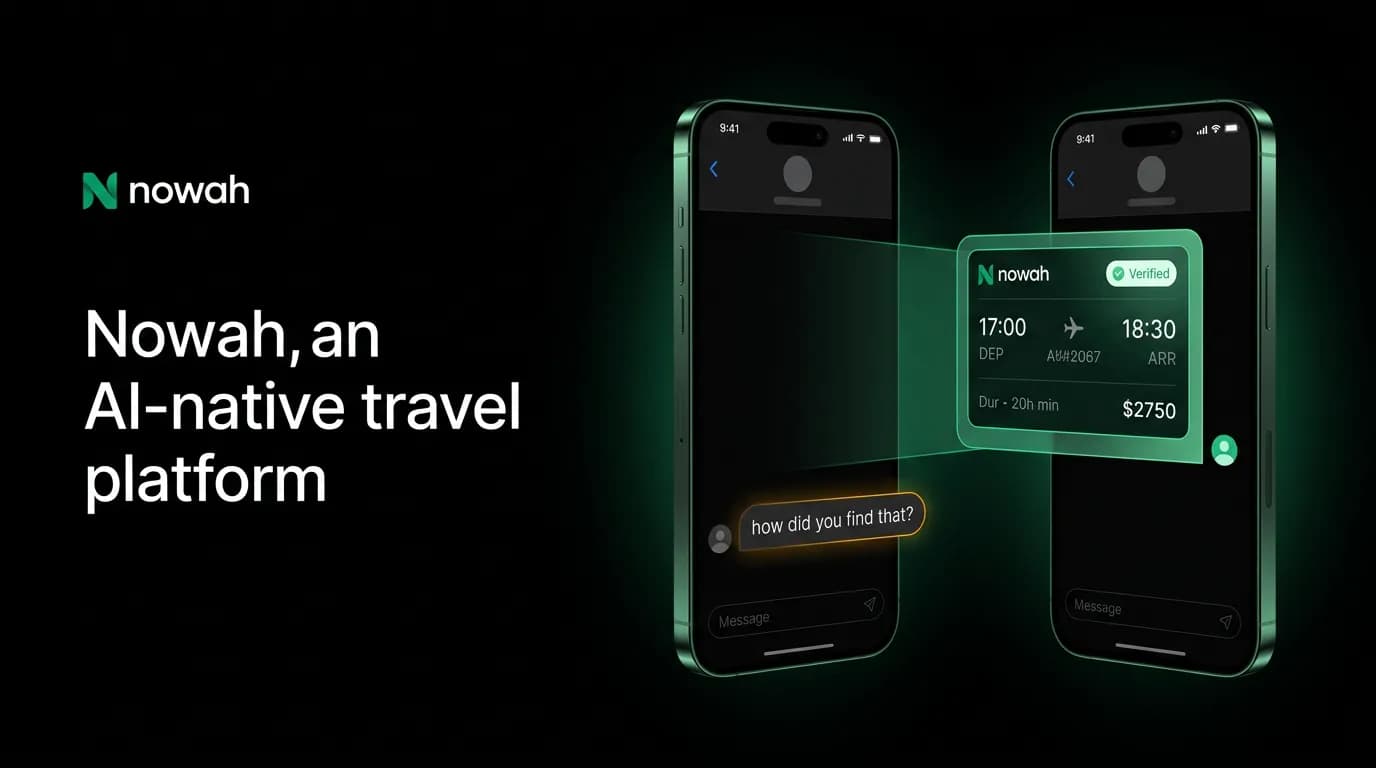
Nobody screenshots an Expedia search results page and texts it to a friend. Nobody records a screen video of themselves sorting Kayak results by price. These products are functional but not remarkable. They work, and that is the problem. "It works" is not a story anyone tells.
But someone will absolutely screenshot a conversation where they said "find me a beach trip for under $2,000 in April" and two minutes later had three fully priced flight-and-hotel packages displayed in a chat. They will text that screenshot to their group chat with "what is this app??" They will show it to their coworker during lunch. They will mention it at dinner.
AI travel creates wow moments. And wow moments are the raw material of organic growth.
The wow moment is shareable
Traditional travel apps do not generate wow moments because they do what users expect. You search for a flight. You get a list of flights. Sorted by price. Expected. Useful. Not interesting.
An AI agent that understands a vague request, searches live inventory, compares options against your personal preferences, and presents three curated choices in a conversational format is unexpected. The first time it happens, users have a visceral reaction. "Wait, it actually did that?" This reaction is the wow moment, and it has a specific quality that makes it shareable: it is demonstrable.
You cannot easily share an "Expedia saved me 10%" story. There is no visual. There is no narrative. It is a data point. You can share an AI conversation screenshot. The narrative is right there: here is what I asked, here is what it did. The visual is compelling: dark theme, clean flight cards, a natural conversation. The story tells itself.
We track first-conversation screenshot rates as a proxy for wow moment generation. About 11% of users take a screenshot during or immediately after their first meaningful conversation with the agent. For context, the average app screenshot rate is under 2%. Users are so surprised by the experience that they capture it to show someone else.
That 11% is not prompted. We do not ask users to share. We do not offer incentives for screenshots. It happens organically because the experience is different enough from what people expect that they want to document and share it.
Travel is inherently social
Travel has a built-in social layer that most product categories lack.
People plan trips together. They ask friends for recommendations. They share photos from trips. They ask "where did you stay?" and "how did you find that flight?" Travel is one of the most discussed topics in casual conversation, right up there with food and weather.
This social layer creates natural product discovery moments. When someone mentions they are planning a trip to Portugal, it is perfectly natural for a friend to say "have you tried Nowah? I just booked my Portugal trip through it." The context is right. The relevance is obvious. The recommendation is not a sales pitch. It is a genuine sharing of something useful.
Compare this to, say, a note-taking app. If someone mentions they need to organize their thoughts, it would be weird for a friend to enthusiastically recommend their note-taking app. The category does not generate enough emotion or conversation to support organic referral.
Travel generates conversation. AI makes the conversation about the tool ("you have to see what this app did"), not just the trip. That combination is why AI travel has natural virality that most product categories cannot replicate.
Screenshot virality
We deliberately designed the product to be screenshot-worthy. This was not an afterthought. It was a design principle from day one.
The dark theme with green accents creates high visual contrast that looks striking in screenshots shared on social media or in messages. Light-themed apps tend to blend into the white background of messaging apps. Our dark interface stands out.
Flight cards are designed to be self-contained: airline, route, times, price, and the AI's one-line assessment, all visible without scrolling. When a user screenshots a set of flight options, the recipient gets enough information to understand what they are looking at without needing to open the app.
The conversation format itself is inherently shareable. A screenshot of a chat shows the user's natural language request and the agent's structured response. It tells a story: "I asked for this, and the AI did that." No other travel app format has this narrative quality. A screenshot of search results is just data. A screenshot of a conversation is a story.
We also made sharing easy from within the app. Trip itineraries can be shared as clean, formatted cards. Booking confirmations include shareable summaries. The currency converter results include context that makes sense out of the app. Every touchpoint is designed to look good when extracted from the product and dropped into a message thread.
The goal is not to make people share. It is to make the thing they naturally want to share look great when they do.
The comparison advantage
Users who switch from legacy OTAs to Nowah become our most vocal advocates. Not because we asked them to be, but because the contrast is so stark that they cannot help commenting on it.
The comparison story is powerful. "I used to spend an hour on Google Flights comparing options. Now I tell the AI what I want and pick one of three options. It took five minutes." This is a concrete, relatable before-and-after that anyone who has booked travel online can appreciate.
Comparison users bring three qualities that make them effective advocates:
Credibility. They have used the alternatives. When they say Nowah is better, they are speaking from experience, not marketing. Their friends trust this opinion more than any ad.
Specificity. They can articulate exactly what is different. "The AI remembered I hate layovers and only showed me direct flights." "It told me my hotel was in a noisy area and suggested a better one nearby." These specific stories are more compelling than generic praise.
Emotion. The switch was a relief. Booking travel used to be stressful. Now it is not. That emotional shift makes people evangelical. They do not just recommend Nowah. They insist on it: "You HAVE to try this."
We see this in our referral data. Users who have previously used competing travel apps refer at 2.3x the rate of users who came to Nowah as their first travel booking experience. The comparison creates the conviction that drives referrals.
Every shared trip is a product demo
Here is the growth insight that took us a while to fully appreciate: every time a user shares anything from Nowah, they are giving someone else a product demo.
A shared booking confirmation shows the recipient: this app books real flights with real prices and confirms instantly. A shared itinerary shows: this app builds organized travel plans. A shared currency conversion with AI context shows: this app has smart tools. A shared conversation screenshot shows: you can just talk to this app and it does things.
Each of these is a micro-demonstration of product capability. The recipient does not need to download the app or sit through a tutorial. They see the output and understand the value.
This is fundamentally different from how other products spread. A social media app needs you to sign up and find friends before you see value. A productivity app needs you to import data before it is useful. Nowah's value is visible in a screenshot. The demo is the share.
We track downstream conversion from shares. When a user shares a booking confirmation or trip itinerary with someone who is not a Nowah user, 18% of recipients visit our website within 48 hours, and 6% create an account within a week. These are strong numbers for completely organic, non-incentivized referral.
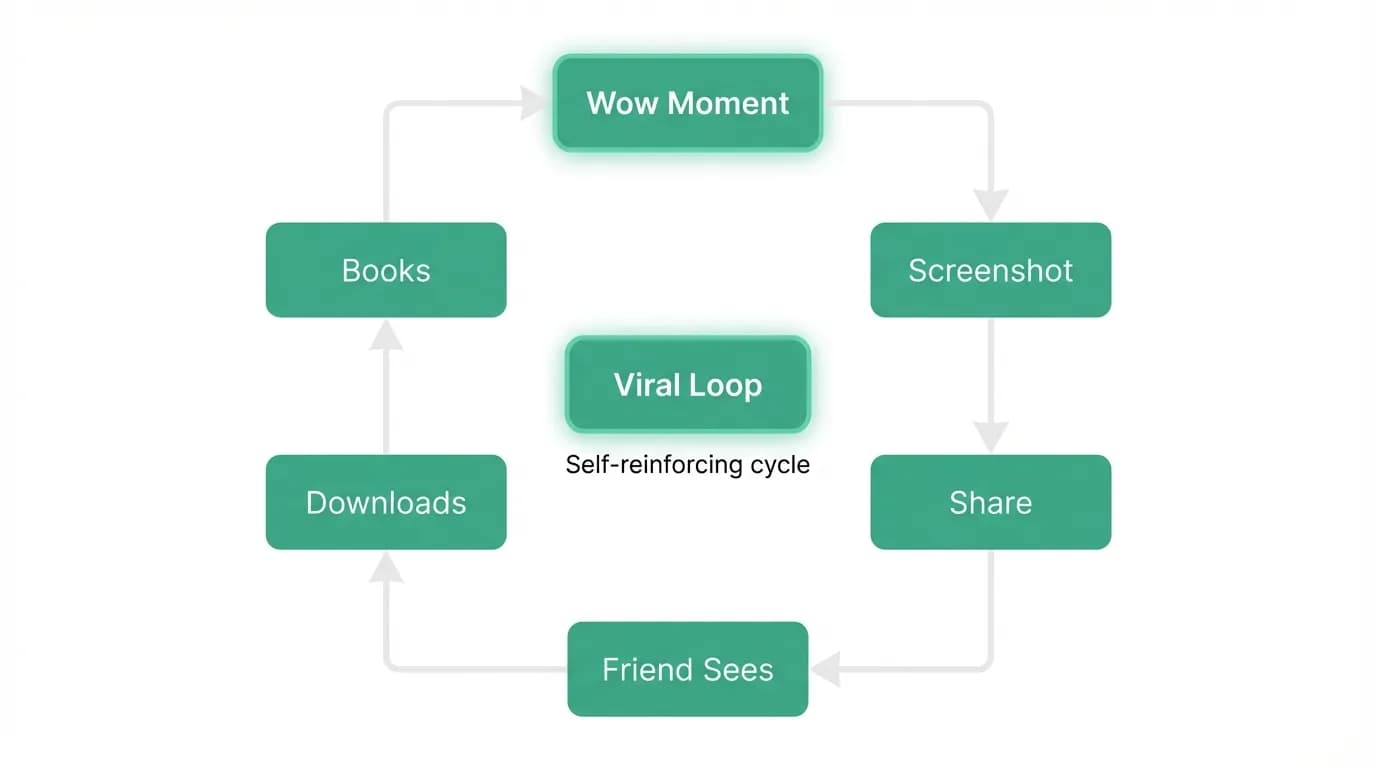
The compounding effect matters. One user shares with five friends. One of those friends signs up. That new user books a trip, has a wow moment, and shares with their five friends. One of those signs up. The loop repeats. This is slow growth compared to paid acquisition, but it is dramatically cheaper and the users it produces are higher quality (they come with a personal recommendation and a built-in referral relationship).
Referral mechanics: amplifying natural sharing
We have natural virality. The question is whether to amplify it with formal referral mechanics, and if so, how.
Our approach is to amplify without distorting. We do not want users sharing because of an incentive. We want users sharing because the product is worth sharing. The incentive is a thank-you, not a motivation.
What this looks like in practice:
Easy sharing, always available. Every booking confirmation, every itinerary, every tool result has a share button. The shared content is formatted to look great in any messaging app. No friction between "I want to show my friend this" and actually doing it.
Referral credit, not referral pressure. When a referred user signs up and books their first trip, the referrer gets a travel credit. We do not plaster "REFER A FRIEND FOR $20!" banners across the app. The referral program exists for users who are already sharing. It rewards behavior that would happen anyway.
Social proof in the product. "Your friend Alex booked their London trip through Nowah" is a gentle nudge to a user who was referred by Alex and has not yet booked. It uses existing social relationships rather than manufactured urgency.
Group travel as natural referral. When a user starts planning a group trip, the other travelers need to be in the app to input their preferences. This is a natural onboarding moment. The referrer is not selling the app. They are saying "join this trip" and the app comes along with it.
We deliberately avoided aggressive referral tactics: no mandatory sharing screens, no "invite 5 friends to unlock features," no gamified referral leaderboards. These tactics optimize for referral quantity but degrade referral quality. A friend who was spam-invited arrives with negative sentiment. A friend who received a genuine screenshot arrives with curiosity and trust.
The product-led growth advantage
Product-led growth (PLG) is the thesis that product quality drives growth more sustainably than marketing spend. For AI travel, this thesis is strong.
Here is why. Paid acquisition for travel apps is expensive. The major OTAs spend billions annually on Google Ads, and customer acquisition costs have been rising every year as the auction gets more competitive. Acquiring a travel app user through paid channels costs $15-30. Acquiring that same user through organic referral costs effectively nothing.
But the deeper advantage is user quality. Users who arrive through referral have:
- 40% higher first-month retention than users from paid channels
- 2x higher booking rate in their first 30 days
- 50% higher lifetime value
These users are pre-qualified. They arrive knowing what the product does (their friend showed them) and expecting it to be good (their friend recommended it). They skip the skepticism phase and go straight to exploration. Their time-to-first-booking is shorter because they already trust the product.
For an AI travel product, PLG is especially powerful because the product improves with usage. Every new user adds to the feedback loop (as I wrote about in the AI feedback loop article). Every booking generates data that makes the AI better. Growth driven by product quality creates a flywheel: better product attracts more users, more users make the product better, which attracts more users.
Marketing-driven growth does not create this flywheel. A user acquired through a Google Ad is no more likely to improve the product than to churn after one session. A user acquired through referral is pre-selected for engagement because someone who actually uses the product vouched for it.
The viral coefficient and the patience required
Let me be honest about the math. Natural virality is not going to produce hockey-stick growth overnight.
Our current viral coefficient is around 0.3. For every 10 users, about 3 new users arrive through referral within 90 days. A viral coefficient above 1.0 produces exponential growth. Below 1.0 produces linear growth supplemented by organic referral. We are in the supplemented zone, not the exponential zone.
That is fine. A 0.3 viral coefficient means that for every 100 users we acquire through any channel, we get 30 additional users for free. Over a year, with compounding, that 30% bonus becomes more significant. And as the product improves and the wow moments get stronger, the coefficient climbs.
The patience required for PLG is its biggest disadvantage and its biggest advantage. The disadvantage is that growth is slow in the early stages. You do not get the instant scale of a big paid campaign. The advantage is that the growth is durable. Users who arrive through referral stay. The base grows steadily. And one day, the viral coefficient crosses 1.0, and the growth curve inflects.
We are playing the long game. Every product improvement makes the wow moment more powerful. Every powerful wow moment generates more shares. Every share brings a new user who becomes a potential referrer. The loop turns slowly at first. Then it turns faster.
Building for shareability
If I had to distill our referral strategy into one principle, it would be this: build a product so good that users feel compelled to show other people.
Not tell. Show. There is a difference. "You should try this travel app" is telling. It is weak. It gets ignored. "Look at this" with a screenshot of an AI conversation that booked a complete trip in two minutes is showing. It is strong. It gets attention.
Everything about the product, the visual design, the conversation format, the card layouts, the dark theme, the AI's personality, is built with shareability in mind. Not as a growth hack but as a design constraint. If it would not look good in a screenshot, it probably does not look good in the app either.
The best referral programs do not feel like referral programs. They feel like a natural extension of using a product that you genuinely enjoy. You share it because you want to, not because a popup asked you to. When the product is the marketing, the growth takes care of itself.
We are not there yet. Our viral coefficient is below 1.0. Our user base is still small. But the pattern is clear: users share because the product surprises them. Shared experiences bring new users. New users have their own surprise moments. The loop turns. And with each turn, the product gets a little better and the story gets a little more compelling.
That is the referral loop for AI travel. Not an incentive scheme. A product strategy.
Nowah is an AI travel agent that searches and books real flights and hotels through conversation — no filters, no thirty open tabs. Plan your next trip.