The Trillion-Dollar Unsolved Problem: Why Travel Booking Is Broken
Despite $1.8 trillion in annual travel spend, the booking experience has barely improved in 20 years. AI is the technology that finally fixes it.

The global travel industry generates roughly $1.8 trillion in bookings every year. That is trillion with a T. It is one of the largest consumer spending categories on the planet, bigger than the global music, film, and video game industries combined.
And the buying experience is terrible.
Not "could be better" terrible. Systematically, structurally, measurably terrible. The data says so. The user research says so. And if you have booked a trip in the last five years, your own experience says so.
Despite two decades of investment by some of the most well-funded technology companies in the world, despite billions spent on product development, marketing, and infrastructure, the fundamental experience of booking travel has barely improved since the early 2000s. The websites are faster. The mobile apps exist. But the core interaction model, you search, you scroll, you compare, you agonize, you give up or grudgingly book something, has not changed.
This is the trillion-dollar unsolved problem. And we believe AI is the technology that finally solves it.
The OTA model was revolutionary in 2001 and largely unchanged since
Let me give credit where it is due. When Expedia launched in 1996 and Booking.com followed shortly after, they did something remarkable. They took an industry that ran on phone calls, fax machines, and physical travel agent offices, and they put it online. Suddenly you could search for flights from your living room. You could compare hotel prices without calling ten front desks. You could book at midnight in your pajamas.
That was a genuine revolution. It democratized access to travel inventory and introduced price transparency to a market that had been opaque.
But here is the thing: the core product built in the early 2000s is essentially the same product that exists today. The search form is the same. Origin, destination, dates, travelers. The results page is the same. A list of options sorted by some default, with filters on the side. The checkout flow is the same. Select, review, enter details, pay, confirm.
The pixels have moved around. The design got more polished. The algorithms behind the sort order got more sophisticated. But the paradigm is identical. You, the user, do the work of searching, comparing, filtering, evaluating, and deciding. The platform provides the inventory and the tools. The labor is yours.
In 2001, this was acceptable because the alternative was calling a travel agent during business hours. In 2026, it is absurd. We have AI that can hold a conversation, understand context, remember preferences, and take actions on your behalf. And the industry is still asking you to fill out a search form.
The data on broken booking
The numbers paint a damning picture.
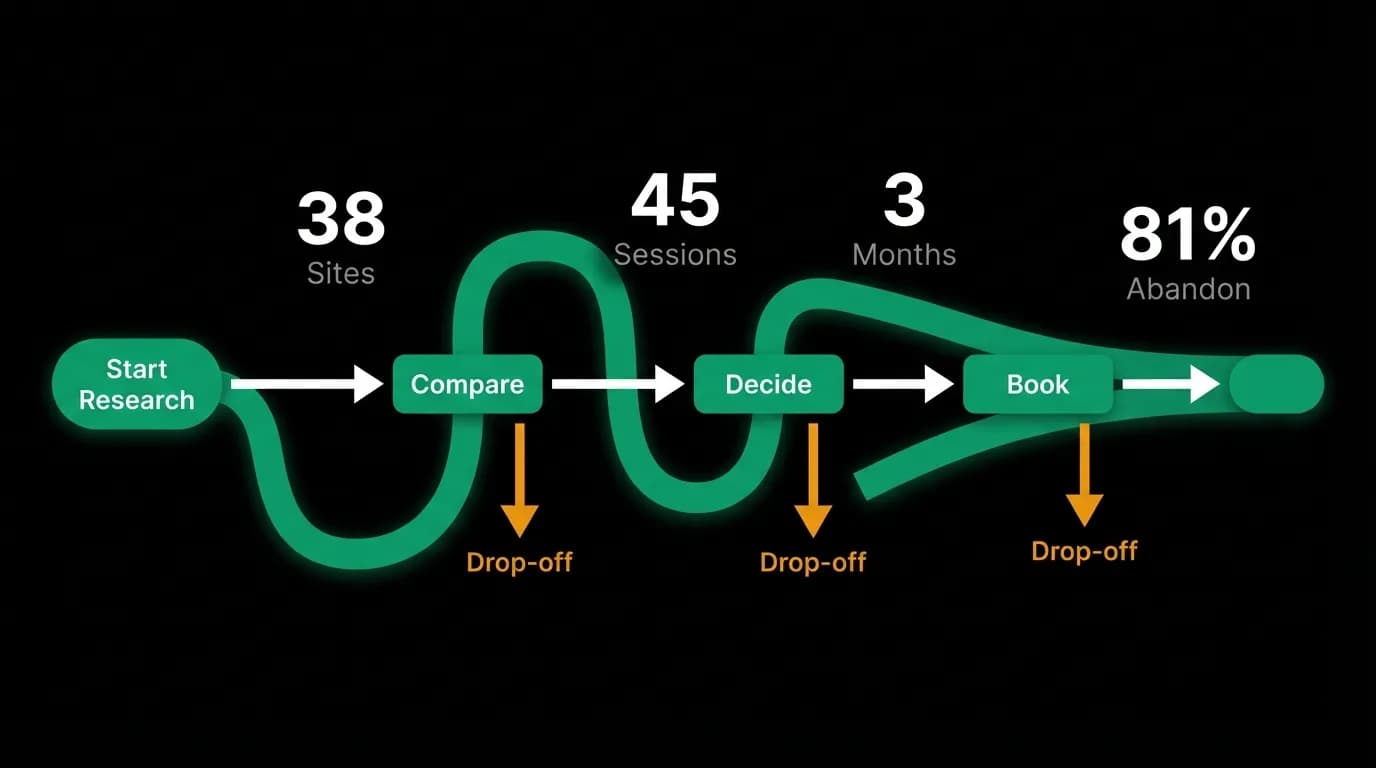
The average traveler visits approximately many websites before making a single booking. Thirty-eight. Not 38 pages on one website. Thirty-eight different websites. Google Flights. Kayak. Expedia. The airline's site. Booking.com. Airbnb. A review site. A travel blog. A Reddit thread. Repeat, in various combinations, for weeks.
Those visits translate to roughly 45 or more touchpoints spread over two to three months. The booking journey for a typical vacation starts months before the trip and involves dozens of separate research sessions. Most of those sessions end without a booking. The user gathers information, loses track of it, gathers more, loses track again.
Online travel bookings now represent about 65% of total travel bookings and are growing at roughly 8% annually. So most people are booking online. They just hate the process.
OTA conversion rates tell the story from the supply side. In the low single digits of visitors to a major OTA actually complete a booking. That means 95-98% of people who show up looking to buy travel leave without buying anything. In any other industry, a low-single-digit conversion rate would be considered a crisis. In travel, it has been the norm for so long that people accept it as natural.
Cart abandonment is the final data point. For travel, the cart abandonment rate runs between 81% and 87%. These are not window shoppers. These are people who found a flight or hotel they liked, started the checkout process, and then left. They wanted to buy. The product failed to close the sale.
More technology made it worse
Here is the counterintuitive part: the technological improvements of the last two decades actually made the booking experience harder, not easier.
In 2005, you might compare flights on two or three websites. By 2015, you could compare flights on twenty. Metasearch engines like Kayak and Skyscanner aggregated results from multiple OTAs, which sounds helpful but actually multiplied the number of options without helping you choose between them. Instead of 50 flight options, you had 500. Instead of three price points for the same route, you had thirty.
More data did not create better decisions. It created paralysis. Barry Schwartz described this as the paradox of choice: beyond a certain point, additional options reduce satisfaction and increase anxiety. Travel crossed that threshold a long time ago.
Mobile apps added a new surface but did not fix the underlying problem. Expedia's mobile app is a smaller version of Expedia's website. Google Flights' mobile app is a smaller version of Google Flights' website. The same search forms, the same results lists, the same filter-and-sort paradigm, just on a smaller screen where it is even harder to compare options.
Review aggregation sites like TripAdvisor added valuable user-generated content but also added another layer of research to the already overloaded journey. Now you are not just comparing prices and schedules. You are reading hundreds of reviews, trying to calibrate whether the person who wrote "terrible hotel, avoid" has the same standards as you.
Each individual technology improvement was rational. More options are better, right? More information is better, right? More devices to access it from are better, right? But in aggregate, they compounded the information overload problem without addressing the fundamental issue: the user is doing all the work.
Why previous attempts to fix it failed
The industry has tried to fix the booking experience multiple times. None of the attempts addressed the root cause.
Metasearch was supposed to simplify comparison by aggregating results across OTAs. Kayak, Skyscanner, Google Flights. They made price comparison easier, which is genuine value. But they still dump you into a list of hundreds of results. And when you click on an option, most metasearch engines redirect you to a different website to complete the booking. The comparison is centralized. The booking is fragmented. The user still does the work.
Mobile apps were supposed to make booking more convenient. And they did, in the sense that you can now endure the same frustrating search-and-scroll experience while standing in line at the grocery store. The interface adapted to the screen size. The paradigm did not adapt to the medium.
Recommendation engines tried to personalize results. "Based on your past searches..." or "Travelers like you also booked..." These are marginally helpful but fundamentally limited by the collaborative filtering approach. They know what groups of users tend to do. They do not know what you specifically want. There is a difference between "people who searched for Tokyo also searched for Kyoto" and "you mentioned wanting a quiet neighborhood near good ramen shops."
Chatbots were the first wave of AI in travel. Expedia, Booking.com, and others added chatbots to their platforms. But these were FAQ engines dressed in a conversational interface. They could answer questions about baggage policies and check-in times. They could not search for flights, compare options, or book anything. They were a new front door to the same old building.
Each of these attempts failed because they tried to make the existing paradigm better rather than replacing it with something fundamentally different. More efficient search is still search. Better recommendations within a list is still a list. A chatbot on top of a search engine is still a search engine.
What AI changes: intelligence, not just information
The problem with travel booking has never been a lack of information. There is too much information. The problem is a lack of intelligence. The user has access to hundreds of flights, thousands of hotels, millions of reviews, and no one to help them make sense of it all.
This is exactly what AI agents solve. Not by providing more information, but by applying intelligence to the information that already exists.
When you tell an AI travel agent "I want to go somewhere warm in March, not too touristy, good food, under $2,000 for the whole trip including flights and hotel," the agent does something no search engine can do. It understands the intent behind the request, including the subjective parts ("not too touristy," "good food"). It searches across multiple categories simultaneously (flights and hotels, not one then the other). It applies constraints and preferences to filter from thousands of options to a few. And it presents curated results that actually match what you asked for.
An AI travel agent does not show you 500 flights and say "good luck." It says "here are three flights that work with your schedule and budget, and here is why I picked each one." It does not show you a map with 200 hotel pins and say "start clicking." It says "based on what you told me and what I know about your preferences, these three hotels are your best options, and here is how they compare."
The difference is not incremental. It is a category shift from information delivery (the OTA model) to intelligent assistance (the agent model). The user goes from doing the work to making decisions. The AI does the work. That sounds like a small distinction, but it changes the entire experience.
The market opportunity in numbers
The scale of this opportunity is hard to overstate.
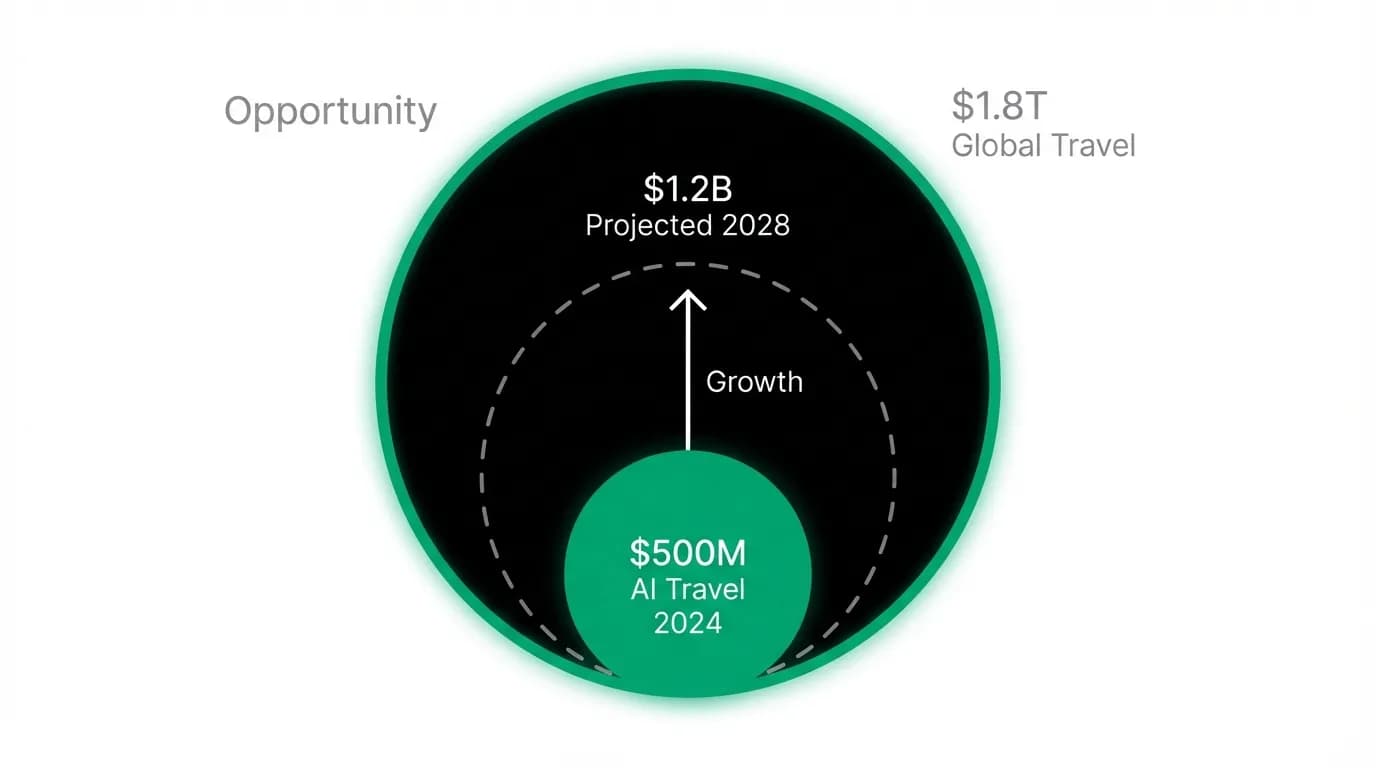
The global travel market generates approximately $1.8 trillion in annual bookings. Online bookings represent about 65% of that, roughly $1.17 trillion. This number grows at about 8% per year as more markets shift online.
The AI-in-travel market segment is projected to grow from roughly $500 million in 2024 to over $1.2 billion by 2028. But that projection likely underestimates the opportunity because it is based on AI as an add-on to existing platforms, not AI as the platform.
Even a small market share of online travel bookings is massive in absolute terms. One percent of $1.17 trillion is $11.7 billion. For a startup, capturing even a fraction of that is transformational.
The revenue model is straightforward. AI travel booking follows the same commission structure as OTAs (roughly 10-15% of the booking value for flights and hotels). The economics improve because AI-first platforms have higher conversion rates (the product works better, so more people buy), lower acquisition costs (the product generates organic growth through word-of-mouth), and higher lifetime value (memory-driven personalization creates retention).
The market is also structurally ready for disruption. Incumbent OTAs are constrained by their existing business models (which depend on showing many options with sponsored placements) and their existing technology (which is built around the search-and-browse paradigm). They cannot easily pivot to an AI-first model because it would cannibalize their current revenue. This creates the classic innovator's dilemma.
Why the fix comes from startups, not incumbents
Expedia has 20,000 employees. Booking Holdings has 22,000. Google's travel division has some of the best engineers in the world. If the fix were easy, they would have built it already.
The constraint is not talent or resources. It is organizational inertia and business model dependency.
Expedia's business model depends on showing users many results with paid placements. Hotels bid for position in the results list. Airlines pay for preferred placement. This advertising revenue subsidizes Expedia's commission rates and marketing spend. An AI agent that presents three curated options eliminates the surface area for paid placements. Expedia cannot move to the AI-first model without replacing a significant revenue stream.
Booking.com's innovation engine is its A/B testing machine. The company runs thousands of experiments on its listing pages, optimizing conversion through urgency signals, social proof, and design tweaks. This optimization expertise is built on the assumption that the listing page exists. An AI-first approach that replaces the listing page with a conversation makes all of that optimization infrastructure irrelevant.
Google has the strongest AI capabilities of any company in travel. But Google Flights is a search product, and search advertising is Google's business. An AI agent that eliminates search in favor of conversation eliminates the search ads that fund Google. Google will be very careful about how aggressively it replaces search with AI in travel, and that caution creates a window for startups.
This is the innovator's dilemma in textbook form. The incumbents cannot move to the better model because the better model undermines their current business. The startup has no current business to protect. The startup can build the right product from day one.
History supports this pattern. The original OTAs disrupted travel agents not because they were better funded (they were not) but because travel agents could not offer the convenience of online booking without making their own storefronts obsolete. The next disruption follows the same logic: incumbents cannot offer AI-first booking without making their own search-and-browse platforms obsolete.
The AI-native future of travel
Here is what we believe the travel booking experience should look like, and what we are building toward.
You open an app. You say what you want. "My partner and I want to do a week in Italy in September. We like history, good food, and we don't want to be somewhere too crowded. Budget is around $4,000 for the whole trip."
The AI, which knows your travel history, your preferences, your dietary needs, and your past trip reviews, processes this against live flight and hotel inventory. It suggests a specific itinerary: fly into Rome, spend three days there, train to a smaller Tuscan town for four days, fly home from Florence. It presents flight options, hotel options for each city, and a rough daily plan. The total is within budget.
You have questions. "Is September still really hot in Rome?" The AI answers with actual weather data. "What is that Tuscan town like?" The AI gives you a concise description based on real information, not marketing copy. "Can we do a cooking class?" The AI finds options and incorporates them into the itinerary.
You approve. The AI books the flights, books the hotels, and creates a trip itinerary in the app. Before the trip, it reminds you about weather, suggests packing, checks your passport, and flags the Borghese Gallery because it requires advance reservation. During the trip, it tracks your flights, suggests restaurants near your hotel, and converts menu prices to your currency. After the trip, it saves a summary and references the experience in future conversations.
That is what a trillion-dollar experience should feel like. Not many websites over three months. A conversation over ten minutes, with an intelligent agent that handles the complexity so you can focus on the excitement.
The technology exists. The data infrastructure exists. The consumer behavior (comfort with AI, preference for mobile, expectation of conversational interfaces) exists. The market opportunity exists.
The only thing that has been missing is a product built from the ground up for this model, rather than a chatbot bolted onto the old one. That is what we are building. And we think the trillion-dollar problem finally has its answer.
Nowah is an AI travel agent that searches and books real flights and hotels through conversation — no filters, no thirty open tabs. Plan your next trip.