What We Aim to Ship by 2027: Our Long-Term Product Vision
Where AI travel booking is headed — multi-modal travel, predictive trips, the convergence of planning and content, and the agent that knows you better than you do.
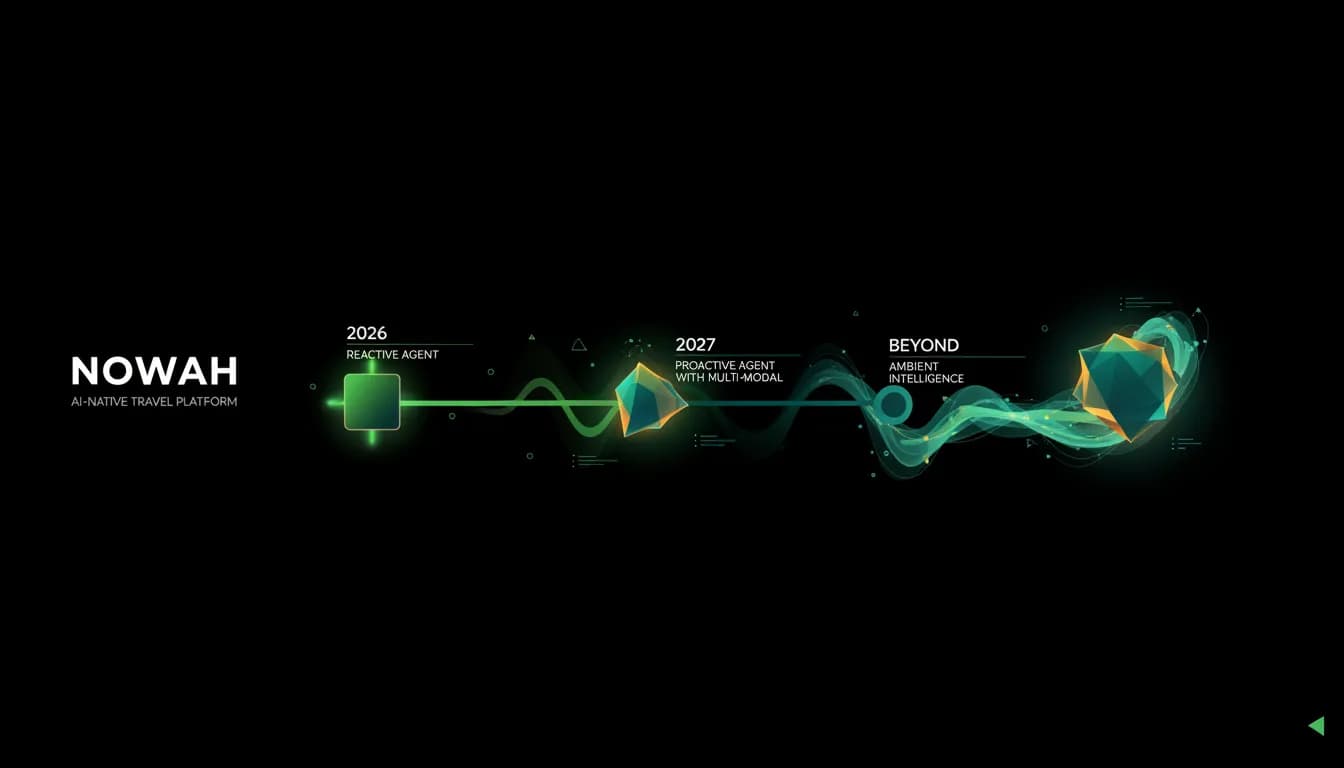
A traveler opened the app to a notification they did not expect: "There is a food festival in Lisbon the week of your anniversary. Direct flights are available at a good price. Would you like me to plan a trip?" The traveler had never searched for Lisbon. They had never mentioned a food festival. But the agent knew they loved Portuguese cuisine from past trip conversations, knew their anniversary date from their profile, and had detected the festival through its content monitoring. The suggestion was perfect.
This is the future we are building toward: an AI travel agent that does not wait to be asked.
Multi-modal travel
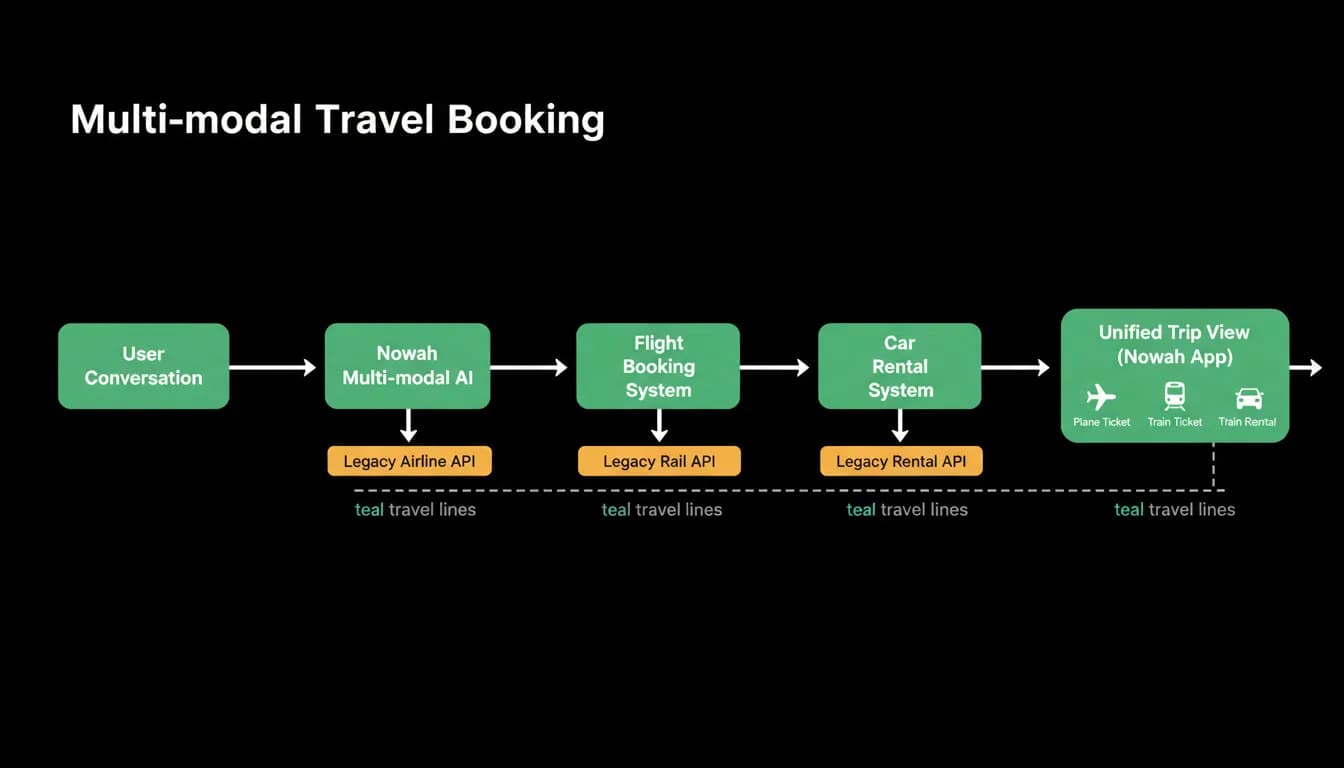
Today, booking a trip that involves a flight, a train, and a rental car requires three separate transactions, often on three separate platforms. The traveler is the integration layer, manually connecting the pieces and ensuring the timing works.
Multi-modal travel unifies these transactions into a single conversation and a single trip. The traveler says "I need to get to a conference in a small town in the Swiss Alps" and the agent plans the full journey: a flight to Zurich, a train to the nearest station, and a car rental for the final stretch. The connections are timed. The booking is unified. The trip view shows the entire journey as a continuous itinerary.
Building multi-modal travel requires integrating new categories of travel data providers beyond flights and hotels. Rail networks, car rental platforms, ferry services, and ground transportation APIs each have their own booking systems, pricing models, and inventory management. Unifying these into a single agent conversation is an integration challenge that we will solve incrementally, starting with the most common multi-modal combinations.
Predictive travel
The current agent is reactive. It waits for a traveler to initiate a conversation and responds to their request. The future agent is predictive. It anticipates travel needs based on patterns, context, and external signals.
Predictive travel builds on the memory system that already stores traveler preferences across sessions. Today, that memory captures what a traveler likes: aisle seats, boutique hotels, morning flights. Tomorrow, that memory will model travel behavior patterns: how often they travel, what triggers trip planning, which destinations interest them, and when they typically start planning.
Combined with external signals, like events, weather patterns, price movements, and holiday calendars, the predictive agent can suggest trips that the traveler would love but has not yet considered. The suggestion is not random. It is a reasoned recommendation built on deep knowledge of the individual traveler and the current travel landscape.
The prediction must be right more often than it is wrong. A bad suggestion is worse than no suggestion because it signals that the agent does not actually understand the traveler. We will launch predictive features gradually, starting with high-confidence suggestions based on strong behavioral signals and expanding as the prediction models prove their accuracy.
The convergence of content and commerce
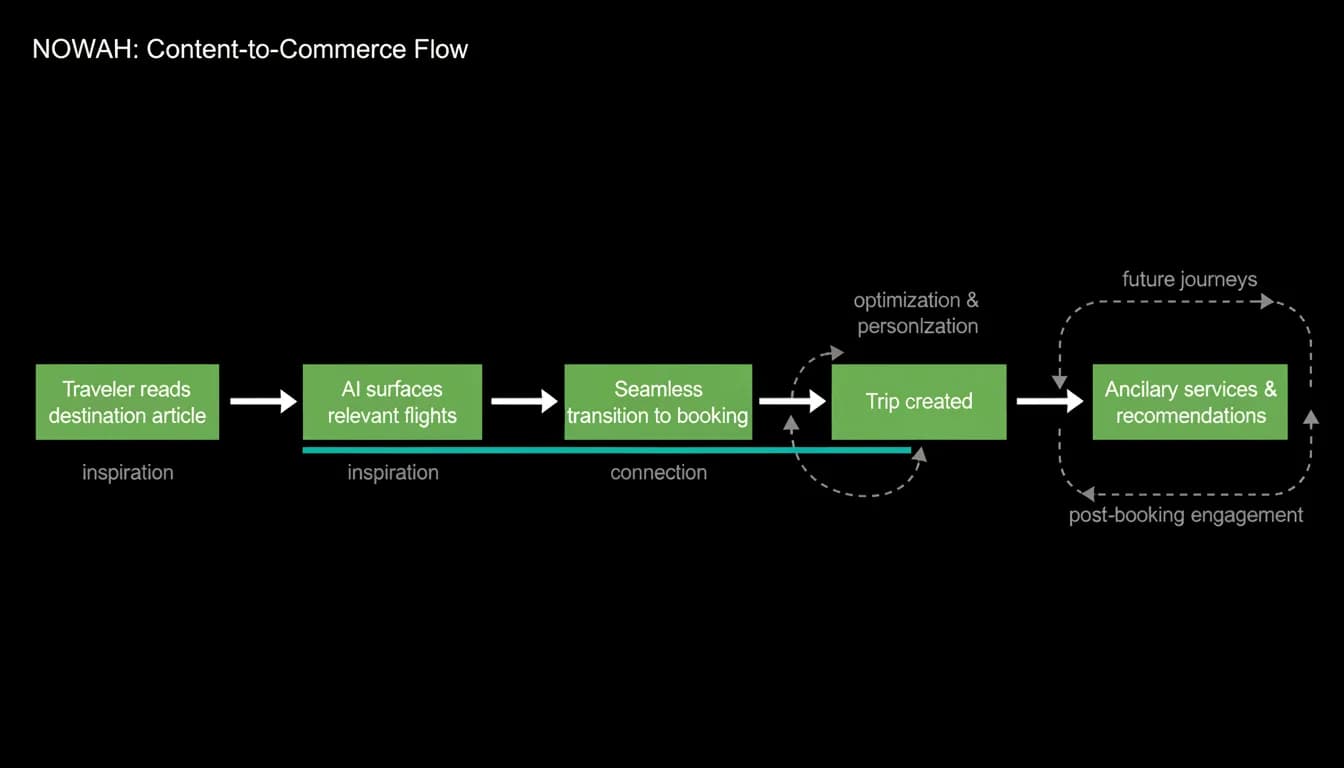
Today, travel inspiration and travel booking are separate activities. A traveler reads a destination article, gets inspired, and then opens a separate app to search for flights. The inspiration and the transaction are disconnected.
We are building toward a world where content flows directly into commerce. A traveler reads about a hidden beach in Portugal. The article seamlessly transitions to "want to go? Here are flights next month." The agent provides real-time pricing, availability, and booking capability within the content experience. The gap between "I want to go there" and "I have a flight booked" shrinks to seconds.
This convergence works in both directions. Booking data flows back into content recommendations. A traveler who just booked a trip to Tokyo receives content about things to do in Tokyo: restaurant recommendations, neighborhood guides, cultural tips. The content enhances the trip that the booking made possible.
Ambient intelligence
The proactive trip management features we are building now are the foundation for ambient intelligence: an AI that manages travel as a background process in the traveler's life.
Ambient intelligence means the agent monitors upcoming trips, adjusts for changes, handles administrative tasks, and surfaces information without being explicitly asked. The traveler's boarding pass updates automatically. Check-in happens without opening the app. Weather disruptions are addressed before the traveler notices them. The trip is managed, not just booked.
The target for 2027 is an agent that handles 80 percent of travel decisions with minimal human input. Not because we want to remove human agency, but because most travel decisions are routine and can be handled better by an AI with perfect memory and tireless attention. The traveler's time and attention are reserved for the decisions that actually benefit from human judgment: where to go, who to travel with, and what to experience.
The social layer
Travel is inherently social, and the platform will increasingly reflect that. Group planning, shared itineraries, and travel communities built around the agent are all part of the 2027 vision.
Shared itineraries let travelers collaborate on trip plans in real time, with the agent facilitating group decisions. Travel communities connect travelers with similar interests, enabling recommendations that go beyond algorithmic suggestions to include peer experiences.
The social layer also creates a content feedback loop. Travelers share their experiences, which become data that improves recommendations for future travelers. A restaurant that every returning traveler raves about gets surfaced more prominently. A hotel that travelers consistently rate below expectations gets deprioritized. The platform gets smarter from every trip.
What this means for travelers
The 2027 vision is not about technology. It is about what the technology enables for the people who use it.
Travel becomes effortless. Not effortless because it is simple, but effortless because the complexity is handled by an AI that is better at logistics than any human. The traveler focuses on the experience. The agent handles everything else.
Travel becomes personal. The agent that has planned twenty trips with you knows you better than any travel advisor. It knows your preferences, your budget patterns, your scheduling constraints, and the experiences that made you happiest. Every recommendation is calibrated to you specifically, not to a demographic segment.
Travel becomes continuous. Instead of discrete events that require explicit planning, travel becomes an ongoing relationship with an agent that is always watching for opportunities, always managing logistics, and always ready when you are.
This is what we are building. Not a better booking tool. Not a smarter search engine. A travel companion that makes the entire experience of exploring the world feel natural, personal, and joyful. The technology we ship in 2027 will be the closest anyone has come to having a world-class travel agent who works just for you, available whenever you need them, and smart enough to help even when you do not know you need it yet.
Nowah is an AI travel agent that searches and books real flights and hotels through conversation — no filters, no thirty open tabs. Plan your next trip.