Why We Are Not a ChatGPT Plugin (and What We Are Instead)
Positioning Nowah as a full-stack travel platform, not a thin wrapper — the depth of integration required for reliable booking and why chat wrappers fail.
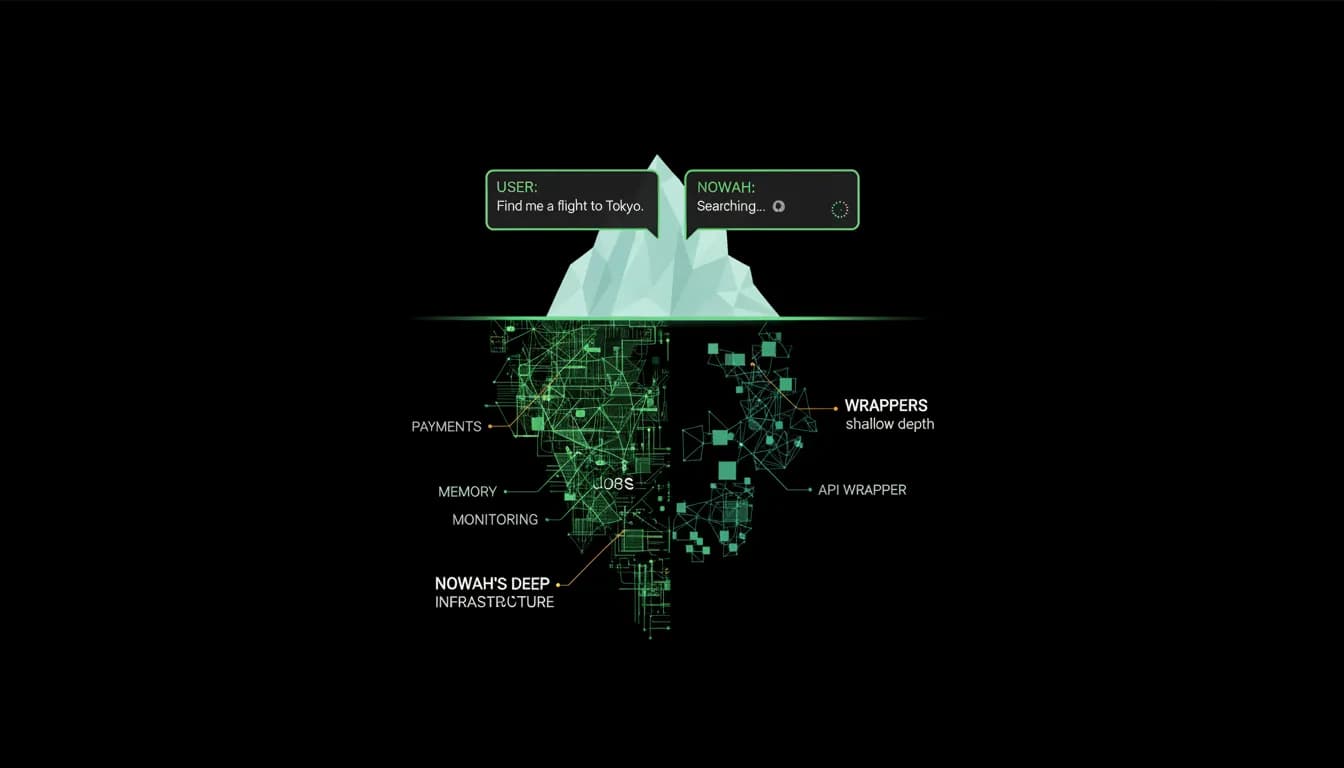
The question comes up in every investor meeting, every press interview, and every casual conversation about what we do. "So, is this like a ChatGPT plugin for flights?" The answer is no, and the distinction matters more than most people realize.
A plugin translates natural language into API calls. We built a full-stack travel platform with an AI agent at the center. The difference between these two things is the difference between a doorbell camera and a security system. They look similar from the outside. One of them actually works when something goes wrong.
What chat wrappers are
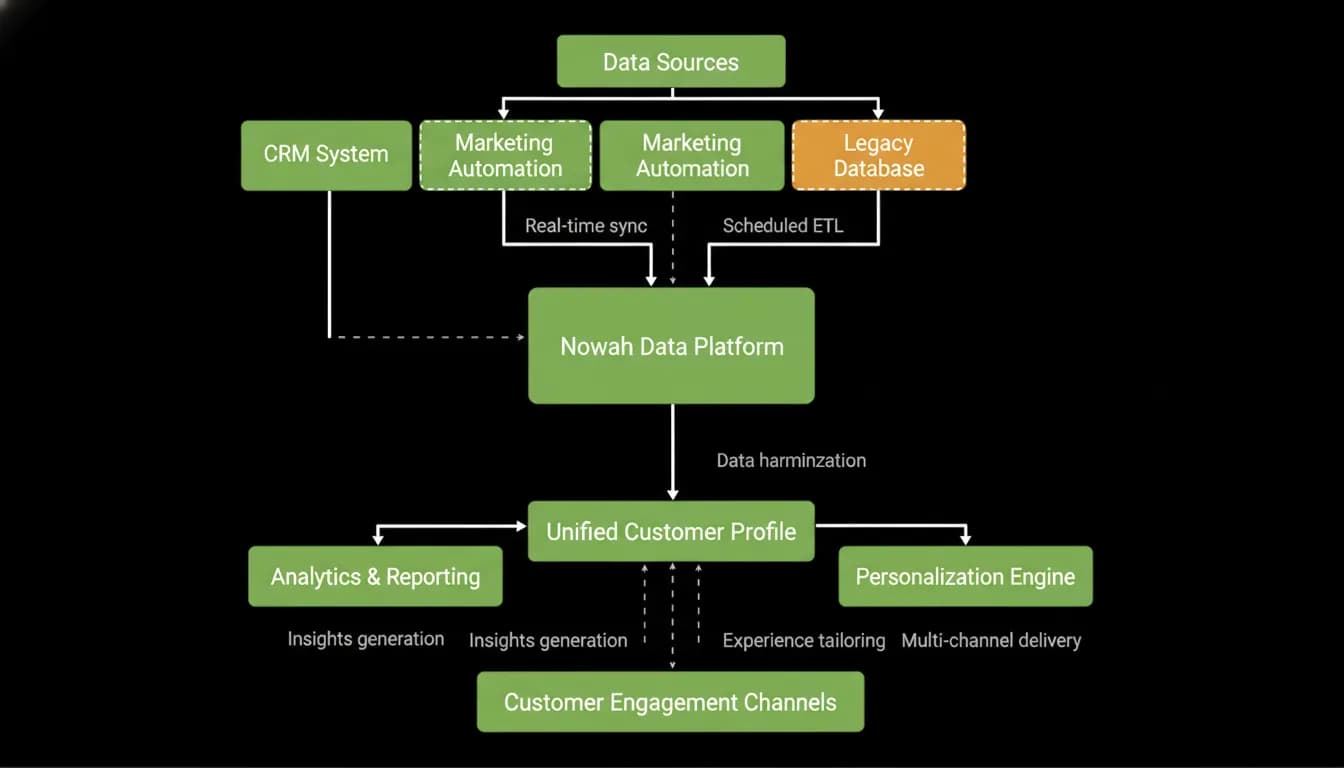
A chat wrapper takes natural language input from a user, translates it into a structured API call to a travel data provider, and displays the results conversationally. At its core, it is a natural language interface on top of someone else's search engine.
Chat wrappers are fast to build. A competent developer can create one in a weekend. Connect a language model to a flight search API, write a model instructions that instructs the model to extract travel parameters from user messages, and format the API responses into readable text. The demo is impressive. A user types "find me a flight to London" and the wrapper returns flight options in a conversational format.
The demo breaks at the transactional layer. When the user says "book it," the wrapper has a problem. It does not have payment processing infrastructure. It does not have booking confirmation flows. It does not have idempotency protection against duplicate charges. It does not have rollback procedures for failed bookings. It does not have post-booking management for changes and cancellations. The moment the interaction moves from advisory to transactional, the wrapper reveals its limits.
What full-stack means
Full-stack means we own the entire experience from conversation to confirmation to post-booking management, and everything in between.
The booking infrastructure includes a multi-layer idempotency checks that prevents duplicate charges even during network failures. The first layer generates a unique identifier for each booking attempt. The second layer uses the payment processor's own duplicate-prevention mechanism. The third layer verifies the booking with the travel data provider before marking it complete. These three layers overlap to ensure that no edge case can produce a duplicate charge. This system cannot exist in a plugin architecture because plugins do not control the payment and booking infrastructure.
Payment processing is deeply integrated with 3D Secure support, currency conversion, refund handling, and dispute management. The payment flow is not a redirect to a third-party checkout page. It is a native experience within the conversation, designed for conversational confirmation rather than form-based checkout.
Trip management extends the relationship beyond the booking. Travelers can view upcoming trips, access documents, receive real-time status updates, and modify bookings through the same conversational interface they used to book. A plugin that can search flights cannot manage a trip after the flight is booked.
Background processing handles asynchronous tasks that require ongoing infrastructure. Seven worker queues process booking confirmations, email delivery, push notification dispatch, flight status monitoring, analytics aggregation, and document management. These workers run continuously whether or not a traveler is actively conversing with the agent. Plugins have no concept of background processing.
Persistent memory maintains traveler preferences across sessions and conversations. The agent that remembers you prefer aisle seats and boutique hotels is using a memory system that stores and retrieves preference data independently of any single conversation. Plugins are stateless between invocations. They start from zero every time.
The reliability gap
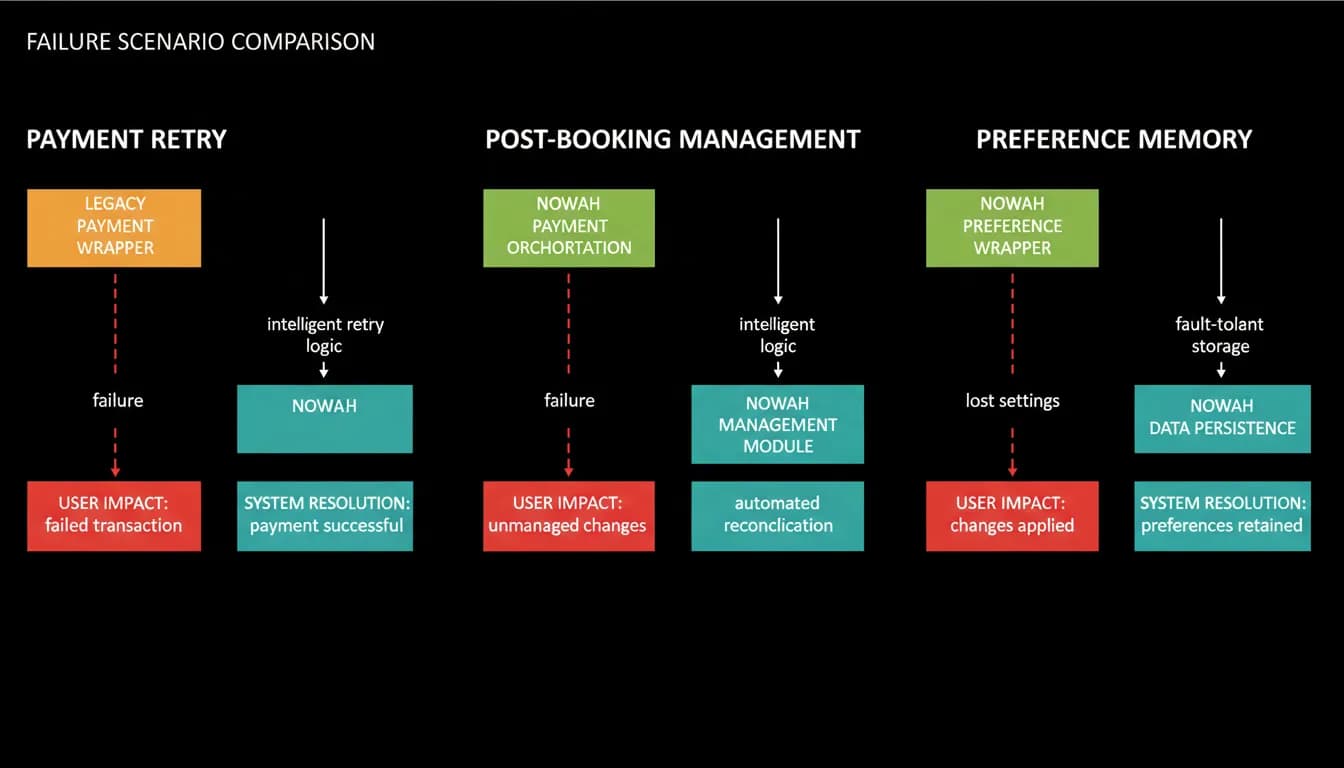
The reliability gap between a wrapper and a full-stack platform shows most clearly in failure scenarios.
When a payment fails during a wrapper-mediated booking, the wrapper has no mechanism to retry, investigate, or resolve the failure. The user sees an error. The wrapper suggests trying again. If the payment went through but the confirmation was lost, the wrapper has no way to check. The user is left wondering whether they were charged.
When a payment fails during a full-stack booking, the idempotency system ensures that retrying does not produce a duplicate charge. The booking attempt is tracked. The payment status is verified with the processor. The booking confirmation is verified with the provider. The traveler receives a definitive outcome: either the booking succeeded, or it did not, with no ambiguity.
Post-booking scenarios expose the gap further. A traveler needs to change their flight. A wrapper cannot change a booking it did not create through its own infrastructure. A full-stack platform can access the booking record, initiate a change with the provider, process the fare difference, and update the traveler's itinerary. The wrapper's capability ends at search. The platform's capability extends through the full travel lifecycle.
The depth of our stack
The agent that powers the conversational interface is not a thin translation layer. It is an eighty-one-kilobyte file containing over seventy tool definitions, each with domain-specific logic, error handling, retry behavior, and provider adaptation.
Each tool is purpose-built for its function. The flight search tool does not just forward parameters to an API. It normalizes dates across time zones, validates airport codes, handles multi-city routing, and processes the provider's response into a format optimized for the agent's ranking system. The booking tool does not just create a reservation. It manages payment authorization, provider confirmation, notification dispatch, and record creation in a coordinated transaction.
The seven background workers handle operations that would be impossible in a plugin architecture. Booking confirmation workers ensure that every booking is verified with the provider and the payment processor. Notification workers deliver real-time updates to travelers across push, email, and in-app channels. Status monitoring workers poll flight information and detect changes that affect the traveler's itinerary.
The memory system persists across sessions, creating a personalization layer that deepens with every interaction. A new traveler's first conversation starts with general search. Their tenth conversation starts with the agent already knowing their airline preferences, seat selections, hotel style, and budget patterns. This accumulated knowledge makes every subsequent interaction faster and more relevant.
Why plugins hit a ceiling
The ceiling for plugins is the boundary of the chat interface's session. Everything a plugin can do must happen within the context of a single interaction. There is no background processing. There is no persistent state. There is no payment infrastructure. There is no booking management.
This ceiling means that plugins can never handle the full travel lifecycle. They can assist with search and recommendation. They cannot handle booking, payment, confirmation, modification, cancellation, status monitoring, or trip management. They are inherently advisory, not transactional.
Some argue that plugins will get better as the underlying platforms add more capabilities. This is true in theory but limited in practice. The platform's architecture determines what plugins can access. If the platform does not offer payment processing as a plugin capability, no amount of plugin improvement can add it. The plugin is constrained by the platform it runs on.
What we are instead
We are a platform that happens to have a conversational interface, not a chat interface with travel bolted on. The distinction determines architecture, capability, reliability, and ultimately the traveler's experience.
The conversational interface is the surface. The full-stack platform is the substance. The agent's intelligence, the booking infrastructure, the payment processing, the trip management, the background workers, and the persistent memory are what make the surface work reliably.
When someone asks "is this like a ChatGPT plugin for flights?" we explain: it is like asking whether a hospital is a first-aid kit. They address similar problems. The depth of what they can handle is incomparable.
Nowah is an AI travel agent that searches and books real flights and hotels through conversation — no filters, no thirty open tabs. Plan your next trip.