Accessibility as AI Advantage: How AI Enables Inclusive Travel
Voice replaces typing for motor impairments. AI summarization aids cognitive accessibility. Natural language replaces complex forms. AI makes travel more accessible than any UI ever could.

Accessibility in most products is a retrofit. The team builds the interface, then adds screen reader labels, increases touch target sizes, and checks contrast ratios. Important work, but it treats accessibility as a layer on top of the core experience rather than a feature of the core experience.
AI flips this. When the product is a conversation, many of the barriers that traditional interfaces create simply do not exist. There is no form to navigate. There is no filter panel to find. There is no 12-step checkout flow to complete. You speak or type what you want, and the AI handles the complexity.
This is not an accessibility feature. It is the product. And it happens to be more accessible than any form-based travel app could be, even with perfect compliance.
Voice-first for motor impairments
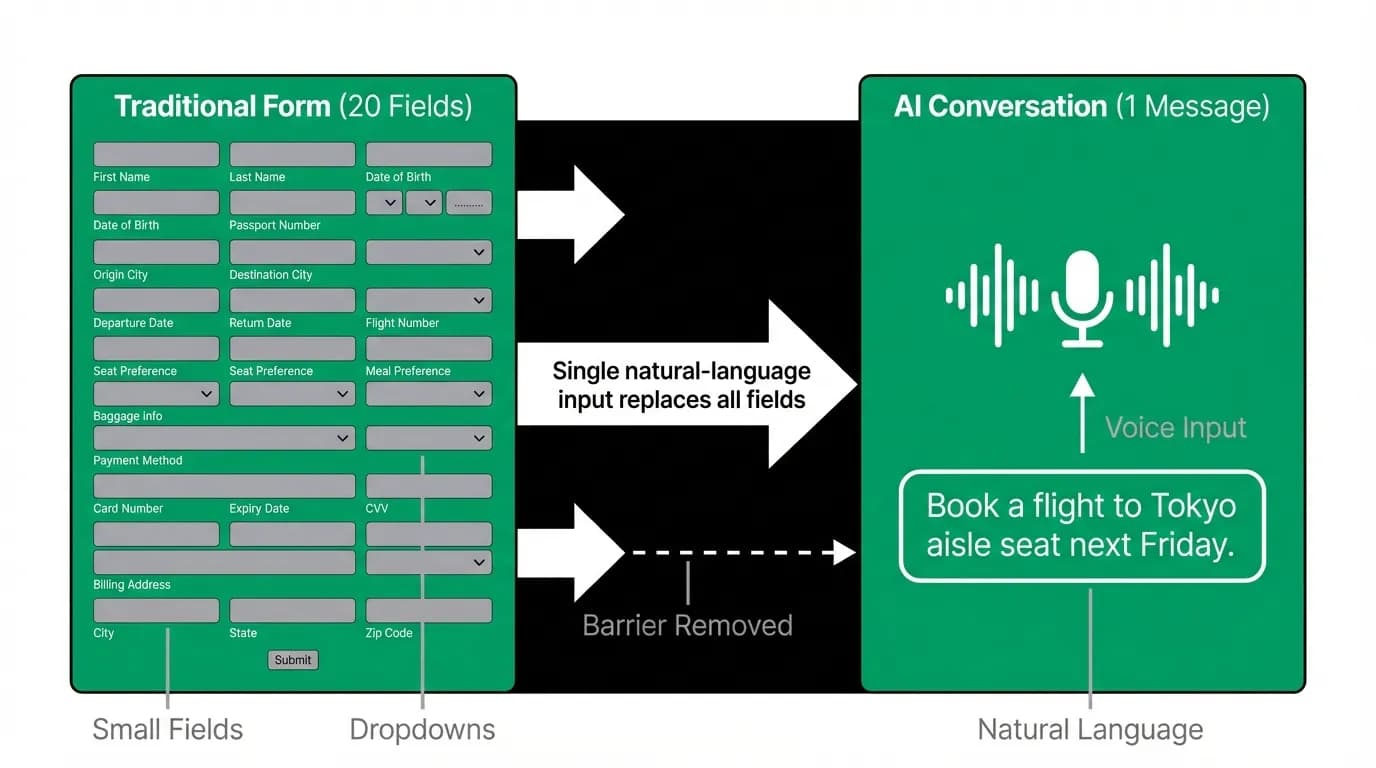
For users with motor impairments that make touchscreen interaction difficult, voice input is transformative. Instead of tapping small targets, swiping through carousels, and typing on a phone keyboard, the user speaks.
"Find me a flight to Barcelona next Friday, aisle seat, under five hundred dollars."
That single sentence replaces a dozen interactions in a traditional interface: opening the search form, selecting the origin airport, typing the destination, opening the date picker, selecting the date, choosing the cabin class, entering a price filter, selecting the stops filter, and searching. Each of those interactions requires a precise tap or gesture. The voice command requires speech.
Our voice input is a primary interaction mode, not an afterthought. The microphone button is always visible and accessible. The transcription appears in the conversation. The AI processes voice input identically to text input. There is no feature gap between voice and keyboard users.
AI summarization for cognitive accessibility
Complex information is a barrier for users with cognitive disabilities. Fare rules, cancellation policies, booking terms, and itinerary details are often presented as dense paragraphs of text or sprawling tables that require significant cognitive processing.
The AI can summarize. A 500-word cancellation policy becomes: "Free cancellation until March 10. After that, you pay a $75 fee." Two sentences. The essential information. Nothing extraneous.
This summarization benefits users with cognitive disabilities, learning disabilities, attention deficits, and anyone who is cognitively impaired by jet lag, stress, or fatigue. It also benefits every other user. Clear, concise information is universally better.
The AI goes further by contextualizing summaries to the user's situation. Instead of presenting a generic cancellation policy, the AI says: "You can cancel this booking for free because your trip is more than 48 hours away." The policy is not just summarized. It is applied to the user's specific context, eliminating the cognitive work of figuring out how the policy affects them.
Natural language over complex forms
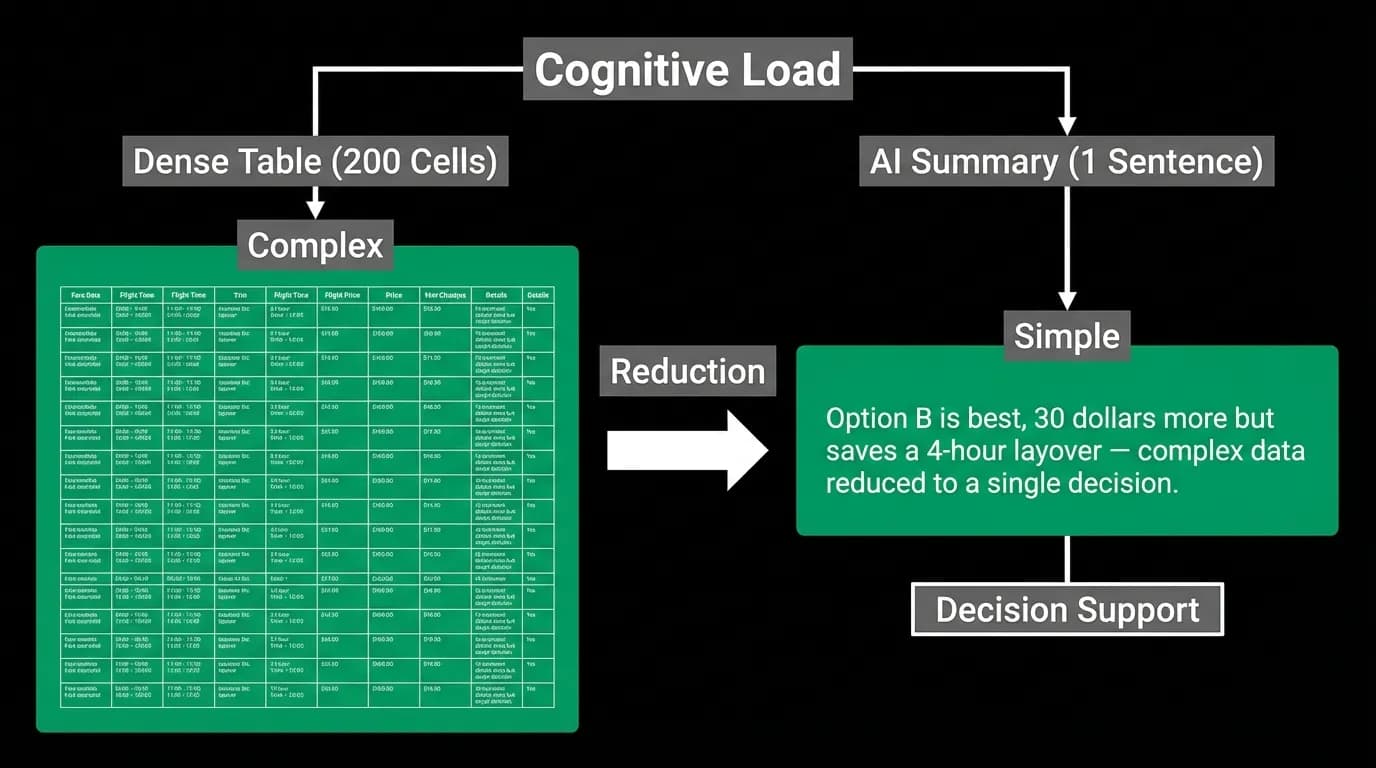
Traditional travel booking forms are multi-field gauntlets. Origin, destination, departure date, return date, number of adults, number of children, cabin class, direct flights only, flexible dates, preferred airlines. Some forms have twenty or more fields.
Each field is a potential barrier. Date pickers require visual coordination. Dropdown menus require precise taps. Number steppers require multiple interactions. The cumulative cognitive and motor load is substantial.
Natural language replaces all of it. "Two adults and a child to Barcelona, second week of April, economy, nonstops if possible." One message replaces six form fields. The AI parses the natural language into the structured parameters that the underlying search needs. The user never interacts with a form.
This benefits users with motor impairments (fewer precise interactions), cognitive disabilities (no form navigation), visual impairments (no layout to parse), and again, every other user. Natural language is more efficient for everyone.
Real-time adaptation
The AI can adjust its response complexity based on user needs. If a user consistently requests simpler explanations or uses shorter messages, the AI can infer a preference for concise communication and adapt accordingly.
For users who specify accessibility needs, the AI can adjust explicitly. More structured responses for screen reader users. Simpler vocabulary for users who request it. More frequent check-ins for users who need guidance through complex flows.
This adaptability is impossible in a static interface. A form is the same form for every user. An AI conversation adapts to each user's communication style and needs.
Translation: breaking language barriers
Travel inherently involves crossing language boundaries. A Japanese-speaking user booking a hotel in France needs information presented in their language, not the hotel's operating language.
AI handles this naturally. The conversation happens in the user's language. The AI translates hotel names, amenity descriptions, and location information contextually. The user experiences the entire booking process in their language, regardless of the destination.
With support for numerous languages, this translation capability makes travel booking accessible to users who previously faced language barriers on English-dominant booking platforms.
Reduced motion for vestibular disorders
Users with vestibular disorders can experience nausea, dizziness, or disorientation from screen animations. Our reduced motion mode replaces all animations with instant transitions. Cards appear rather than sliding in. Loading indicators are static rather than pulsing. Tab changes are instant rather than cross-fading.
The reduced motion mode is not a degraded experience. It is a different experience optimized for users who are better served by stillness. All information is the same. All functionality is the same. The motion is simply removed.
Design for accessibility first
The pattern is consistent: features designed for accessibility benefit all users. Voice input designed for motor impairments is also faster for busy users. Summarization designed for cognitive accessibility is also clearer for everyone. Natural language designed to replace complex forms is also more efficient for all users.
AI-first design is inherently more accessible than form-based design. Not because of accessibility features bolted on after the fact, but because the core interaction model, conversation, is more accessible than the core interaction model it replaces, forms.
When you design the conversation well, accessibility comes not as a feature but as a consequence.
Nowah is an AI travel agent that searches and books real flights and hotels through conversation — no filters, no thirty open tabs. Plan your next trip.