How Agentic Memory Makes Nowah Smarter Every Trip
Traditional travel apps forget you exist between sessions. Our AI agent builds a persistent model of your preferences that compounds over time.

I've booked flights on Google Flights probably fifty times. Every single time, it asks me for my origin airport. I live in New York. I have always lived in New York. Google knows this — it knows where I am, where I've been, what I've searched. But when I open Google Flights, it starts from zero. Blank form. Origin field empty.
Expedia is the same. I have a loyalty account. I've booked twenty trips. They know my name, my email, my credit card. But when I search for a hotel, the results aren't noticeably different from what anyone else would see. Maybe there's a "recommended for you" section that's slightly personalized, but it's doing collaborative filtering — "users who booked this also booked that" — not individual personalization.
Every traditional travel platform has session-based amnesia. Each visit starts from scratch. Your past interactions, your preferences, your travel patterns — none of it compounds into a better experience over time.
At Nowah, we built an agentic memory system that changes this fundamentally. The AI agent remembers you. Not just your name and email, but your actual travel preferences, your past experiences, and the patterns in how you travel. And it gets better at helping you with every trip.
What agentic memory actually means
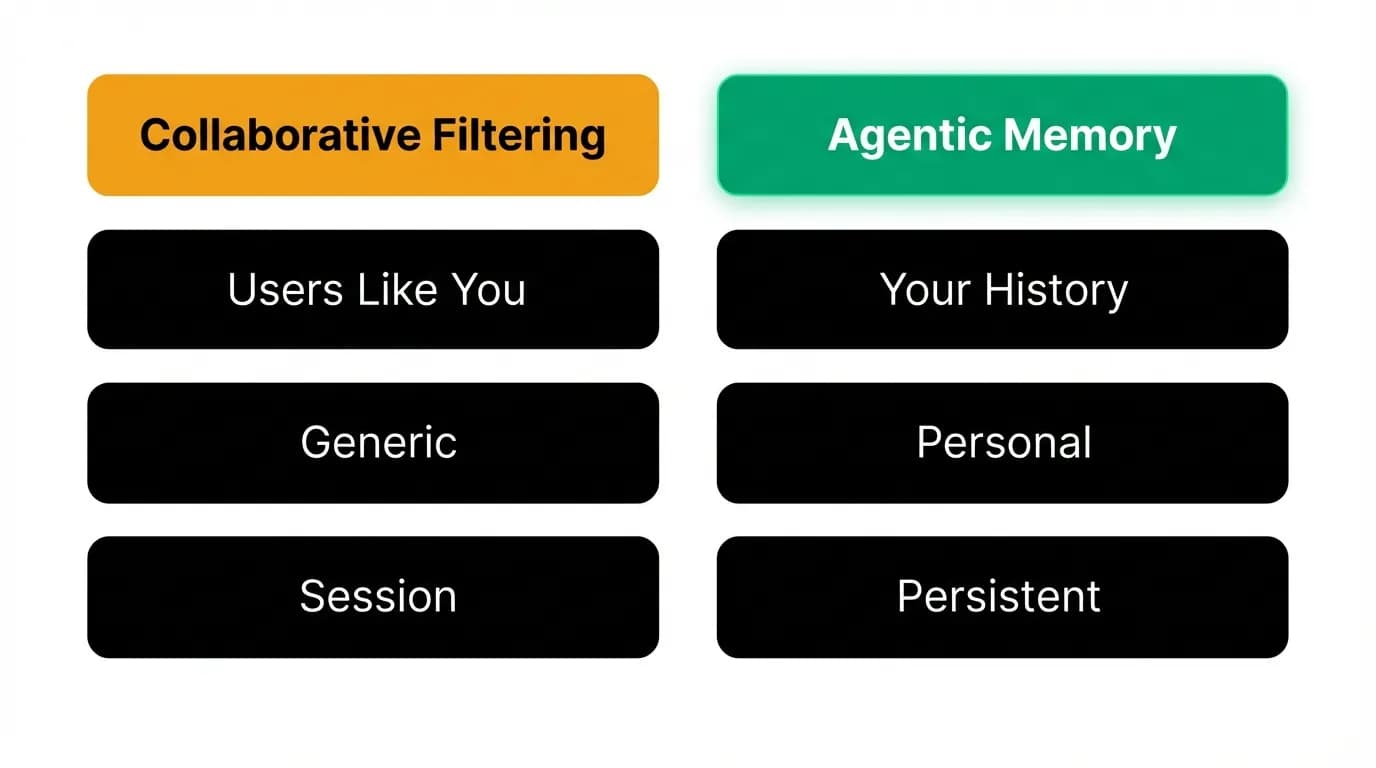
When I say "agentic memory," I mean something specific and different from what most apps call personalization.
Traditional personalization is collaborative filtering. Netflix recommends shows based on what other people with similar viewing patterns enjoyed. Amazon suggests products based on what people who bought the same things as you also bought. It's "users like you tend to like this."
Agentic memory is individual knowledge. It's not about users like you. It's about you, specifically. The agent remembers that you prefer aisle seats because you're tall and need legroom. It remembers that you stayed at the Riad Dar Anika in Marrakech last April and told it the location was perfect but the Wi-Fi was terrible. It remembers that you always fly out on Fridays when possible and that you've mentioned you hate connections through Miami International.
This is a fundamentally different data model. Collaborative filtering says "travelers who book economy to Tokyo tend to prefer hotels in Shinjuku." Agentic memory says "you specifically told me you want to stay near Shibuya because your friend lives there." The distinction matters because travel is deeply personal. Two people on the same flight to the same city for the same dates might have completely different needs. One is going for work and needs a quiet hotel near the convention center. The other is on a honeymoon and wants a boutique place with character. Collaborative filtering can't distinguish between them reliably. Individual memory can.
Individual knowledge vs. collaborative filtering
Let me make this concrete. Here's what the agent knows about a hypothetical user named Sarah after five trips:
She always books window seats. She prefers morning flights. She'll accept one connection but not two. She checks one bag and one carry-on. She likes boutique hotels over chains. She doesn't eat seafood. She travels with her partner who has a mild peanut allergy. She prefers Airbnb for trips longer than five days. Her passport expires in November 2027. She gets anxious about tight layovers — anything under 90 minutes makes her uncomfortable.
None of that comes from collaborative filtering. All of it comes from conversations Sarah had with the agent over five bookings. Some she stated explicitly ("I hate tight layovers"). Some the agent inferred from patterns ("you've selected morning flights on four of your five trips — should I prioritize morning departures?"). Some came from trip feedback ("you mentioned the hotel was too far from the city center last time").
Now when Sarah says "plan a trip to Lisbon for me and Jake in October," the agent already knows most of what it needs. It searches for morning window-seat-available flights with layovers over 90 minutes. It finds boutique hotels with good reviews and no peanut-allergy concerns. It schedules a dinner reservation at a restaurant with strong non-seafood options. It checks that Sarah's passport has sufficient validity for Portugal.
It does all of this without asking. Sarah didn't have to re-state any preferences. The agent just knows.
Compare that to Expedia, where Sarah would fill out the same form, get the same results page, and manually apply the same filters she applies every single time.
The compounding advantage
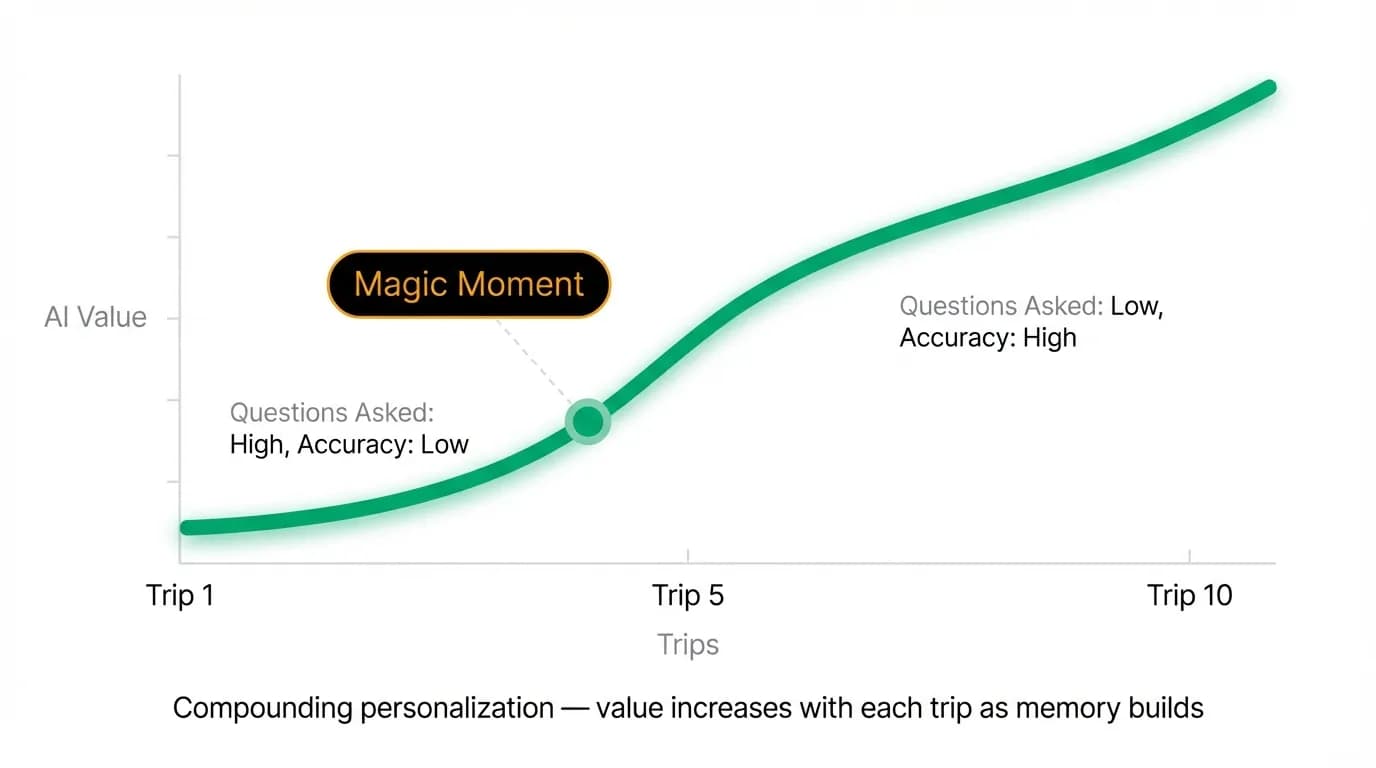
The first time you use Nowah, the experience is good but not magical. The agent doesn't know you yet. It asks more questions. It offers more generic recommendations. It's operating on general knowledge about travel rather than specific knowledge about you.
By the third or fourth trip, things start to change. The agent asks fewer questions because it already knows many of the answers. The options it presents align more closely with what you actually want. Conversations get shorter and more efficient. By the fifth trip, the experience is qualitatively different. The agent might open with "I noticed you usually take a long weekend in the fall — want me to start looking at options?" It pre-fills constraints you didn't state. It avoids airlines and hotel chains you've expressed dissatisfaction with. It remembers that you mentioned wanting to visit Japan someday and proactively flags a deal when one appears.
Personalized recommendations convert at two to five times the rate of generic results. That multiplier applies on each booking, but it also compounds across bookings. Each successful trip builds the user's trust that the agent knows them, which increases their willingness to accept recommendations, which generates more signal for the agent to learn from.
This is the compounding advantage. The product gets better for each individual user the more they use it. And that curve never plateaus because there's always more to learn — new destinations, changing preferences, life events that shift travel patterns.
Privacy-first memory design
Any system that remembers personal information needs to handle privacy carefully. We think about this a lot.
The user controls what the agent remembers. You can ask the agent what it knows about you at any time, and it'll tell you. You can tell it to forget specific things — "forget that I mentioned my salary" or "stop assuming I want budget options." You can wipe the entire memory if you want to start fresh.
The agent doesn't remember things it shouldn't. Financial details like credit card numbers aren't stored in the preference model. Sensitive medical information is handled with explicit consent. The agent distinguishes between preferences (useful to remember) and transient context (not useful to store permanently).
There's also a distinction between what the agent infers and what you state explicitly. If the agent notices you've booked business class three times in a row and starts recommending business class by default, you can correct it. "I only fly business for work trips — for personal travel I want economy." The agent updates its model accordingly.
About 80% of travelers cite price as their top factor, but roughly 55% say they'd pay more for convenience. That gap between stated and revealed preferences is exactly what agentic memory navigates well. Over time, the agent learns not just what you say you want, but what you actually choose — and it can calibrate its recommendations to match your real behavior, not just your stated preferences.
How Booking.com's Genius tiers miss the point
Booking.com's loyalty program, Genius, gives frequent bookers access to discounted rates and perks. Stay more, pay less. It's a transaction — your loyalty in exchange for a lower price.
What it doesn't do is learn anything about how you travel. A Genius Level 3 member with fifty bookings gets the same search results as a brand new user, just at a slightly lower price. The platform knows you're a frequent traveler but not what kind of frequent traveler you are. Your preference for sea-view rooms, your dislike of hotel chains with buffet breakfasts, your habit of always booking a late checkout — none of that is captured or applied.
Loyalty discounts are not personalization. They're a pricing strategy. The difference between "here's 10% off because you're a repeat customer" and "here's the exact hotel you'd love based on everything I know about your taste" is the difference between a loyalty program and an intelligent agent.
Users who book via app have a roughly 30% higher repeat booking rate compared to web. Part of that is convenience, but part of it is that apps have more surface area for personalization — push notifications, saved preferences, easier login. Agentic memory takes that further. It makes the app not just convenient but genuinely personalized in a way that makes switching to another service feel like starting over.
Memory as switching cost
This brings us to what might be the most important strategic implication of agentic memory. Once you've built a preference history with Nowah — once the agent knows how you travel, what you like, what you avoid, where you've been, where you want to go — leaving means abandoning all of that accumulated knowledge.
Switching to Expedia or Google Flights means going back to blank forms. Back to applying the same filters every time. Back to results that don't know you prefer morning flights or hate tight connections or always want a hotel with a gym.
This isn't a dark pattern. We're not making it hard to leave. We're making it genuinely better to stay because the product improves with use. The switching cost is the loss of personalization, which is a real cost the user would feel.
Each conversation adds to the agent's persistent model. A throwaway comment — "I wish they'd had better coffee at that hotel" — becomes a data point that slightly adjusts future hotel rankings toward properties with highly-rated coffee or cafe amenities. Over months and years, thousands of these micro-observations build a remarkably detailed understanding of how you travel.
No traditional travel platform has this. They have your booking history. They might have your loyalty tier. But they don't have a working model of your preferences that improves with every interaction.
That model is what makes the fifth booking feel like a different product from the first. And it's why we believe agentic memory isn't just a feature of our product — it's the foundation of the entire experience.
Nowah is an AI travel agent that searches and books real flights and hotels through conversation — no filters, no thirty open tabs. Plan your next trip.