Beyond Price: Why Cheap Flights Are Not All Travelers Want
Price is the default sort because legacy UIs cannot express other value. AI presents convenience, comfort, and timing alongside cost for smarter choices.

Open any flight search engine. What's the default sort? Price, lowest first. Always. On Google Flights, Kayak, Expedia, Skyscanner, every single one. The cheapest flight sits at the top, and everything below is organized by ascending cost.
This default tells a story about how the industry thinks about travelers. It assumes price is the primary decision variable. It assumes that given 300 flights, users want to see the cheapest one first. It assumes that the best sorting dimension for a list of options is the one that's easiest to compute and display.
Here's the problem: about 80% of travelers cite price as a top factor, but roughly 55% say they'd pay more for convenience or certainty. Those numbers aren't contradictory. They reveal that price is the default because the interface doesn't know how to express anything else, not because travelers don't value anything else.
AI changes this. Instead of sorting by one dimension, it can present options across multiple value dimensions simultaneously. "This flight costs $50 more but saves you four hours and avoids the layover in Dallas." That sentence communicates multi-dimensional value in a way no sort dropdown ever could.
Price as default sort is a UI limitation
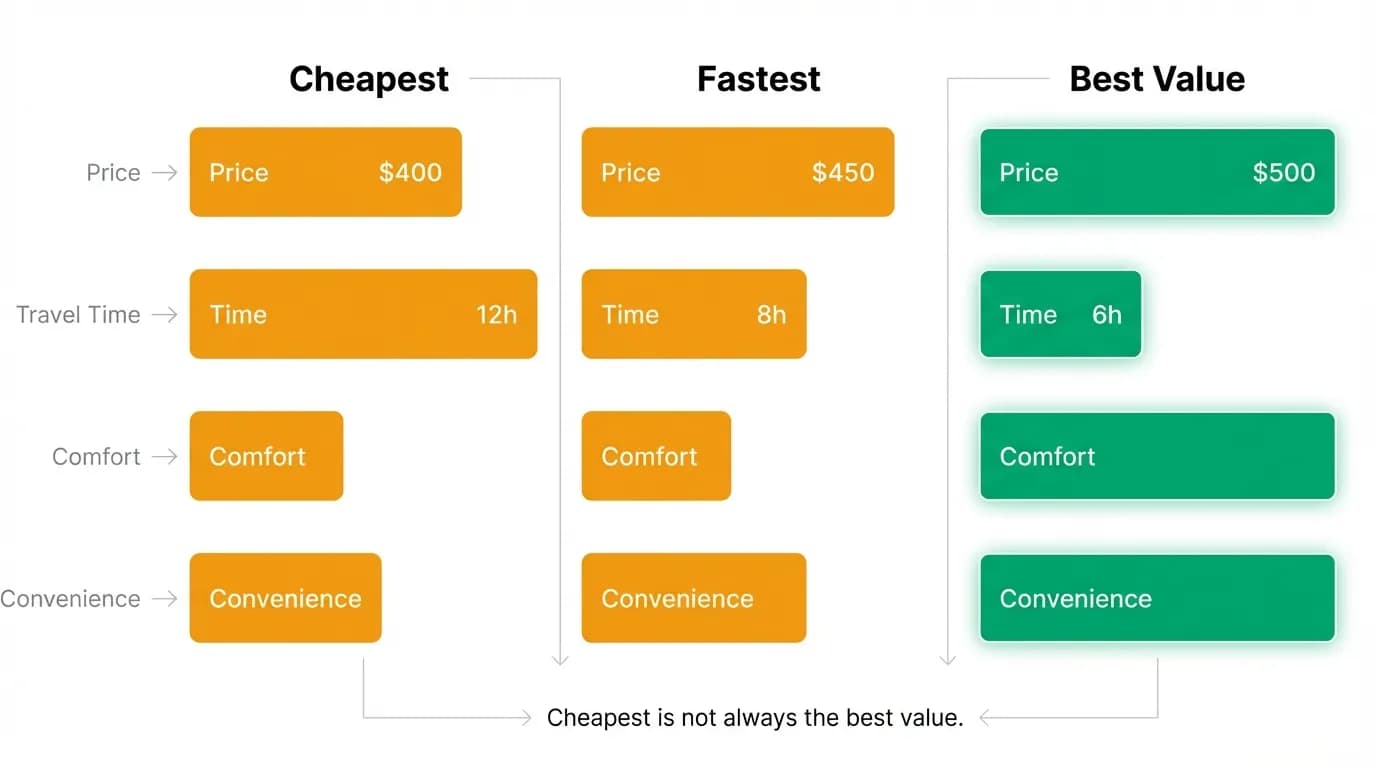
Why is price the default? Not because product designers sat down and concluded that price is the most important factor for all travelers in all situations. It's the default because price is the easiest value to display, compare, and sort.
Price is a number. Numbers sort cleanly. You can show them in a column, rank them low to high, and the user instantly understands the ordering. Try doing the same thing with "convenience." What number do you assign to "your layover is at a nice airport with a lounge"? How do you quantify "you arrive at a reasonable hour instead of 11 PM"? How do you sort by "this airline has better legroom in economy"?
These dimensions of value are real. They matter to travelers. But they resist quantification. And because legacy UIs are built on structured data, sorted lists, and numerical comparison, they default to the dimension that works best in that format: price.
The result is that the entire travel shopping experience is organized around saving money, even when the user would happily spend a bit more for a meaningfully better experience. The UI has trained travelers to focus on price because price is all the UI can effectively communicate.
What travelers actually value
When you talk to people about how they choose flights, a much richer picture emerges than "cheapest wins."
Timing matters. An 11 AM departure versus a 5 AM departure is worth real money to most people. Nobody wants to wake up at 3 AM to get to the airport, even if it saves $60. But on a price-sorted results page, that 5 AM flight sits proudly at the top, inviting you to destroy your morning.
Connections matter, but not in the binary way filters present them. "Nonstop" versus "1 stop" misses the nuance. A 90-minute connection through a comfortable airport with lounge access is qualitatively different from a 90-minute connection at a small regional airport with no food options. Both show up as "1 stop" in the filter.
Airline quality matters. There is a meaningful difference in the experience of flying a full-service carrier versus an ultra-low-cost carrier, even in economy. Seat pitch, baggage policies, in-flight service, on-time performance. These differences are invisible in a price-sorted list but very visible at 35,000 feet.
Total trip impact matters. A flight that arrives at midnight means a taxi to the hotel instead of public transport. A flight that arrives at 4 PM means you have an evening in the city. The flight price doesn't capture these downstream effects.
Stress and uncertainty matter. Some people would pay $100 extra for the peace of mind of a nonstop flight. Not because the connection is logistically unworkable, but because the anxiety of potentially missing a connection degrades their experience.
The false savings problem
The most insidious consequence of price-first sorting is what I call the false savings problem.
A traveler sees two options. Flight A: $400 nonstop, arrives at 2 PM. Flight B: $340 with a connection, arrives at 10 PM. Flight B is $60 cheaper and sits higher in the results. The traveler picks Flight B.
Now add the hidden costs. Flight B's late arrival means a $45 taxi instead of a $15 train (public transport stops at 11 PM). The traveler loses an evening at the destination, which for a short trip represents a significant percentage of their total vacation time. The connection adds two hours of airport waiting and the stress of a tight transfer. The traveler arrives tired and irritated instead of refreshed and excited.
The "savings" of $60 evaporated. The traveler actually spent more money, lost time, and had a worse experience. But the OTA counts this as a conversion success because the cheaper flight was booked.
This happens constantly. Price-sorted results systematically steer travelers toward options that are cheap in ticket price but expensive in total experience. The interface can't calculate the total cost because it doesn't know about taxis, lost time, or stress. It only knows the number on the ticket.
How AI presents value
An AI agent doesn't sort by price. It curates by value.
When you tell the AI "find me flights to Rome next month," it doesn't return a list sorted by ticket price. It presents three options, each optimized for a different value dimension.
Option one might be the best value: reasonable price, convenient timing, no connection. "This is $450, nonstop, arriving at 3 PM. It's $120 below the average price for this route."
Option two might be the cheapest: lower price but with trade-offs clearly stated. "This is $380, but it connects through Madrid with a three-hour layover. You'd arrive at 9 PM."
Option three might be the best experience: slightly higher price but premium. "This is $520 on a carrier with better seat pitch and a complimentary meal. Morning departure, afternoon arrival."
Each option comes with context that makes the trade-offs explicit. The user isn't scanning 300 rows trying to figure out which numbers matter. They're comparing three options where the value dimensions are already articulated.
The AI can also factor in things the user hasn't explicitly stated. If it knows from memory that the user has never booked an ultra-low-cost carrier, it won't recommend one. If it knows the user typically prefers morning flights, it'll weight those higher. If it knows the user's passport has visa-on-arrival access to Italy, it won't waste time flagging visa requirements.
This is value-based recommendation, not price-based sorting. It's what a good human travel agent does when they say "I could book you the cheaper flight, but honestly, for $50 more you get a much better experience." Except the AI does it at scale, instantly, for every user.
The premium traveler blind spot
Price-first platforms have a structural blind spot: premium travelers. Business travelers, affluent leisure travelers, and anyone who values time over money are poorly served by interfaces that organize everything around the cheapest option.
A business traveler booking a same-day flight doesn't care about saving $40. They care about schedule, airline, and availability. But the OTA shows them the same price-sorted list as the budget backpacker. The premium options are buried below dozens of cheaper flights they'd never consider.
This blind spot represents significant unrealized revenue. Premium travelers spend more per booking and book more frequently. They're the highest-LTV customers in the travel industry. And they're underserved by every major OTA because the UI can't express the value they care about.
AI naturally adapts to premium travelers because it adapts to individual preferences. If you consistently book full-service carriers and never sort by cheapest, the AI learns this. Your third search gets options that prioritize schedule, airline quality, and timing over price. The AI doesn't need a separate "business traveler" mode. It infers your priorities from your behavior.
How Hopper and Google handle price intelligence
Credit where it's due: some platforms have started moving beyond pure price sorting.
Hopper's price prediction is genuinely useful. Telling you "prices for this route are likely to drop in two weeks" addresses one dimension of value beyond raw price: timing intelligence. Users can factor in price trends when deciding when to book. But Hopper's intelligence is still fundamentally about price. It helps you get a better price. It doesn't help you evaluate whether the cheapest option is actually the best option for you.
Google Flights' "best departing flights" section is an attempt to show multi-dimensional value. The "best" options factor in price, duration, and number of stops. This is better than pure price sorting. But it's opaque. Users don't know how Google defines "best." There's no explanation of the trade-offs. And it's still a list, not a curated recommendation with reasoning.
Both approaches gesture toward value-based booking without fully embracing it. They add nuance to price-centric search. They don't replace price-centric search with value-centric recommendation.
From price comparison to value recommendation
The shift from price comparison to value recommendation is one of the biggest changes AI enables in travel commerce.
Price comparison is mechanical. Sort options by cost. Show the cheapest. Let the user decide. The product adds no intelligence beyond aggregation.
Value recommendation is intelligent. Understand the user's priorities. Evaluate options across multiple dimensions. Present a curated selection with explicit reasoning about trade-offs. Help the user make a decision they'll be satisfied with, not just the cheapest decision.
At Nowah, this is how every flight and hotel recommendation works. The AI doesn't show you the cheapest flight. It shows you the best flight for you, with an explanation of why. If price is your primary concern (because you told the AI, or because your booking history suggests it), the cheapest option will be there. But it'll be presented alongside alternatives that might be worth the extra cost, with the trade-offs clearly laid out.
"This flight is $50 more but saves you 4 hours and avoids the layover." That's not a price comparison. That's a value recommendation. And it's the kind of help that turns a stressful decision into a confident one.
The cheapest flight isn't always the best flight. Every traveler knows this intuitively. The industry just hasn't built products that acknowledge it. Until now.
Nowah is an AI travel agent that searches and books real flights and hotels through conversation — no filters, no thirty open tabs. Plan your next trip.