The Death of Filters: How AI Changes Flight Shopping
Filter sidebars assume you know your constraints upfront. AI discovers them through conversation — and most users never used all those filters anyway.

Go to Google Flights right now. Search for any route. Look at the left sidebar. You'll see filters for stops, airlines, bags, price, times, duration, connecting airports, emissions, and sometimes more depending on the route. That's ten or more filter dimensions before you've made a single meaningful decision about your trip.
Now think about how many of those filters you actually use. If you're like most people, the answer is one or two. Price. Maybe stops. The rest sit there untouched, a museum exhibit of options that somebody thought would be useful but nobody actually needs in the moment.
This is the dirty secret of filter-based search: most users ignore most filters. And the users who do use them often make worse decisions because of them.
AI doesn't need filters. It discovers your constraints through conversation. And that simple shift changes everything about how flight shopping works.
The filter sidebar nobody fully uses
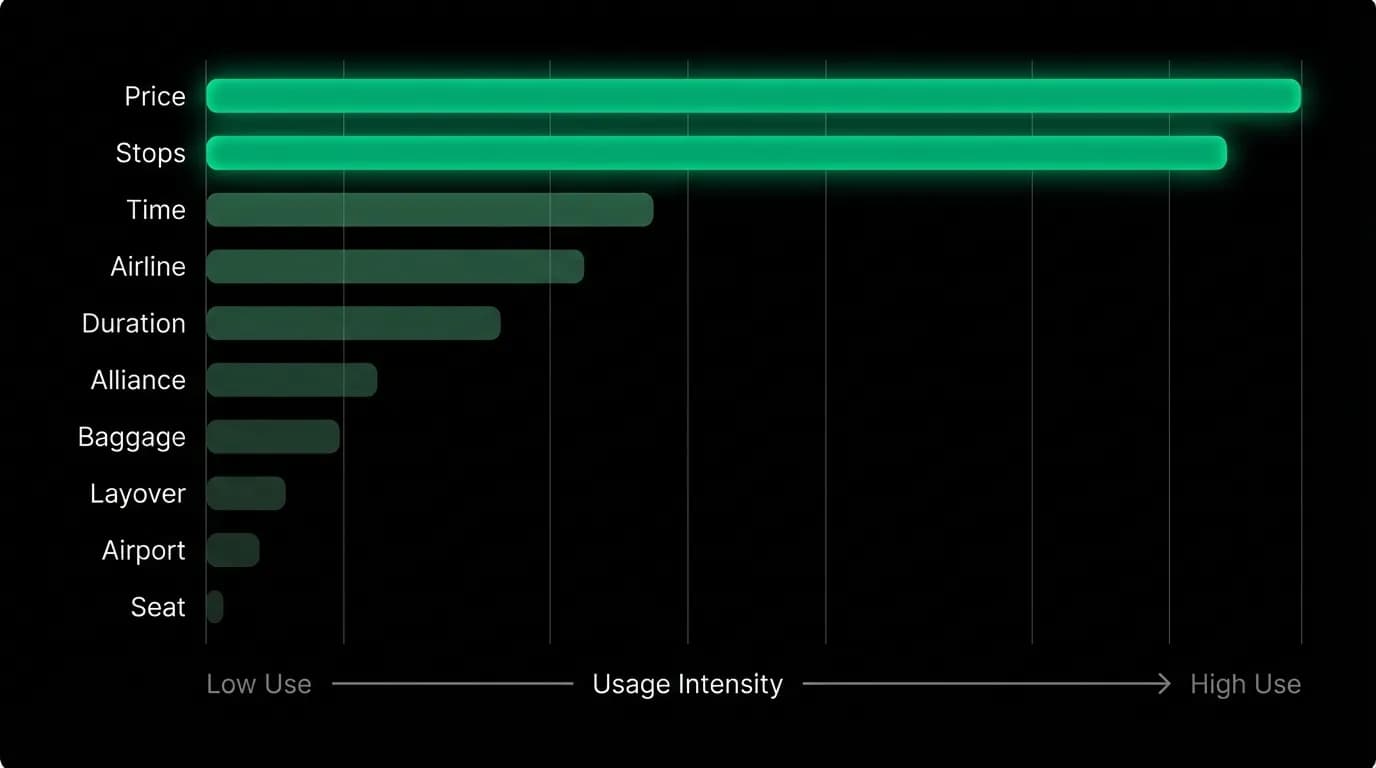
Industry data consistently shows that the majority of users interact with one to two filters out of the ten or more available on a typical flight search page. Price is the most used. Number of stops is second. Departure time is a distant third. Everything else, airline preference, alliance, baggage inclusion, connection duration, airport preference, emissions, is used by a small minority.
This creates a strange situation. Flight search products dedicate significant screen real estate and engineering effort to filters that most users never touch. Google Flights has invested in a carbon emissions filter. Kayak lets you filter by seat pitch. Expedia offers airport proximity filtering. These are impressive engineering achievements that affect maybe 3-5% of searches.
The reason most filters go unused isn't that people don't have preferences. They do. It's that translating fuzzy preferences into rigid filter parameters is cognitively demanding and often impossible.
"I don't want a terrible layover" is a real preference. But what does that mean as a filter? Maximum connection time of 3 hours? Or is it that you don't want to connect through certain airports? Or that you don't want an overnight connection? The filter dropdown forces you to pick a number. Your actual preference is more nuanced than any number can capture.
Filters assume you know your constraints
Here's the fundamental problem with filter-based search: it requires you to know your constraints before you start searching. The interface presents all possible dimensions of choice upfront and expects you to configure them correctly.
But most travelers don't know their constraints upfront. They discover them as they see options.
"I didn't know I cared about nonstop until I saw that the connecting flights add six hours." "I didn't realize I had an airline preference until I saw Spirit in the results." "I thought I wanted the cheapest option, but then I saw the 5 AM departure time."
This is a well-documented phenomenon in decision science. People often don't know what they value until they're presented with concrete options that force them to make trade-offs. Asking them to set constraints before seeing options is asking them to predict their own preferences, which humans are notoriously bad at.
A conversation handles this naturally. You say "find me flights to Barcelona next month." The AI shows you three options. You say "that layover in Munich is too long, what else?" The AI refines. You discover your constraints through the process of evaluating options, not by pre-configuring a form.
The cognitive load of filtering
Every filter is a micro-decision. Should I filter by stops? What's my maximum price? Do I care about departure time? Each one takes mental energy, and that energy comes from the same pool you need for the actual decision: which flight to book.
Cognitive load theory, developed by John Sweller, tells us that working memory is limited. When you force users to make many small decisions (configuring filters) before the big decision (choosing a flight), you exhaust their cognitive resources. They make worse decisions on the thing that matters because they spent their mental energy on the things that don't.
Adding more filters doesn't help. It makes things worse. Each additional filter option increases the combinatorial complexity. Ten filters with an average of five options each create millions of possible configurations. Nobody evaluates that possibility space. People either accept the defaults or set one or two filters and hope for the best.
Google Flights and Kayak have responded to this by adding more sophisticated filters over time. Kayak now has a "best" sort that tries to combine multiple dimensions. Google shows "best departing flights" alongside the price-sorted list. These are band-aids. They acknowledge that pure filtering doesn't work while still committing to the filter paradigm.
AI as the intelligent filter
An AI agent doesn't present filters. It applies intelligence.
When you say "find me flights to Barcelona, something reasonable," the AI understands "reasonable" in context. If it knows from your history that you typically spend $400-600 on European flights, "reasonable" means within that range. If it knows you've never booked a connection longer than three hours, it filters those out automatically. If it knows you fly a particular airline's loyalty program, it weights those options higher.
None of this required you to set a filter. The AI applied your preferences, both explicit and inferred, as intelligent constraints. The result is a small set of flights that match what you actually want, not what you could have configured in a filter form if you had perfect self-knowledge and unlimited patience.
The AI also handles the nuance that filters can't. "Something with a decent layover" is a real user statement that contains real information. A filter can't process it. An AI can. It understands that "decent" means not too short (risk of missing the connection) and not too long (sitting in an airport for hours). It factors in the connecting airport, because a two-hour layover at Singapore Changi is different from a two-hour layover at a small regional airport with nothing to do.
This kind of contextual reasoning is impossible with filters. It's natural in conversation.
The transition in user language
Something interesting happens when you give users a conversational interface instead of a search form. The language they use changes completely.
In a search form, users think in structured parameters: "JFK to BCN, June 15, nonstop, economy." This is search-engine language. It's compressed, stripped of context, optimized for machine parsing. It's not how anyone talks or thinks.
In a conversation, the same intent becomes: "I need to get to Barcelona around mid-June, probably for a week. I'd rather not have a connection but I'm flexible if the price is right." This is human language. It contains the same core information plus flexibility signals, trade-off willingness, and temporal softness ("around mid-June") that a search form can't capture.
The conversational version gives the AI more to work with, not less. The flexibility signal ("I'm flexible if the price is right") tells the AI to check nearby dates for better fares on connecting flights. The temporal softness tells the AI to search a date range instead of a single day. The trade-off willingness tells the AI to show a mix of nonstop and connection options with clear price comparisons.
A filter form gets six data points from the user. A single conversational sentence can give the AI twelve.
How Google Flights and Kayak doubled down on filters
Google Flights' response to the limitations of basic filtering has been to add smarter filtering. The price graph showing fare fluctuations over a date range. The "date grid" that shows prices across flexible dates. The "explore" feature that shows cheapest destinations on a map. Kayak went even further with its "Explore Everywhere" tool and price alerts.
These are genuinely useful tools. I use the Google Flights date grid myself. But they represent a doubling down on the filter paradigm rather than a departure from it. Each one adds another tool to the user's toolkit, another interface to learn, another set of options to evaluate. The user still does all the work. The tools just give them more data to work with while doing it.
More data does not equal better decisions. In fact, the relationship is often inverse. More information leads to longer deliberation, more second-guessing, and lower satisfaction with the eventual choice. This is why OTA conversion rates have stayed at low-single-digit despite enormous improvements in search tools over the past decade. Better filters haven't solved the fundamental problem because the fundamental problem isn't filterable.
What replaces filters
Filters don't disappear entirely. They evolve into conversational refinement.
In a filter-based system, you set constraints before seeing results. In a conversational system, you refine after seeing results. This is a better sequence. You see three options. You react. "The first one is too early." "Can I see something that doesn't connect through Dallas?" "What if I leave a day later?"
Each refinement is natural. It doesn't require understanding filter mechanics or dropdowns. It's just talking. And each refinement gives the AI more information about what you actually want, progressively building a precise understanding of your preferences through dialogue rather than demanding it upfront through form fields.
The AI also refines proactively. "I noticed the nonstop is $200 more than the connection. The connection is through Amsterdam with a 90-minute layover, which based on your past bookings seems within your comfort zone. Want me to include it?" This is refinement that no filter sidebar can provide because it requires knowledge of the user and judgment about the trade-off.
At Nowah, we built the entire flight search experience around this model. No filter sidebar. No configuration screen. You talk. The agent searches. You react. The agent refines. Within a few exchanges, you're looking at flights that match what you want with a precision that no combination of filters could achieve, because the AI understood your intent, not just your parameters.
The filter sidebar had a good run. Twenty-five years of flight shopping have been organized around it. But it was always a compromise, a way of giving users control when the system couldn't understand what they actually wanted. AI understands. So the filter can retire.
Nowah is an AI travel agent that searches and books real flights and hotels through conversation — no filters, no thirty open tabs. Plan your next trip.