Gen Z Doesn't Search — They Ask: AI Meets New Consumer Behavior
Younger consumers grew up with voice assistants and DMs, not search bars. AI-native travel booking aligns with how they already interact with tech.
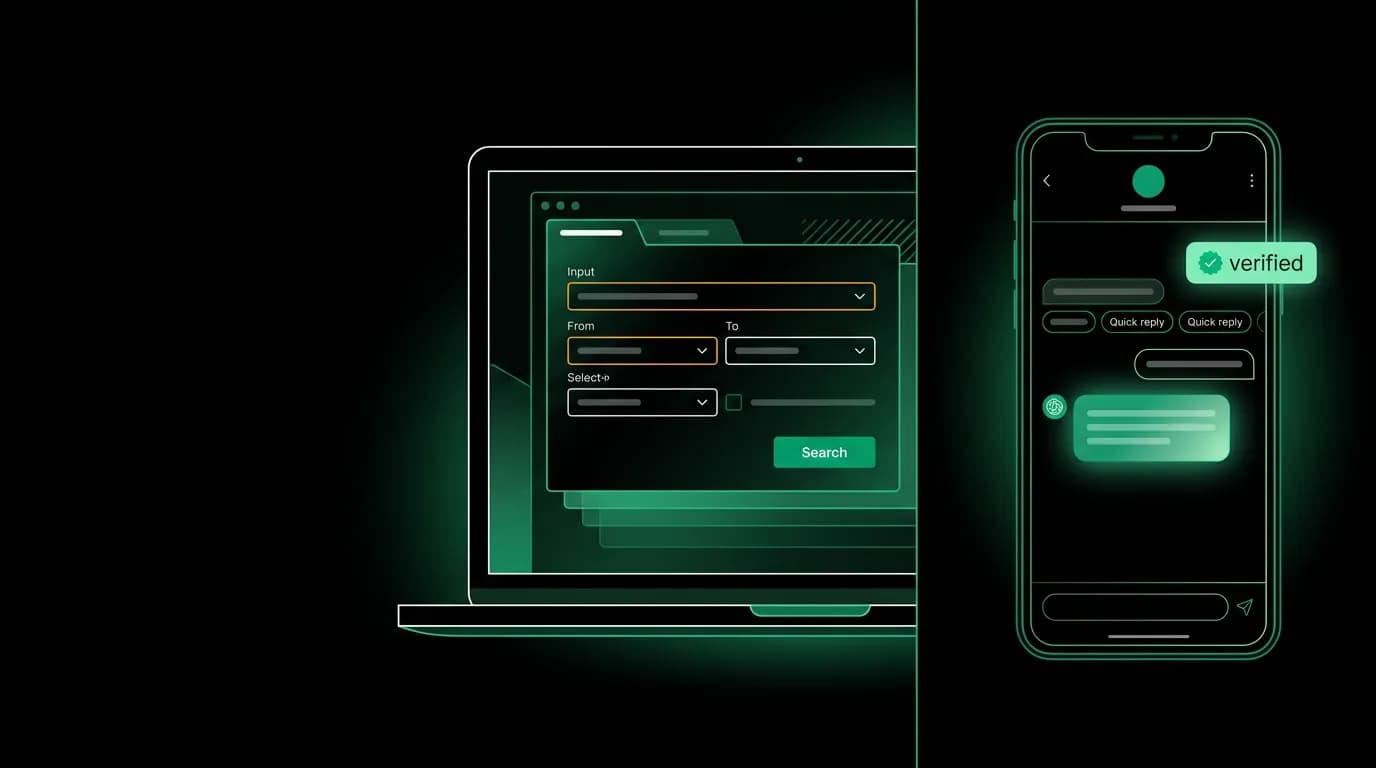
There's a generation of travelers who have never used a phone book, never MapQuested directions, and never thought of a search engine as the only way to find information. They grew up sending DMs, talking to voice assistants, and scrolling algorithmic feeds that predicted what they wanted before they asked.
When this generation goes to book a flight on Expedia and encounters a form asking for origin, destination, dates, number of travelers, cabin class, and preferred number of stops, they don't feel empowered by the options. They feel like they've been handed a tax return.
Gen Z's relationship with technology is fundamentally conversational. AI-native travel booking isn't something we need to convince them to try. It's what they've been waiting for.
The generational interface shift
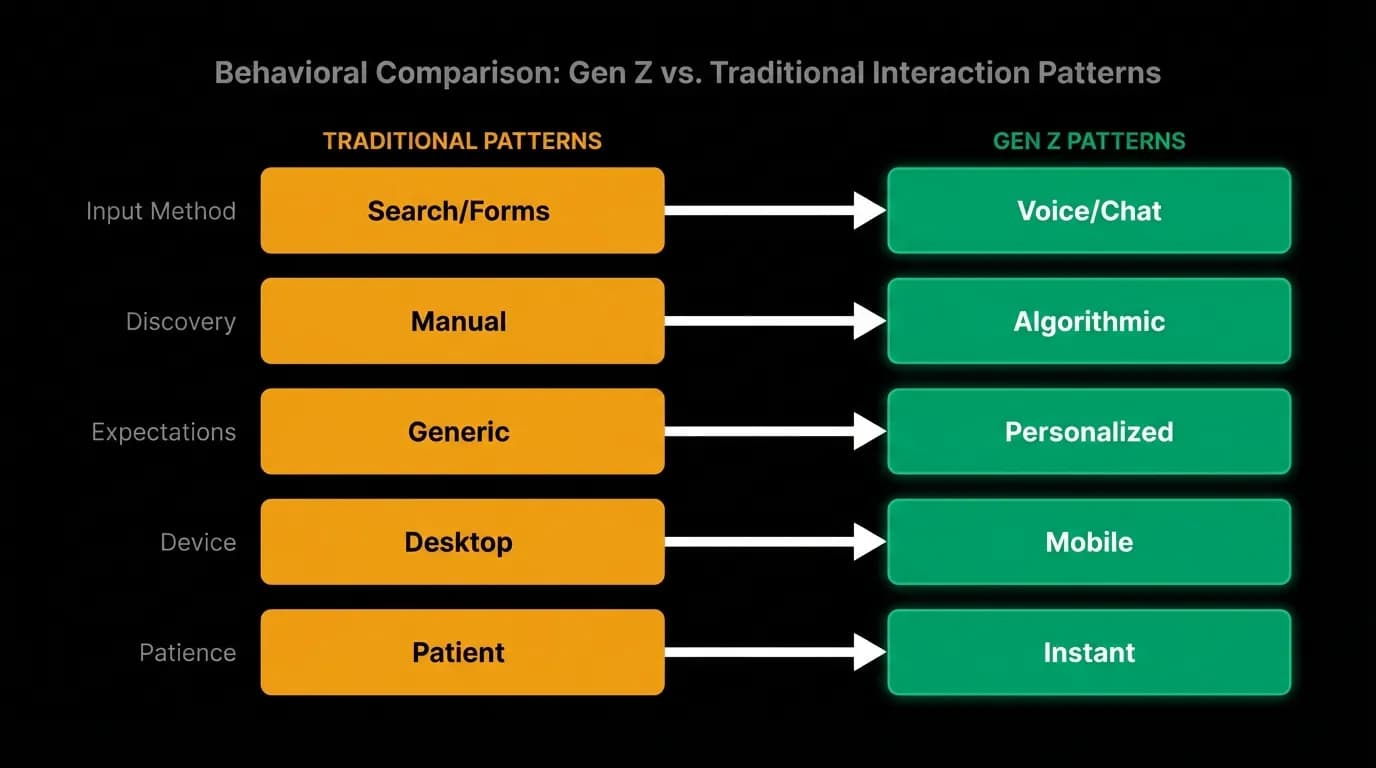
Every generation's default interface shapes how they expect all technology to work.
Boomers grew up with directories and catalogs. Their mental model for finding things is structured: categories, alphabetical indexes, organized systems. This is why early websites had extensive navigation menus and sitemaps. They mirrored the catalog.
Gen X and older Millennials grew up with search engines. Their mental model is query-based: type keywords, get results, pick one. This is the model that Expedia, Booking.com, and Google Flights are built around. Search bars. Keywords. Lists of results.
Gen Z grew up with something different. Their primary interfaces are messaging apps, social feeds, and voice assistants. Their mental model is conversational and algorithmic: tell the system what you want (or let it figure it out), and the system delivers.
When a Gen Z user wants restaurant recommendations, they don't Google "best restaurants near me." They ask in a group chat, or they scroll TikTok for local food content, or they ask a voice assistant. The idea of typing structured keywords into a box feels archaic to someone whose primary information interface has always been a chat window.
About 65% of consumers under 35 say they're comfortable with the idea of booking travel through AI. That number isn't surprising when you realize these are people who already conduct most of their digital life through conversational interfaces.
Search-first to chat-first discovery
The way Gen Z discovers travel is already conversational. They're not starting trips on Expedia. They're starting trips on TikTok, Instagram, and in group chats.
A typical Gen Z trip planning process starts with a TikTok video showing a hidden beach in Portugal. They screenshot it. They send it to their friend group. A conversation starts: "we should go here." "when?" "maybe September?" "how much are flights?" Someone opens Google Flights, finds a price, screenshots it, sends it to the chat. More discussion. Eventually someone books, maybe weeks later, through whatever app they happen to open.
The entire discovery and planning phase is conversational. It happens in chat. But then the actual booking requires a completely different modality: filling out forms on a website designed in 2005. The disconnect is jarring.
An AI travel agent fits seamlessly into this behavior pattern. The conversation doesn't have to stop when booking starts. "Find me flights to Lisbon in September for two people, under $500 each" is the same kind of message they'd send in a group chat. Except now the response isn't a screenshot from a friend. It's three flight options with real prices, bookable immediately.
The personalization expectation
Gen Z expects personalization as a default, not a premium feature. They've grown up with algorithmic feeds that learn their preferences and adapt. TikTok's For You page. Spotify's Discover Weekly. Netflix's recommendations. YouTube's suggested videos.
These algorithms created an expectation: the product should know me. It should learn what I like and show me more of it. Having to manually configure preferences feels like a bug, not a feature.
This expectation is completely unmet by traditional travel platforms. Every time you search on Google Flights, you start from zero. It doesn't know you prefer window seats. It doesn't know you always fly with a carry-on only. It doesn't know that your budget is flexible on timing but rigid on nonstop flights. Each search is stateless.
Booking.com's Genius program and Expedia's loyalty tiers offer discounts but not personalization. A 10% discount is nice, but it's not the same as a product that knows your preferences and adapts to them. Discounts are generic. Personalization is individual.
AI-native travel products with memory fit Gen Z's expectations perfectly. The more you use it, the better it knows you. By your fifth booking, the AI has a model of your travel preferences that no OTA loyalty program can match. This is the same compounding personalization that makes TikTok sticky, applied to travel.
The TikTok analogy
TikTok is the most relevant analogy for understanding what Gen Z expects from product experiences.
Before TikTok, social media feeds were chronological or based on your social graph. You saw content from people you followed, in the order they posted it. Discovery required active effort: searching hashtags, following new accounts, browsing explore pages.
TikTok eliminated all of that. You open the app and it shows you content. No following required. No configuration. No search. The algorithm figures out what you want based on what you watch, how long you watch it, and what you skip. Within an hour of usage, TikTok's feed is remarkably personalized.
Now apply that same expectation to travel. Gen Z doesn't want to configure 10 filters to find a flight. They want to say "find me something good to Barcelona" and have the AI figure out the rest based on what it knows about them. They don't want to browse 300 hotel listings. They want three options that match their vibe, presented without effort.
The TikTok-ification of travel isn't about short-form video (though travel content on TikTok is massive). It's about the expectation that products should understand you and curate for you, rather than presenting everything and making you sort through it.
Mobile-native or it doesn't exist
About 60% of millennials and Gen Z prefer mobile-first booking, and that number keeps climbing. Mobile travel bookings account for roughly 45% of all online travel transactions, growing at about 15% annually.
But here's the thing: most OTA mobile apps are just responsive versions of their desktop sites. The same search forms, the same results lists, the same filter sidebars, squeezed onto a smaller screen. It's a worse experience of the same paradigm.
A conversational interface is inherently mobile-native. Chat works on phones. It's the primary interaction model on mobile devices. People spend hours in messaging apps. The thumb ergonomics of a chat interface are perfect for one-handed phone use.
Nowah was built mobile-first for this reason. The center tab is the chat. You can talk or type. The AI responds in the same conversational format you use all day in your messaging apps. Flight and hotel cards appear within the chat, tap-to-expand, designed for the phone screen. Payment happens with a native sheet that slides up. No pinching, no zooming, no horizontal scrolling through tables designed for desktop.
For Gen Z, if it doesn't work perfectly on a phone, it doesn't exist. Travel booking has been getting away with subpar mobile experiences because there was no alternative. Now there is.
How Hopper captured younger users
Hopper deserves credit for understanding younger travelers better than any other travel company. Their app-only model, their price prediction features, their clean mobile interface, all of it resonated with younger users in a way that Expedia and Booking.com couldn't match.
Hopper's price freeze feature is particularly smart. It addresses the specific anxiety younger travelers feel about timing: "should I book now or wait?" By letting users lock in a price while they decide, Hopper removed one of the biggest friction points for a demographic that's more price-sensitive and more indecisive about large purchases.
But Hopper's innovation is narrow. Price prediction and price freeze are two features. The core booking flow is still search, filter, select, pay. There's no conversational interface. There's no AI agent that handles the full trip. There's no memory that learns your preferences over time.
Hopper proved that younger users will adopt a travel app that respects their expectations. It didn't go far enough to prove that younger users will accept the same fundamental paradigm that Expedia established in 1996.
Building for the generation that won't accept forms
Voice search is growing at roughly 25% year-over-year. Gen Z uses voice input more naturally than any previous generation. They send voice notes as casually as text messages. Asking a travel app to "find me a cheap flight to somewhere warm next month" by speaking feels completely normal to them. Typing "JFK-warm-February-nonstop" into a search box does not.
The demographic tailwind for AI-native travel products is strong and accelerating. Gen Z is entering their peak travel years. They have disposable income. They prioritize experiences over possessions. They travel more frequently than previous generations did at the same age. And they have near-zero tolerance for dated interfaces.
We built Nowah knowing that the future of travel booking looks like a conversation, not a form. Not because conversation is trendy, but because it matches how the largest and fastest-growing demographic of travelers already interacts with technology. They don't search. They ask. They don't filter. They describe. They don't compare 300 options. They trust algorithms to curate.
The travel industry can either build for this reality or watch this generation book trips somewhere else. Given that the incumbents are still optimizing filter sidebars, I know which outcome I'm betting on.
Nowah is an AI travel agent that searches and books real flights and hotels through conversation — no filters, no thirty open tabs. Plan your next trip.