The Psychology of Booking Anxiety (And How AI Reduces It)
FOMO, regret aversion, decision paralysis, price uncertainty — behavioral psychology explains why booking is stressful and how AI addresses each trigger.

Booking travel should be exciting. You're planning a trip. You're going somewhere new, or returning somewhere you love. The anticipation of travel is one of life's genuinely enjoyable feelings. Research consistently shows that the planning phase of a trip contributes as much to happiness as the trip itself.
So why does the actual booking part feel like a dental appointment?
About 70% of travelers report feeling overwhelmed during the booking process. A third experience post-booking regret. Cart abandonment in travel is 81-87%, higher than any other e-commerce category. These numbers don't describe people enjoying the anticipation of travel. They describe people in a state of low-grade psychological distress.
The distress has specific, identifiable causes. Four psychological mechanisms drive almost all booking anxiety: FOMO, regret aversion, decision paralysis, and price uncertainty. Each one is well-documented in behavioral economics. And each one can be directly addressed by how an AI agent presents information and frames choices.
FOMO: "Is there a better deal I haven't found?"
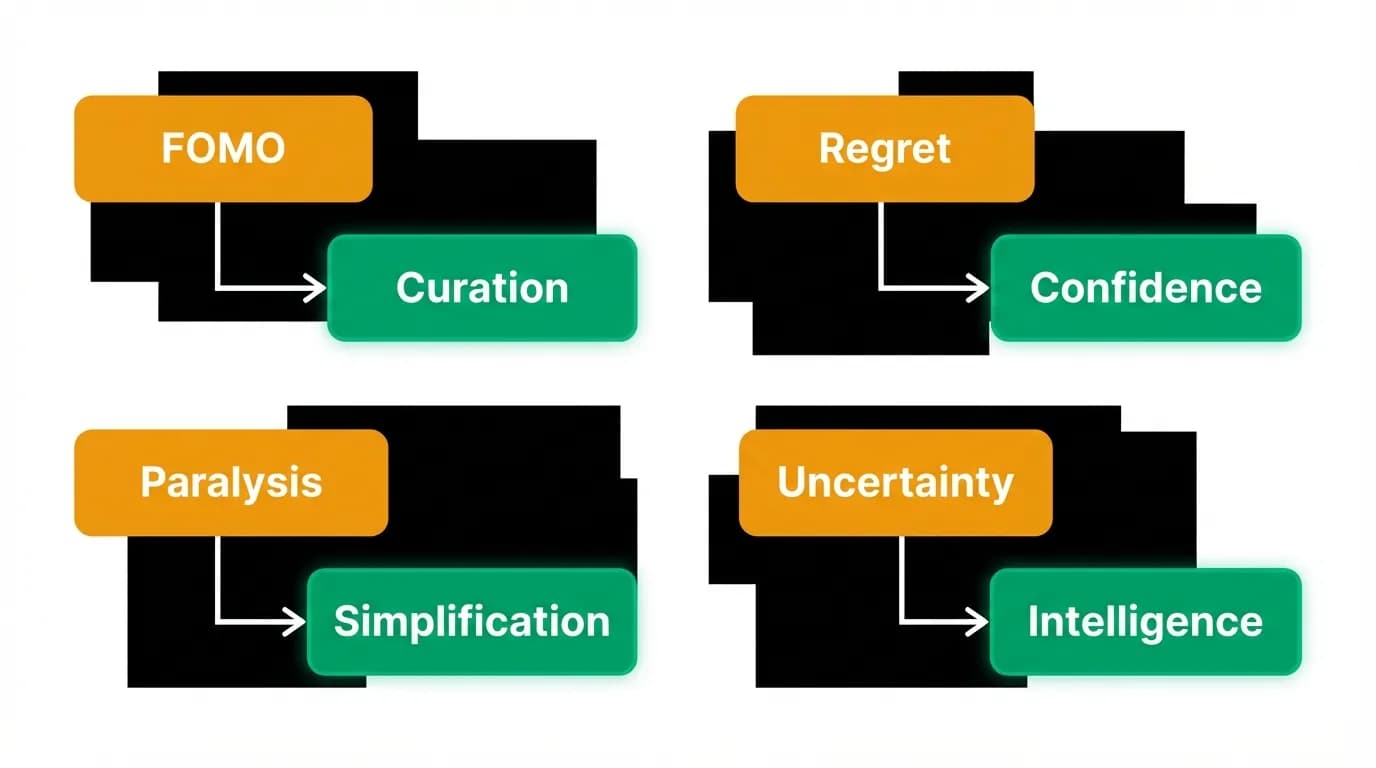
Fear of missing out is the most pervasive form of booking anxiety. It's the nagging feeling that somewhere, on some website you haven't checked, there's a better flight at a lower price. It drives the 38-website comparison behavior that Google and Phocuswright documented. It's the reason people spend weeks researching a trip that takes days.
FOMO in travel is particularly acute because of how the market works. Different platforms show different prices for the same flight. Prices fluctuate hourly. Fare sales appear and disappear without warning. There are discount codes, membership rates, credit card portals, airline-direct pricing, and opaque fares on third-party sites. The landscape is designed, intentionally or not, to make comprehensive price comparison nearly impossible.
The rational response to this uncertainty is to keep searching. Check one more site. Wait one more day. See if the price drops. The irrational result is that the search never ends. The traveler is caught in an infinite loop of checking, rechecking, and never committing.
How AI addresses FOMO. The AI agent provides completeness assurance. "I searched all available options across carriers for these dates. These three are the best." This single statement addresses the core fear: that you're missing something. The AI has already done the comprehensive search that you would spend hours doing manually. You're not missing a deal because the agent already found every deal.
The AI also provides price benchmarking: "This is $120 below the average price for this route in June." This contextualizes the price against the broader market. You're not just seeing a number. You're seeing where that number sits relative to what other people pay. If the price is below average, the FOMO signal weakens considerably.
Finally, the AI eliminates the multi-site comparison by doing it internally. You don't need to check Google Flights, then Kayak, then the airline direct, then a discount site. The agent queries across available inventory in one search. The comparison is done. You just see the results.
Regret aversion: "What if I book the wrong flight?"
Regret aversion is a concept from Kahneman and Tversky's prospect theory. People feel the pain of a bad outcome about twice as intensely as the pleasure of an equally good outcome. In travel booking, this means the fear of booking the wrong flight is psychologically twice as powerful as the excitement of booking the right one.
Regret aversion manifests as an inability to commit. The traveler has found a good flight. The price is reasonable. The timing works. But they can't pull the trigger because "what if I regret it?" What if the price drops tomorrow? What if there's a better airline? What if they should have chosen the nonstop instead of the connection?
This isn't irrational. About 33% of travelers report experiencing post-booking regret. The regret is real and common. But the anticipation of regret is far more common than actual regret, which means the fear prevents far more bookings than the reality warrants.
How AI addresses regret aversion. The AI uses what we call confidence framing. Instead of presenting a flight as one option among many (which invites comparison and second-guessing), the AI presents it as a recommendation with reasoning.
"This is the best option for you because it's direct, it's on your preferred airline, it arrives at a reasonable hour, and the price is below average for this route."
The reasoning does two things. First, it shifts the decision from subjective judgment ("do I feel good about this?") to objective evaluation ("does this meet my criteria?"). Objective decisions are easier to commit to and harder to regret.
Second, it provides a defense against future regret. If the traveler later wonders "did I make the right choice?", they can recall the AI's reasoning. The decision was grounded in facts and preferences, not a gut feeling. This retrospective justification significantly reduces regret.
The AI also offers cancellation clarity upfront: "This fare is refundable with a $75 fee within 24 hours." Knowing the exit option reduces the psychological weight of the commitment. Booking becomes less of a permanent decision and more of a provisional one that can be reversed.
Decision paralysis: "Too many options, I'll decide later"
Barry Schwartz's paradox of choice describes how increasing options beyond a threshold causes satisfaction to decline and decision difficulty to increase. In travel, this threshold is crossed before the results page even finishes loading.
A Google Flights search returns 200+ options. Each one is slightly different in ways that matter (price, timing, airline, stops) and ways that might not matter but are hard to ignore (layover airport, fare class name, baggage details). The user faces a combinatorial explosion of comparison possibilities.
The cognitive response to this overload is not deliberation. It's avoidance. "I'll decide later" is the most common outcome of decision paralysis. The traveler closes the tab and returns to it days or weeks later, only to face the same overwhelming options (now with different prices, adding more uncertainty).
This cycle repeats until either urgency forces a decision (the trip is next week) or the traveler gives up entirely (abandons the trip or asks someone else to book it).
How AI addresses paralysis. Three options. Not thirty. Not three hundred. Three.
The AI curates aggressively. It evaluates all available flights and presents exactly three: the best price, the best schedule, and the best overall value. The user can hold all three in working memory. They can compare them directly. The decision becomes "which of these three?" rather than "which of these three hundred?"
Research shows that users presented with 3 options decide roughly 40% faster than users presented with 10 or more. They also report higher satisfaction with their choice. Fewer options don't mean worse outcomes. They mean better decisions.
The AI also provides recommendation ranking: "If I had to pick one, I'd go with option two. It's the best balance of price and schedule for your preferences." This isn't the AI making the decision for the user. It's the AI making the decision easier by providing a starting point. The user can accept the recommendation or choose differently, but they have a clear default to anchor on.
Price uncertainty: "Will this get cheaper if I wait?"
The final anxiety trigger is temporal: should I book now or wait?
Flight prices are notoriously volatile. They change based on demand, capacity, time to departure, day of week, and dozens of other factors. Travelers know this, and the knowledge creates a gambling dynamic. Book now and risk overpaying. Wait and risk the price going up. The optimal strategy is unknowable, which makes every booking a bet.
Hopper built an entire business around this anxiety. Their price prediction feature tells you whether to buy now or wait. It's useful. But it also reinforces the frame that timing is a gamble, which perpetuates the anxiety even when the prediction is favorable ("buy now" still carries the implicit "because if you wait, you'll lose").
How AI addresses price uncertainty. The AI provides historical price context: "Prices for this route in June are currently below the 12-month average." This anchors the current price against a reference point. Below average reduces the "wait for cheaper" impulse. At or above average might prompt the AI to suggest "you might save money by flying a day earlier or a day later."
The AI also provides directional guidance based on booking patterns: "For this route, prices typically increase in the two weeks before departure." This isn't a guarantee, but it helps the user make an informed timing decision rather than an anxious guess.
Most importantly, the AI frames the price in absolute terms, not just relative ones. "This flight is $487. Based on your typical spending, this is within your comfort range for a domestic flight." This shifts the evaluation from "is this the cheapest possible?" to "is this a price I'm comfortable with?" The second question is much easier to answer affirmatively.
The behavioral economics toolkit
The four anxiety types map neatly to well-established behavioral economics frameworks.
FOMO maps to Schwartz's satisficing vs. maximizing. Maximizers (people who need the best possible option) suffer more FOMO than satisficers (people who accept "good enough"). OTAs turn everyone into maximizers by showing all options. AI turns everyone into satisficers by showing curated options with "good enough" assurance.
Regret aversion maps to Kahneman and Tversky's loss aversion. The pain of a bad booking outweighs the pleasure of a good one. AI reduces the perceived risk of loss through reasoning and reversibility.
Decision paralysis maps to Hick's Law. More options equals longer decision time. AI reduces options to the manageable threshold where Hick's Law predicts fast, confident decisions.
Price uncertainty maps to Thaler's mental accounting. People evaluate prices relative to reference points, not in absolute terms. AI provides the reference points (route average, historical trend, personal spending history) that make price evaluation possible.
These aren't obscure academic frameworks. They describe the actual psychological experience of booking travel. And they suggest specific interventions that directly translate to product design decisions.
From anxious to confident: the emotional redesign
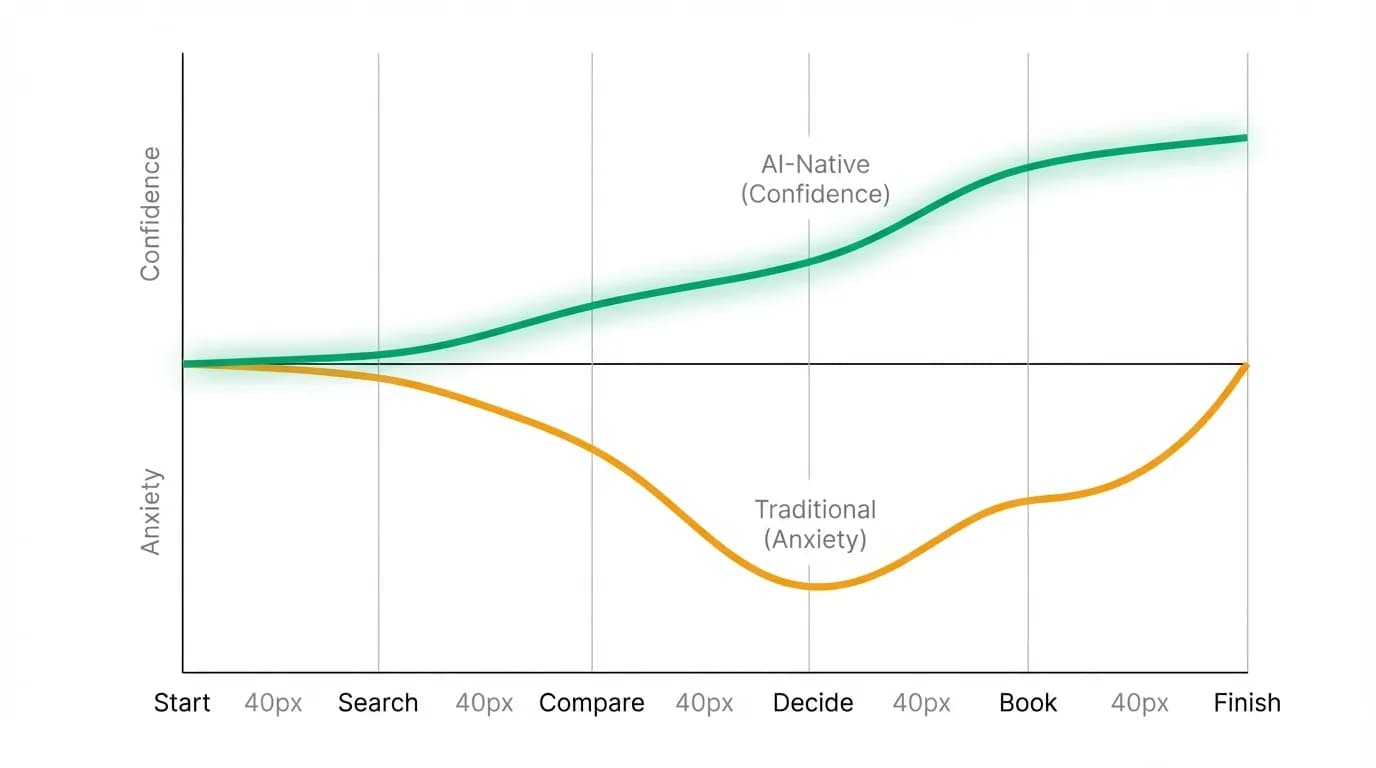
The traditional OTA booking experience follows an anxiety curve. It starts with excitement (I'm planning a trip!), rises through research stress (so many options), peaks at decision anxiety (which one? should I wait?), and partially resolves at booking (finally decided) before potentially spiking again with post-booking regret (should I have waited? was there a better option?).
The AI booking experience follows a confidence curve. It starts with excitement (same), progresses through engaged conversation (the AI is helping me), builds through curated options (these are good, I can choose), peaks at confident decision (the AI explained why this is the best choice for me), and settles into satisfied confirmation (booked, and I feel good about it).
The difference between these curves is the difference between a product that creates anxiety and a product that resolves it. And it's not an accident. It's designed.
Every product decision we make at Nowah is evaluated against these psychological triggers. Does this feature reduce FOMO or increase it? Does this presentation build confidence or create doubt? Does this flow reduce decisions or add them? Does this framing anchor the user's evaluation or leave them unmoored?
When we show three options instead of three hundred, we're applying Hick's Law. When we include "below average price for this route," we're providing Thalerian reference points. When we say "this is the best option for you because...", we're arming the user against Kahneman's regret aversion. When we show "I searched all available flights," we're converting Schwartz's maximizers into satisficers.
Why this matters for the industry
The $600 billion in abandoned travel bookings represents, in large part, the cost of booking anxiety. Every abandoned cart is a traveler who wanted to buy but couldn't overcome the psychological friction.
Traditional OTAs have responded to this problem with conversion optimization tactics: urgency signals ("only 2 seats left!"), social proof ("47 people booked this today"), and price manipulation ("prices have gone up since your last search"). These tactics address symptoms, not causes. And some of them, particularly the manufactured urgency signals, actually increase anxiety rather than reducing it. "Only 2 seats left" doesn't make you feel confident. It makes you feel rushed.
AI offers a genuinely different approach. Instead of manipulating behavior through urgency and scarcity, it builds confidence through information, reasoning, and personalization. The user books because they feel good about the choice, not because they feel pressured.
This isn't just better for users. It's better for the industry. Confident bookings have lower cancellation rates. They generate less customer service volume. They produce higher satisfaction, which drives repeat usage and referrals. The ROI of reducing booking anxiety is positive across every business metric, not just conversion rate.
We built Nowah knowing that the biggest barrier to travel booking isn't price, or inventory, or technology. It's how the booking process makes people feel. Fix the feeling, and the bookings follow.
Travel planning should feel like the start of an adventure, not a standardized test. AI doesn't just make booking faster. It makes booking feel better. And for a product category where 70% of users feel overwhelmed and 33% regret their choices, "feeling better" isn't a luxury. It's the whole product.
Nowah is an AI travel agent that searches and books real flights and hotels through conversation — no filters, no thirty open tabs. Plan your next trip.