3 Options, Not 300: Our AI Curation Philosophy
Showing 300 flight results is not a feature — it is a failure of product design. AI curation presents three options and converts better.

Open Google Flights right now and search for a round trip from New York to London next month. You will get somewhere between 150 and 400 results depending on the dates. The page will show you a grid with prices, times, airlines, stop counts, and durations. You can sort by cheapest, fastest, or "best" (a black-box ranking nobody can explain). You can filter by airline, stops, times, and price range.
And then you will sit there for twenty minutes trying to figure out which one to pick.
Kayak will show you even more. They aggregate results from multiple OTAs, so now you have the same flights at different prices from different sellers with different booking conditions. It is comparison shopping for your comparison shopping.
This is not a feature. It is a failure of product design. When your product shows 300 options and the user's job is to figure out which one to pick, you have not solved their problem. You have restated it.
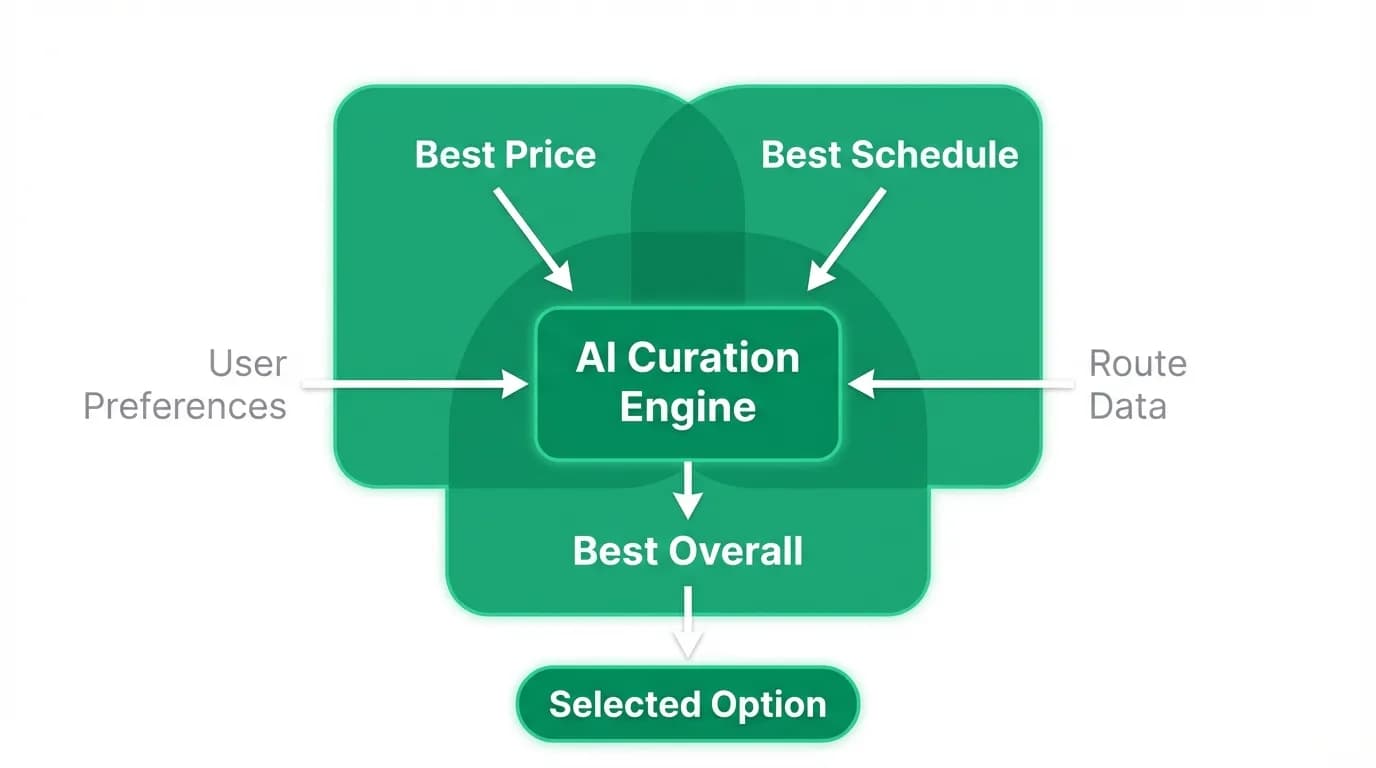
At Nowah, the AI shows you three options. Best price. Best schedule. Best overall. That is it. And it works better than 300 ever did.
The paradox of choice hits travel hardest
Barry Schwartz published "The Paradox of Choice" in 2004, and his central argument has been validated repeatedly in the two decades since: more options lead to less satisfaction, more regret, and more decision paralysis. When people face too many choices, they either freeze, pick randomly, or just leave.
Travel is the worst-case scenario for this phenomenon. Consider how many variables a single flight involves: airline, departure time, arrival time, total duration, number of stops, layover airports, layover duration, aircraft type, fare class, baggage policy, seat selection policy, change policy, cancellation policy, and price. A single flight has fifteen or more dimensions that might matter to a given traveler.
Now multiply that across 300 results. You are asking a human brain to perform multi-dimensional comparison across hundreds of options. We are bad at this. Cognitive science has established that humans can effectively compare about three to five options across a handful of dimensions before our brains start taking shortcuts. Beyond that, we resort to simplification heuristics. Usually we just sort by price and pick the cheapest one, which means all those other dimensions go unused anyway.
Roughly 70% of travelers report feeling overwhelmed by options during the booking process. That number should not surprise anyone who has used Kayak at 11 PM trying to figure out if the 45-minute layover in Chicago is long enough or if they should take the 2-hour layover in Dallas instead even though it costs $80 more.
And here is the number that should concern every product person in travel: cart abandonment rates for travel bookings run between 81% and 87%. That is the highest in all of e-commerce. Higher than fashion, higher than electronics, higher than groceries. People show up wanting to buy a trip and leave without buying at a rate that would be considered catastrophic in any other industry.
This is not a UX polish problem. It is not something you fix with a better font or a faster page load. It is a structural failure of the "show everything and let the user sort it out" approach.
How the AI selects three
When you ask Nowah for flights, the AI runs a real search against live inventory. It gets back all the same options that Google Flights or Kayak would show you. Hundreds of results with all the same airlines, times, prices, and routes. The difference is what happens next.
Instead of dumping the raw results on you, the AI ranks every option across multiple dimensions and selects three to present.
The best-price option is exactly what it sounds like. Cheapest total cost, but with an important twist: it factors in the real cost, not the headline fare. If you have told the agent you always check a bag, the AI adds baggage fees to every option before comparing. If you know you will want to pick a seat, that cost gets included too. The "cheapest" flight on Kayak often is not actually the cheapest once you add the stuff most people need. Our best-price option accounts for that.
The best-schedule option optimizes for timing and comfort. Shortest total travel time, most convenient departure and arrival windows based on your stated preferences, fewest or shortest layovers. For someone who told the agent they hate early morning flights, this option will not depart at 6 AM even if that route is technically the "fastest." For someone who said they need to arrive before dinner, the agent picks the schedule that gets them there by late afternoon with a buffer for delays.
The best-overall option is the balanced pick. It weighs price, schedule, airline quality, layover comfort, and your personal preferences to find the option that represents the best fit when everything is considered together. Think of it as the option a good human travel agent would recommend if you said "just pick the best one for me."
These three options are not randomly sampled from the full list. They represent three genuinely different strategies for this particular trip. Best price might be a budget carrier with a layover. Best schedule might be a direct flight on a major airline. Best overall might be something in between that gets most things right without being the absolute cheapest or fastest.
The ranking is not static or one-size-fits-all. It adapts to what the AI knows about you. A business traveler who flies weekly and values schedule predictability gets different "best overall" results than a college student booking spring break on a tight budget. Past behavior, stated preferences, and the specific context of this trip all feed into the selection. The more the AI knows about you, the better the three options become.
The human travel agent test
Here is a thought experiment we keep coming back to. Imagine you called a human travel agent, a good one, someone who has been doing this for twenty years and knows the industry inside out. You ask them to find you a flight to Paris.
They would never, ever come back with 300 options. That would be absurd. If your travel agent emailed you a spreadsheet with 300 rows and said "let me know which one you want," you would fire them.
A good agent comes back with two or three options. "Here is the most affordable one, but it has a layover in Amsterdam. Here is the direct flight, which is about $200 more but saves you three hours. And here is a flight with British Airways that is somewhere in between, and I know you like their service." If you do not like any of them, they ask what is wrong and come back with different options.
That is what expertise looks like. An expert absorbs complexity so you do not have to. Their job is curation, not data presentation.
Kayak and Google Flights do the opposite. They present raw data and give you tools to filter it yourself. They have outsourced the hard part, which is actually deciding, to the user. And they call the tools they give you (sort by, filter by, flexible dates, price alerts) features. But those tools are actually evidence that the product has failed to do the job the user hired it for.
Nobody hired Kayak to show them 300 flights. They hired Kayak to find them a good flight. Those are fundamentally different jobs, and only one of them requires showing hundreds of results.
When three is not enough
I should be honest about where our approach has limits. Three options work well for the most common booking patterns: direct routes on popular corridors where the trade-offs between price, schedule, and comfort are clear. But sometimes three is not enough.
Complex multi-city itineraries might warrant more options because the permutations are genuinely different. A route from New York to Tokyo to Bangkok to Sydney has so many possible combinations that three might not cover the range. In these cases, the agent presents more options or groups them by routing strategy.
Trips with genuinely ambiguous trade-offs sometimes need the user to see a wider spectrum. When there is a flight that costs $400 less but adds a 7-hour layover, some people want to see the full range between those extremes to find their comfort point. The agent recognizes these situations and adjusts.
Some users simply want to see more. They are experienced travelers with strong opinions about airlines and routings, and they do not want the AI deciding for them. That is fine. The agent accommodates.
We handle all of this through expansion. The agent presents three as the starting point, and if you say "show me more options" or "what else is available in that time range" or "I want to see what's available on different dates," it opens up. The default is three. The ceiling is wherever you want it.
The key point: most people do not ask for more. When the three options are well-chosen and personalized, people feel confident picking from them. The desire to see 50 more options usually comes from a lack of trust that the options presented are the right ones. When the AI explains why it picked each one, citing your preferences and the trade-offs it considered, that trust forms quickly.
What the data says about curation vs. comprehensiveness
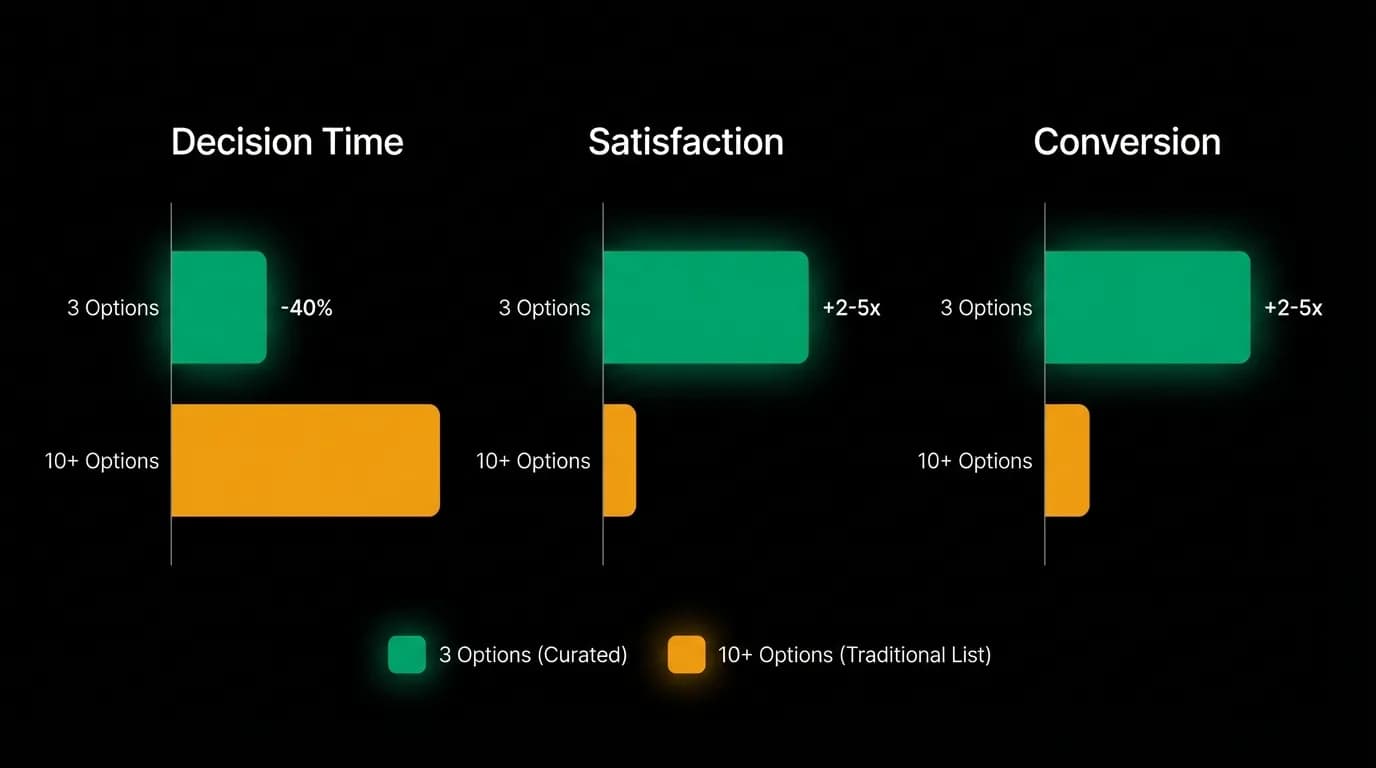
The research on this is fairly settled. Users who see three options make decisions about 40% faster than users who see ten or more. That speed does not come from impulsiveness. It comes from reduced cognitive load. Comparing three things along a few dimensions is something human brains handle well. Scrolling through a list of fifty options trying to remember what you saw six screens ago is something human brains handle poorly.
Personalized recommendations convert at two to five times the rate of generic results. This is true across e-commerce broadly, but it is particularly pronounced in travel where the purchase size is large and the decision anxiety is proportionally high. When someone feels like the options were chosen specifically for them, their confidence in the decision goes up. And confident people buy.
Satisfaction also goes up, which matters for retention. Schwartz's paradox of choice predicts this: fewer options, less regret. When you pick from 300, there is always the nagging feeling that option number 47 might have been better. You checked 50 of the 300 results, which means 250 went unexamined. Did one of those have a better layover? A nicer aircraft? You will never know, and that uncertainty lingers.
When you pick from three well-curated options, the decision feels cleaner. You are choosing between genuinely different strategies (save money, save time, balance both) rather than micro-variations on the same thing. There is nothing left to wonder about because the AI already evaluated the other 297 on your behalf and determined these three were the strongest.
Travel's 81-87% cart abandonment rate is, in our view, largely a consequence of too many options. People add a flight to their cart, then keep browsing because they are not sure it was the best one, then get tired and leave. Or they find a slightly cheaper option, switch, then find another one, switch again, and eventually close the tab because the whole process feels exhausting. Reducing the option set to a curated three gives people permission to commit. It says: you have seen the best options. Pick the one that fits your priorities and move on.
Why Kayak and Google Flights get this backwards
Kayak's entire business model is built on comprehensiveness. Their value proposition is "we search everywhere so you don't have to." But searching everywhere is the easy part. Aggregating flight inventory from multiple sources is a solved problem. The hard part is deciding what to book. Kayak has optimized aggressively for the part of the problem that technology solved twenty years ago (gathering inventory) while largely ignoring the part that still causes users to abandon at 85% rates (choosing from that inventory).
Google Flights is better in some ways. Their "best flights" ranking does some curation, pushing certain options to the top. But it still presents a long scrollable list, and the ranking algorithm is opaque. When Google shows you a "best" flight, you cannot ask why it is the best. You cannot say "I don't care about price, optimize purely for convenience" and have the list re-rank in a way that incorporates that preference. The interaction is one-directional: Google ranks, you scroll.
Both products are optimized for volume of results displayed. They want to show you as much as possible so you feel like you have done thorough research. That feeling of thoroughness is part of their value proposition. "I checked Kayak" carries a connotation of comprehensiveness that reassures the buyer they did not miss a deal.
But thoroughness and confidence are not the same thing. You can spend two hours on Kayak and still feel uncertain about your choice. In fact, you might feel less confident after two hours than after twenty minutes, because you have seen so many options that the decision space feels impossibly large. You saw a slightly better price on one option but it had a worse layover, and another option had a great schedule but the airline had bad reviews, and now you are in a comparison loop that has no natural exit.
Curation takes the opposite approach. It says: we did the thorough search for you. We considered everything. We evaluated every option against your specific preferences and situation. Here are the three that matter. The user gets the benefit of comprehensive search without the cognitive cost of comprehensive results.
Curation as competitive moat
Here is why we think this approach has staying power as a competitive strategy.
Anybody can access the same flight inventory. The airlines, the distribution systems, the aggregator APIs, the data is increasingly commoditized. If your product's value is "we have all the flights," you are competing with everyone else who also has all the flights. That is a race to the bottom on price, speed, and interface polish, and it is a race that Google will always win because they have more infrastructure than everyone.
AI curation quality is a different kind of advantage. The ability to take 300 options and select the right three for a specific user on a specific trip with specific preferences, that quality improves with more data, more user interactions, and more feedback on which recommendations actually led to good outcomes.
Every time a Nowah user books a flight and later tells the agent "that layover was too short, I was running through the airport," that feedback makes the next recommendation better. Not just for that user but for everyone booking similar itineraries. The agent learns that a 55-minute connection at O'Hare is risky because terminals are far apart, and it starts favoring longer layovers at that airport for future recommendations.
Metasearch sites do not have this feedback loop because they do not know what happened after the click. Google Flights does not know if you had a good trip. Kayak does not know if the layover was stressful or the hotel was disappointing. They optimize for clicks and bookings. We optimize for outcomes. Did the user have a good flight? Was the connection comfortable? Did the total price end up matching what they expected?
That feedback loop is what makes curation quality improve over time. And curation quality is what makes three options eventually better than 300 for any given user. The inventory is the same everywhere. The ranking is the difference. And ranking is a problem that gets better with data, not just engineering. That is the kind of competitive advantage that compounds rather than erodes.
Three options sounds like a limitation. It is actually the hardest thing we build. Getting the right three requires understanding the user, understanding the options, and understanding the trade-offs between them. It requires the AI to have an opinion about what "good" means for this specific person. And it requires the confidence to leave 297 options on the cutting room floor.
That confidence is earned, one booking at a time, one piece of feedback at a time. And it is why we believe curation will beat comprehensiveness in AI travel booking, not just for us, but as an industry-wide shift in how travel products work.
Nowah is an AI travel agent that searches and books real flights and hotels through conversation — no filters, no thirty open tabs. Plan your next trip.