Why We're Building a Travel Super App (And Why AI Makes It Possible)
The Asian super app model failed in the West because consolidation meant complexity. AI is the simplification layer that makes the travel super app work.

In 2018, every Silicon Valley product strategist was obsessed with WeChat. A single app that handled messaging, payments, ride-hailing, food delivery, government services, and basically every other digital interaction in China. The holy grail. The super app.
Then Western companies tried to copy it. Uber wanted to be a super app. Facebook tried. Revolut tried. Grab succeeded in Southeast Asia. But in North America and Europe, the model never took hold. Users kept their separate apps for separate things. The super app thesis was declared dead in the West sometime around 2021.
I think the obituary was premature. The super app did not fail in the West because users did not want consolidation. It failed because consolidation without AI means complexity. You are just shoving more features into one app and hoping the navigation holds together. AI changes this equation fundamentally. And travel is the domain where it makes the most sense to prove it.
The Asian super app model
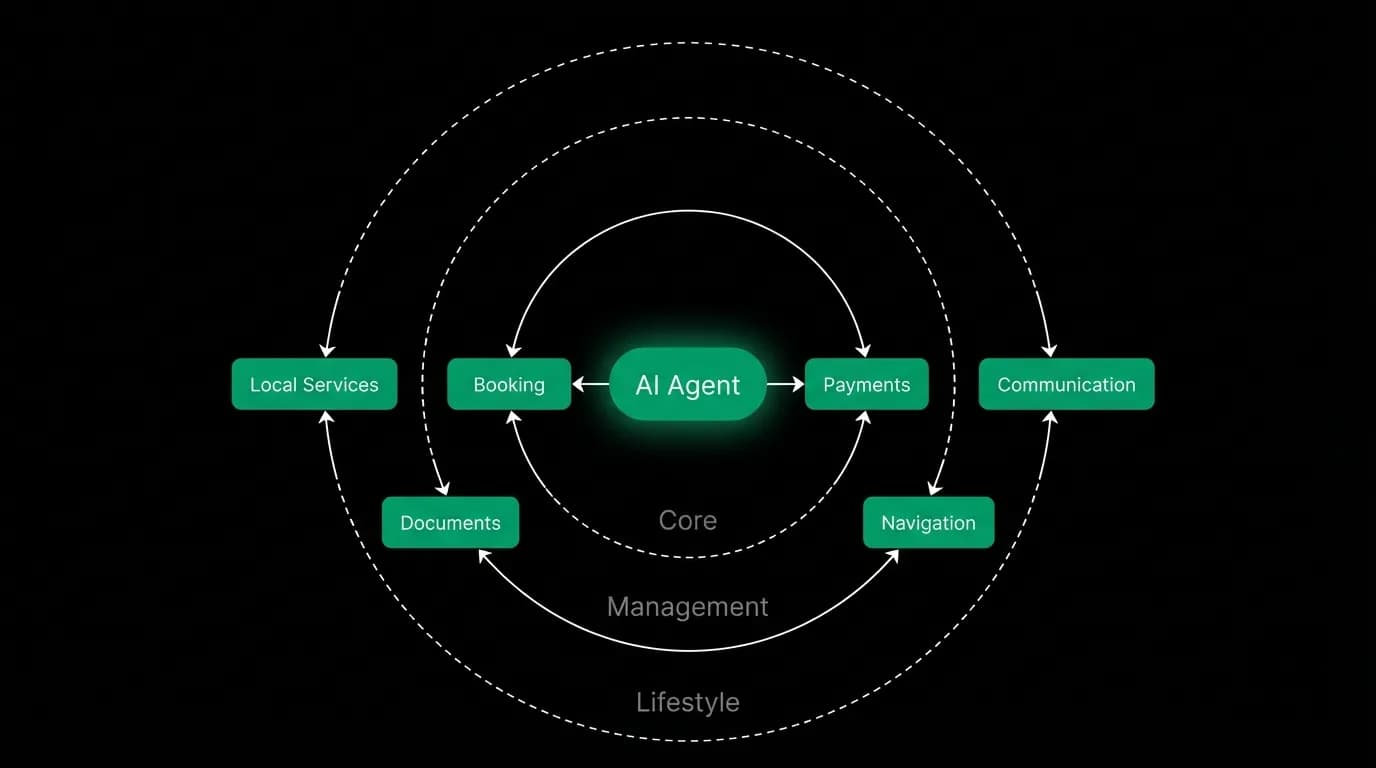
WeChat's genius was not that it did many things. It was that those things were connected. You chatted with a friend about dinner, and a restaurant recommendation appeared in the conversation. You tapped it to see the menu, made a reservation, and paid, all without leaving the chat. The payment went through WeChat Pay, which you loaded from your bank account inside the same app.
This worked because the data flowed between features. Your social graph informed your commerce. Your payment history informed your recommendations. Your location informed your local services. Every feature made every other feature smarter.
Grab replicated this in Southeast Asia. You took a Grab ride, paid with GrabPay, ordered GrabFood, and the system learned your patterns across all of these interactions. The more you used Grab, the more useful it became, because the data flywheel connected disparate services into a coherent understanding of your life.
The key insight: the super app is not a product strategy. It is a data strategy. Consolidation is not about convenience (though that helps). It is about building a comprehensive model of the user that no single-function app can match.
Why it failed in the West
When Uber tried to become a super app by adding food delivery, freight, and grocery, the app became cluttered. Feature discovery suffered. Users could not find what they needed. The navigation went from clean and simple to a maze of menus and categories.
The same thing happened to every Western super app attempt. More features meant more UI surface area, which meant more cognitive load. The onboarding for each new feature was essentially a new product launch crammed into an existing app. Users felt overwhelmed.
The deeper problem was that Western super app attempts treated consolidation as aggregation. Take separate products and stack them in one app. But stacking is not integration. Uber Eats inside the Uber app is still a separate product with a separate interface and a separate mental model. The data connections between riding and eating were minimal. Your ride history did not meaningfully improve your food recommendations.
Without a unifying intelligence layer, the super app is just a folder on your phone. Marginally more convenient than switching between apps, but not different enough to change behavior.
This is where AI enters the picture.
AI as the simplification layer
The super app needs an abstraction layer that handles complexity so the user does not have to. In WeChat, that layer was the chat interface itself, where mini-programs launched from within conversations. In the West, that layer did not exist until AI agents became capable enough to serve as general-purpose interfaces.
Think about what an AI agent does for a travel super app. Instead of separate interfaces for flights, hotels, activities, payments, documents, and navigation, there is one conversation. You tell the agent what you need. The agent routes your request to the right underlying service, processes the result, and presents it in the chat.
Want to book a flight? Tell the agent. Need to convert currency? Ask the agent. Looking for a restaurant near your hotel? The agent knows your hotel, knows your dietary preferences from past conversations, and makes a recommendation. Need to check your boarding pass? The agent surfaces it because it knows your flight is tomorrow.
The AI agent is the simplification layer that makes feature consolidation feel simple instead of cluttered. Every feature is accessible through the same interface: a conversation. The user's cognitive load does not increase as features are added because the interaction model stays the same.
This is fundamentally different from the Western super app attempts of 2018-2021. Those added features as separate UI surfaces. We add capabilities as tools the agent can use. The interface does not grow more complex. The agent just gets more capable.
What the travel super app includes
Travel is the ideal domain for the super app thesis because a single trip touches so many different services. Today, a typical traveler uses five to eight separate apps for a single trip:
- Google Flights or Kayak for flight search
- Booking.com or Hotels.com for hotels
- Google Maps for navigation
- XE or Revolut for currency conversion
- TripIt or email for itinerary management
- Splitwise for group expense splitting
- WhatsApp for trip communication
- Notes app for saving restaurant recommendations
That is eight apps, eight logins, eight sets of notifications, and zero data sharing between them.
Nowah consolidates all of this into five tabs:
Chat is the center of the app. This is where you book flights, book hotels, get destination information, ask questions about your trip, and interact with the AI agent for anything travel-related. One conversation handles what currently requires three or four separate apps.
Trips is your command center for booked travel. Itineraries, documents, boarding passes, hotel confirmations, real-time updates on delays and changes. Everything TripIt does, but generated automatically from your bookings without forwarding emails.
Tools provides practical travel utilities: currency converter with AI context about whether you are getting a good rate, tip calculator that knows local customs for over 100 countries, and a bill splitter for group expenses. These are the everyday tools that keep the app on your home screen between trips.
Passport is your travel journal. Trip memories, highlights, photos organized by destination. The AI generates trip summaries and lets you relive past travel.
Profile is where your preferences live: preferred airlines, seat preferences, budget comfort zones, dietary restrictions. All of this feeds into the AI agent's memory, making every future interaction more personalized.
Five tabs. One app. Every travel need.
The data flywheel
Here is where the super app model gets really interesting, and where it diverges from simply having a lot of features.
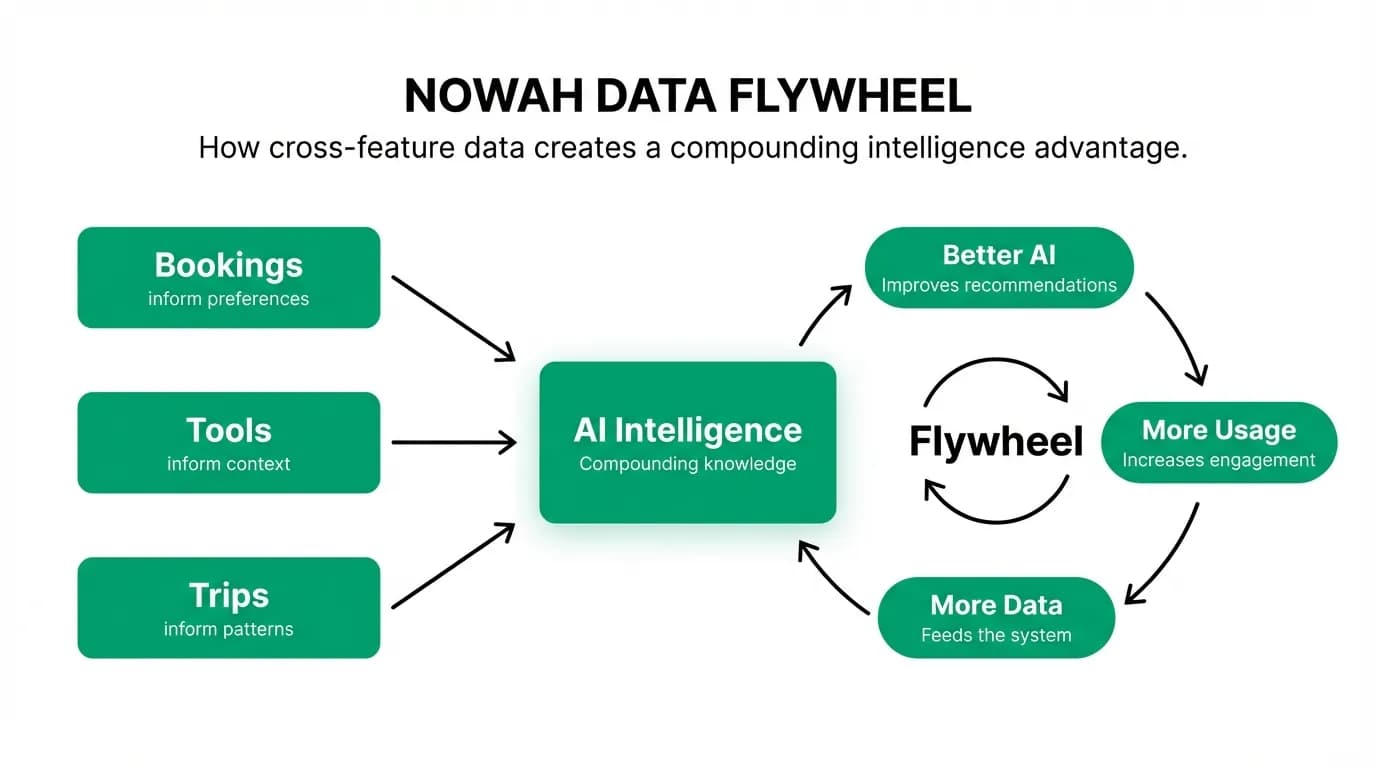
When you book a flight through Nowah, the AI learns your airline preferences, your price sensitivity, your scheduling patterns. When you book a hotel, it learns your accommodation style. When you use the currency converter during a trip, it knows you are traveling and can proactively offer relevant information. When you check your boarding pass, it knows your trip is imminent.
Each feature feeds data into the AI agent, and the AI agent uses that data to improve every other feature. Your flight booking informs your hotel search. Your hotel location informs restaurant recommendations. Your currency conversions tell the agent which country you are in. Your past trip patterns inform future trip suggestions.
This is the flywheel: more features used means more data captured means better AI means more useful features means more features used. It is a compounding loop that gets stronger with every interaction.
No single-function app can build this flywheel. Google Flights knows your flight search history. Booking.com knows your hotel preferences. Neither knows both. Neither can combine them to give you a hotel recommendation that factors in your flight arrival time, your neighborhood preferences from past trips, and your current budget flexibility based on how much you spent on flights.
The super app with AI at the center can. And over time, the intelligence gap between a consolidated AI travel platform and a collection of single-purpose apps will only widen.
How Uber and Grab navigated super app expansion
There are lessons to learn from the companies that tried the super app path, both successes and failures.
Uber's mistake was expanding into adjacent categories that were operationally distinct from their core. Ride-hailing and food delivery share some infrastructure (driver network, mapping, payments), but the user experiences are fundamentally different. You hail a ride in real-time. You order food for future delivery. The mental models are different, and cramming both into one app created confusion about what the app even was.
Grab succeeded because their expansion felt natural. You are already in a Grab ride. The driver asks if you want to pick up food on the way. GrabPay was already in your wallet from the ride. Using it for food was zero friction. Each new feature reinforced the existing behavior rather than requiring a new one.
The lesson: super app expansion works when new features share the same interaction model and enrich existing use cases. It fails when new features require users to learn new patterns.
Travel is perfectly suited for this. Every feature in a travel super app shares the same interaction model: conversation with the AI agent. Booking a flight, searching for a hotel, converting currency, checking your itinerary, splitting a bill. All of these are requests you can make in natural language, and all of them are answered by the same agent with the same context.
You never need to learn a new interface. You never need to discover a new feature by exploring menus. You just tell the agent what you need, and if the capability exists, it handles it.
The competitive moat
The super app strategy creates a moat that is nearly impossible to replicate from the outside.
Consider what a competitor would need to build to match a fully realized AI travel super app. They would need flight search (Kayak's territory), hotel search (Booking.com's territory), trip management (TripIt's territory), currency conversion (Wise's territory), expense splitting (Splitwise's territory), and an AI agent that connects all of them with shared context and memory. Plus years of accumulated user data that feeds the flywheel.
No single incumbent has all of this. And building it from scratch requires either massive capital investment or the strategic vision to start with AI as the foundation rather than trying to retrofit it.
Kayak cannot easily add hotel booking that shares context with flight search because their architecture was not designed for cross-product intelligence. Booking.com cannot easily add a currency converter that knows where you are staying because their app is organized around accommodation listings, not user context. Each incumbent is locked into their feature silo.
Starting with AI as the foundation means every new feature is connected from day one. The architecture supports shared context natively. Adding a new tool to the agent is not a product launch; it is a capability expansion that users access through the same conversation they have always used.
This is the real moat. Not any single feature, but the compound intelligence that emerges from having all features under one AI agent. The data from flights informs hotels. The data from hotels informs activities. The data from activities informs future trip planning. It all reinforces itself.
The travel super app nobody expected
The irony of the super app story is that the Western tech industry gave up on the concept right before the technology arrived to make it work. AI agents are the missing layer that transforms feature consolidation from "cluttered app with too many tabs" into "simple conversation that handles everything."
Travel is the right domain to prove this because:
- A single trip touches eight or more separate services that benefit from shared context.
- Travel planning is conversational by nature, making chat the perfect unifying interface.
- The data flywheel is strong because travel preferences compound over time.
- The competitive landscape is fragmented across single-function apps that do not share data.
- The stakes are high enough (trips cost hundreds to thousands of dollars) that users are motivated to use a better tool.
We are not building Nowah by cramming features into an app and hoping for the best. We are building it by expanding the AI agent's capabilities one tool at a time, with every new tool connected to the same context, the same memory, and the same conversation.
The super app works when the interface stays simple while the capabilities grow. AI makes that possible. And five years from now, I think people will look back and wonder why they ever used eight separate apps to plan a single trip.
Nowah is an AI travel agent that searches and books real flights and hotels through conversation — no filters, no thirty open tabs. Plan your next trip.