From Booking Confirmation to Trip Command Center
Booking is just the beginning. The AI trip dashboard manages itineraries, documents, real-time updates, and local intelligence in one place.
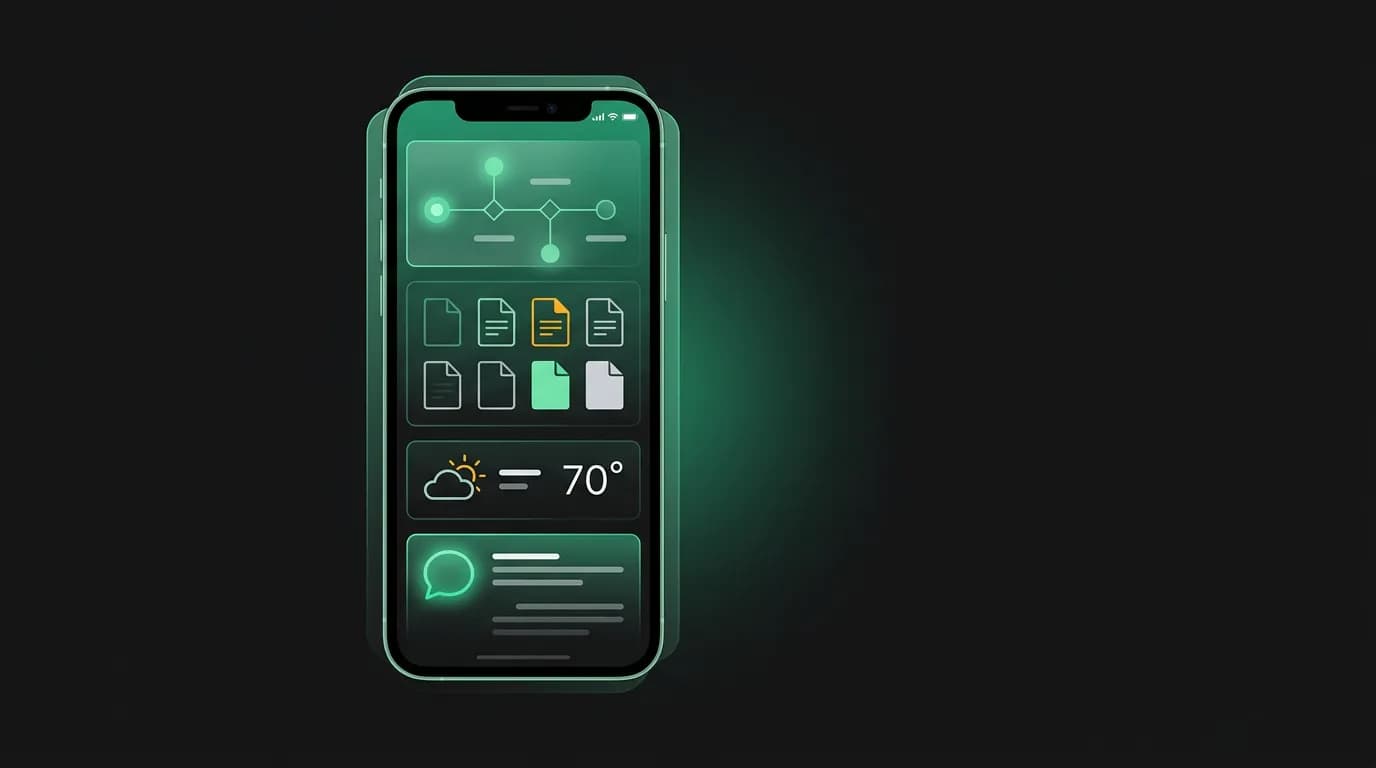
You just booked a trip to Barcelona. You get an email from Expedia: "Your booking is confirmed! Confirmation number: XYZ123." There's a PDF itinerary attached. Maybe a link to "manage your booking." And that's it. Expedia is done with you until your next search.
For the next three weeks leading up to your trip, you're on your own. You build your own itinerary in Google Docs or a shared spreadsheet. You screenshot your boarding pass and save it to your camera roll where it gets lost between food photos. You check the weather forecast manually. You Google "best restaurants in Barcelona" and open twelve tabs. When your flight time changes, the airline sends you an email you might miss.
This is the post-booking experience for virtually every major travel platform. The relationship ends at the confirmation email. Everything between "booked" and "next search" is a dead zone.
We think that's the biggest missed opportunity in travel tech. The trip itself — the part people actually care about — is where an AI agent can be the most useful. Nowah doesn't stop at the booking confirmation. That's where it starts paying attention.
The confirmation email dead end
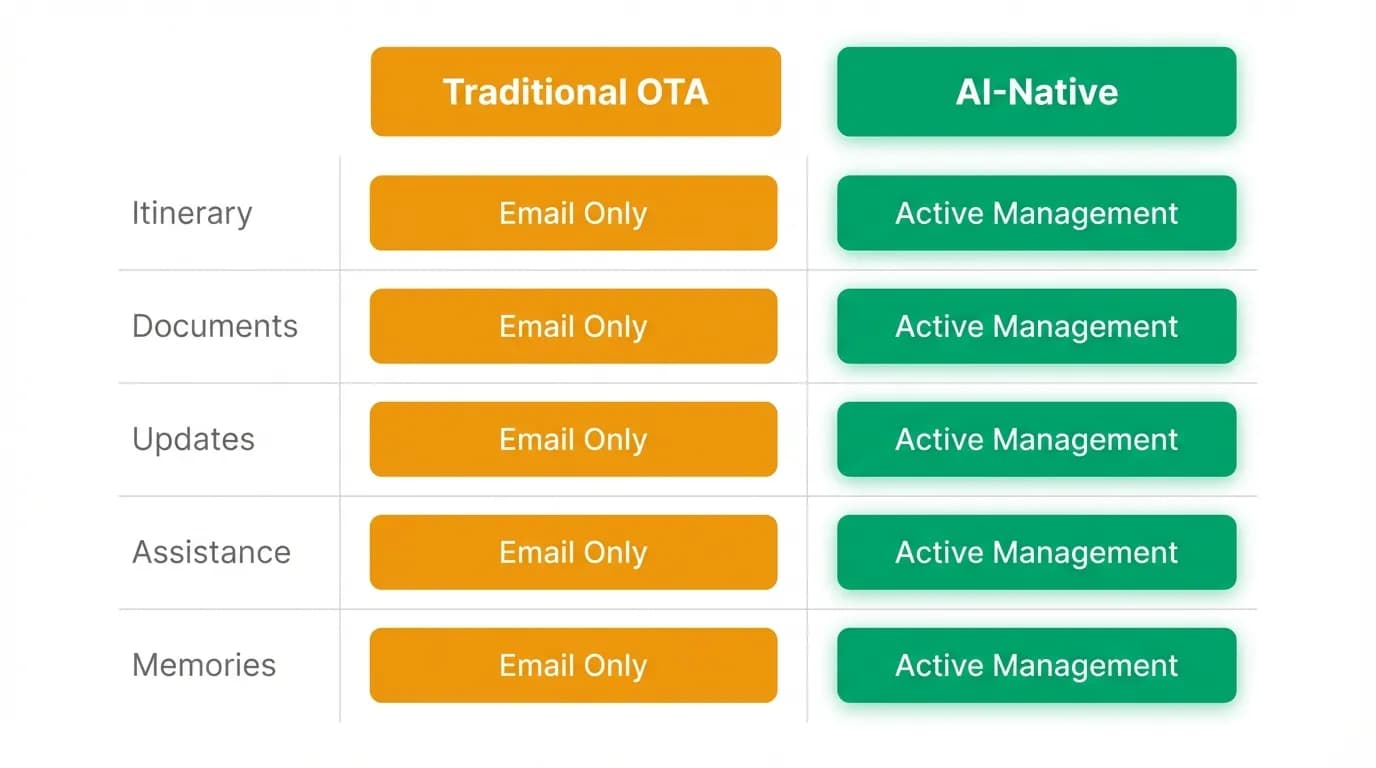
Most OTAs send a confirmation and disappear. This isn't accidental. Their entire business model is built around the transaction. Expedia earns its commission when you book. Booking.com earns its fee when you complete your stay. After the booking, these platforms have no revenue incentive to keep helping you.
So the post-booking experience gets minimal investment. Expedia has a "trips" section in their app, but it's essentially a list of confirmation details. Booking.com will send you a couple of push notifications as your trip approaches — "Your trip to Barcelona is in 3 days!" — but that's marketing, not utility.
The result is a gap. You booked everything in one place, but managing the trip requires a separate set of tools: Google Maps for navigation, TripIt for itinerary organization, Google Docs for trip notes, your email inbox for confirmations, and your camera roll for boarding passes. The booking platform that should be the hub for your trip becomes a receipt drawer.
Users who book via app have roughly a 30% higher repeat booking rate compared to web. Part of this is the app's persistent presence on their phone, but part of it is opportunity cost — if the app were useful during the trip, that 30% could be much higher. The post-booking gap is a retention leak.
AI-generated itineraries vs. user-assembled itineraries
Here's what most people's trip planning looks like: they book the flight and hotel, then spend hours building an itinerary. They Google "things to do in Barcelona." They read blog posts. They ask friends. They create a day-by-day schedule in a notes app or a spreadsheet, manually mapping out locations, transit times, and opening hours.
This is work. It's often enjoyable work — some people love trip planning — but it's still hours of research and coordination that a well-informed AI agent could handle in seconds.
When you book a trip through Nowah, the agent generates an itinerary based on what it knows about you. It factors in your travel style (relaxed vs. packed), your interests (food, history, nature, nightlife), your past trips (you've been to Barcelona before, so it suggests neighborhoods you haven't explored), and practical constraints (jet lag on day one, early flight on the last day).
The itinerary isn't a static PDF. It's a living document that you can modify through conversation. "Move the Sagrada Familia visit to Tuesday." Done. "Add a restaurant near the hotel for dinner on Wednesday." The agent finds one based on your cuisine preferences and books a reservation. "What's the best way to get from the hotel to Park Guell?" The agent provides transit directions with timing.
This is qualitatively different from a TripIt-style itinerary that organizes your confirmations chronologically. The AI itinerary is proactive — it fills in the gaps between your bookings with things you'll actually enjoy, based on individual knowledge about how you travel.
Documents in one place
Travel generates a surprising number of documents. Boarding passes. Hotel confirmations. Visa documentation. Travel insurance policies. Car rental agreements. Restaurant reservations. Event tickets.
Most people manage these across a dozen different places. The airline's app for boarding passes. Email for hotel confirmations. A photo of the visa stamp. A PDF somewhere for the insurance policy. When you need something — at the airport gate, at hotel check-in, at a border crossing — you're scrolling through apps and emails trying to find it.
Nowah's trip dashboard centralizes all of this. Your boarding passes are there. Your hotel confirmations are there. Visa documents, insurance, everything. Uploaded manually or pulled automatically from your booking data. When you approach the gate, the relevant boarding pass is surfaced proactively. When you check in to your hotel, the confirmation number is right there.
This sounds simple, and in some ways it is — TripIt has done document aggregation for years. The difference is that our document management is part of the same interface where you planned and booked the trip. It's not a separate app. It's not a separate workflow. The agent knows about your documents and can reference them in conversation. "What time is my check-in?" The agent looks at your hotel confirmation and answers. "Is my travel insurance valid in Morocco?" The agent checks the policy document.
Real-time intelligence
Your flight gets delayed by two hours. In the traditional model, you find out when the airline sends you a notification (if you have their app installed) or when you check the departure board at the airport. You then have to figure out on your own what this means for your connection, your hotel check-in, your dinner reservation.
In Nowah, the agent knows about the delay as it happens. It pushes a notification: "Your flight from JFK to BCN has been delayed by 2 hours. New departure: 9:45 PM. This won't affect your hotel check-in since you're arriving in the morning. I've updated your itinerary accordingly."
If the delay cascades — if you're going to miss a connection or arrive too late for a planned activity — the agent tells you and offers solutions. "You'll now arrive at 2 PM instead of noon. Your Sagrada Familia tickets are for 1 PM. Want me to check if we can reschedule to 3 PM?"
Push notification engagement rates for travel apps run between 8% and 12%. That's because most travel notifications are low-value — promotional offers, reminders to leave a review. Notifications about real-time trip changes are high-value. People open those because the information is immediately actionable. An agent that provides useful, timely intelligence during a trip earns the right to send notifications, which in turn keeps users engaged with the app.
The AI stays useful throughout the trip
Here's where the trip dashboard diverges most sharply from traditional OTAs. The AI agent remains available and useful throughout your entire trip, not just during the booking phase.
Day two of your Barcelona trip. You're walking through the Gothic Quarter and you're hungry. You open Nowah: "What's a good lunch spot nearby? Nothing touristy." The agent knows where you are (with your permission), knows your food preferences from past trips, and suggests a place two blocks away that has strong reviews from locals and serves the cuisine you like.
Day three. You're wondering about day trip options. "Is Montserrat worth visiting?" The agent knows you enjoy hiking and religious architecture (learned from past conversations), so it provides a specific answer rather than a generic one: "Based on your interest in hiking, Montserrat is a great fit. The hike up takes about 90 minutes and the monastery views are excellent. You could take the 9 AM train and be back by 4 PM."
Day five. You're at a restaurant and the bill arrives. "How much should I tip in Barcelona?" The agent provides local tipping norms rather than generic advice, because it knows this is your first time in Spain.
The agent becomes your on-the-ground travel companion. It handles the questions you'd otherwise Google, text a friend about, or guess at. And because it has context about your specific trip and your specific preferences, the answers are tailored rather than generic.
How Expedia and Booking.com handle post-booking
Let me be specific about what the incumbents do after you book.
Expedia's app has a "Trips" section that shows your upcoming bookings in a list. You can view confirmation details, access your e-ticket, and see a basic map. There's a "things to do" section powered by Viator that shows generic activities for your destination. That's about it. No itinerary generation. No document management beyond what they booked. No real-time intelligence beyond airline notifications passed through.
Booking.com is slightly better for accommodation. They'll send check-in reminders and sometimes local tips via push notification. But for flights booked elsewhere, they're blind. And their in-trip utility is limited to hotel-specific information. Google Trips used to be interesting — it automatically organized travel confirmations from Gmail and created itineraries. Google shut it down in 2019, partly because it didn't generate revenue and partly because the technology wasn't good enough to provide meaningful recommendations. The AI capabilities that exist now would make a product like Google Trips dramatically more useful, but Google hasn't rebuilt it.
The gap is enormous. Users spend five to eight minutes per session in travel apps, and that session time is valuable real estate. If your app is only useful during the booking phase — a few days of planning — you're missing the weeks of pre-trip anticipation, the days of the actual trip, and the post-trip reflection period.
Trip management as the retention engine
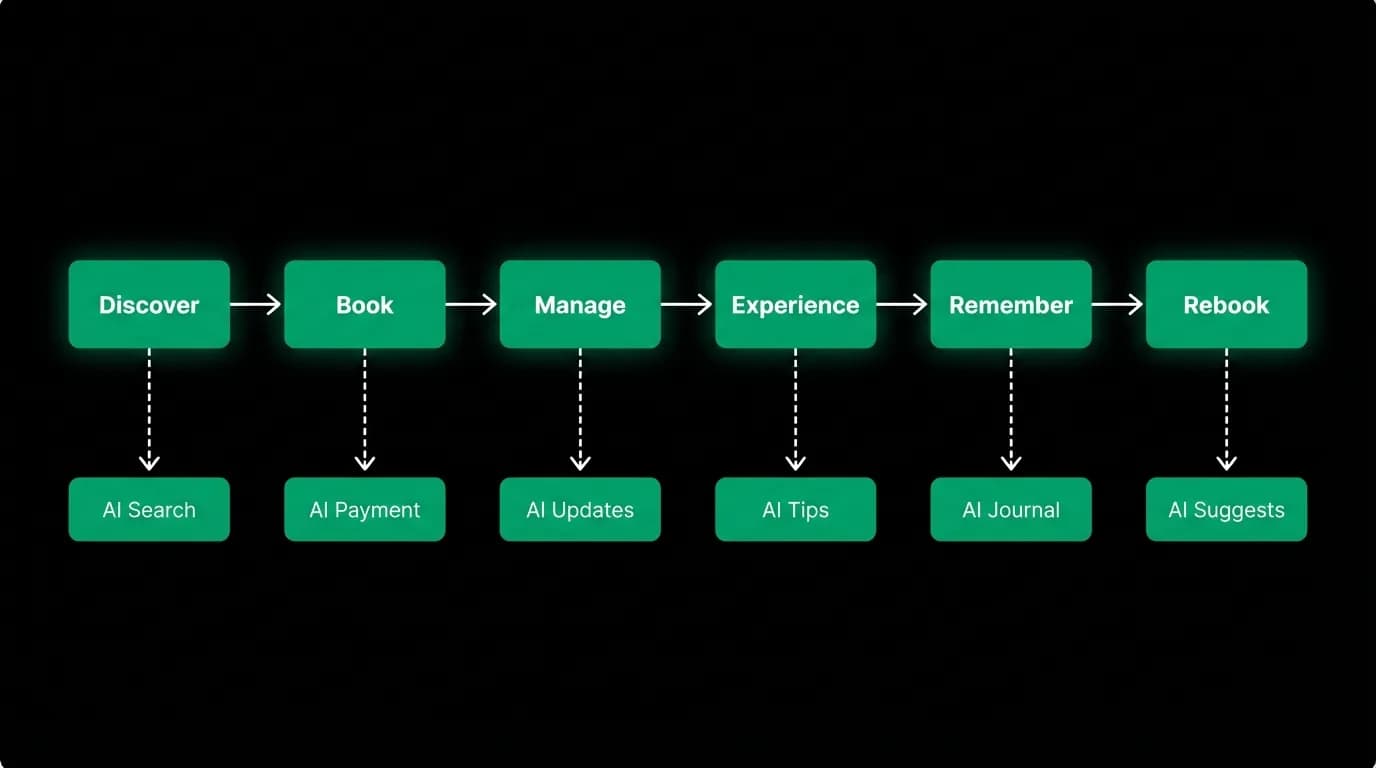
Here's the business case. The full travel lifecycle has six phases: discover, book, manage, experience, remember, rebook. Traditional OTAs participate in discover and book. They miss manage, experience, remember, and rebook.
Each missed phase is a missed touchpoint. And touchpoints drive retention. A user who opens your app five times during their trip (checking itinerary, accessing boarding pass, asking for restaurant suggestions, checking weather, looking at transit options) is far more likely to rebook with you than a user who opened your app once to book and never again.
The math on retention is straightforward. Acquiring a new travel customer costs significant marketing spend. Retaining an existing one — especially one who's had a good trip experience with your agent — costs almost nothing. The agent that helped plan, manage, and enhance a trip has earned trust that directly translates into the next booking.
We've built the trip dashboard as the place you come back to before, during, and after your trip. Before: review your itinerary, check your documents, ask about weather and packing. During: get real-time updates, ask for local recommendations, manage changes. After: look back at your trip timeline, reflect on highlights, let the agent remember what you loved for next time.
The post-booking experience isn't a nice-to-have that you build after the booking flow is solid. It's the retention mechanism that makes the entire business model work. The confirmation email is the beginning of the relationship, not the end of it.
Nowah is an AI travel agent that searches and books real flights and hotels through conversation — no filters, no thirty open tabs. Plan your next trip.