Designing for AI Agents That Act on Your Behalf
When AI moves from 'helping you book' to 'booking for you,' the UX challenge shifts to approval flows, action summaries, undo patterns, and calibrated trust escalation.
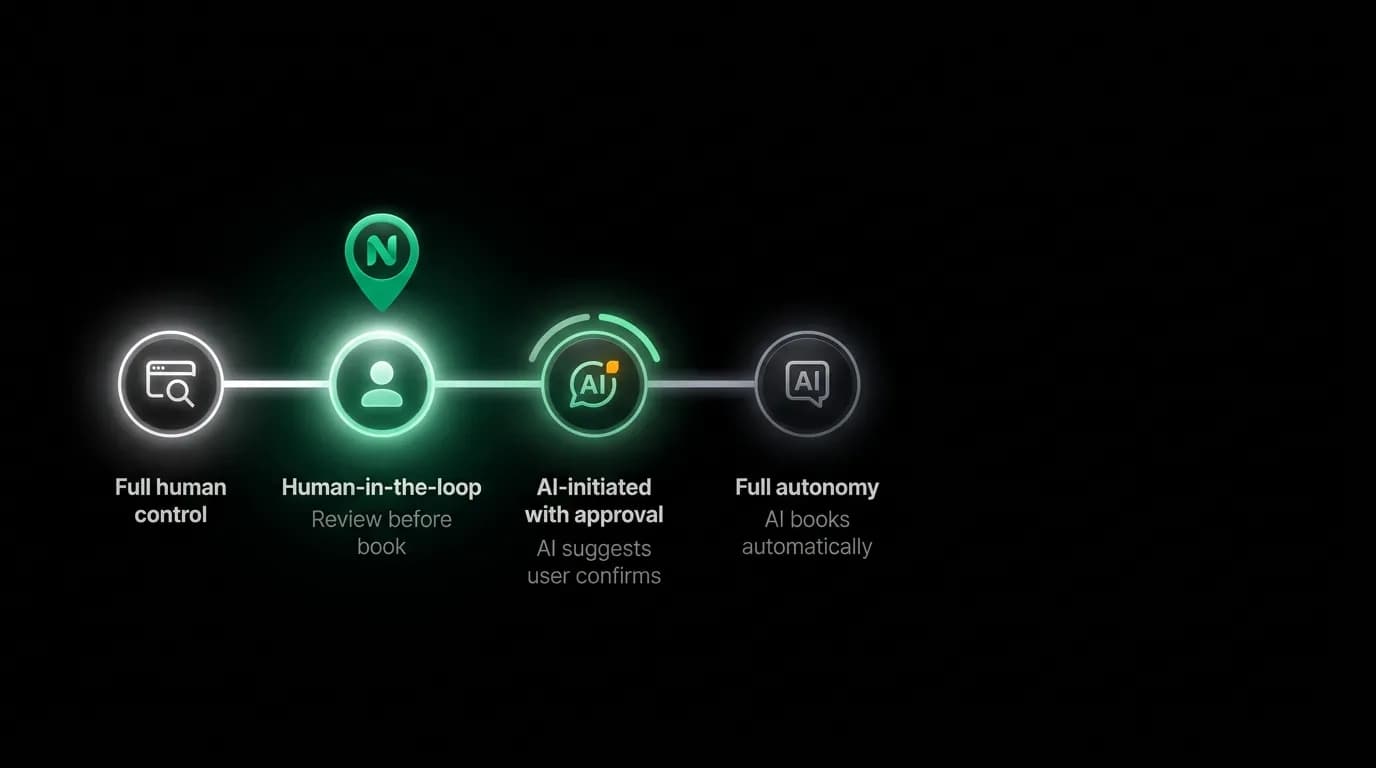
There is a qualitative difference between "find me a flight" and "book my usual flight." The first is a search request. The second is an action mandate. The user is not asking the AI to present options. They are asking it to make a decision and execute it.
This is the autonomy leap, and it changes the design challenge fundamentally. When the AI helps you book, the interface needs to present options clearly and guide you through a decision. When the AI books for you, the interface needs to communicate what was done, confirm it was correct, and provide a way to undo it if it was not.
The first model is a recommendation engine. The second is an autonomous agent. The design patterns for each are different, and getting the second model wrong has real consequences: the AI books the wrong flight, charges the wrong amount, or makes an assumption the user would not have made.
Approval flows: what needs explicit confirmation
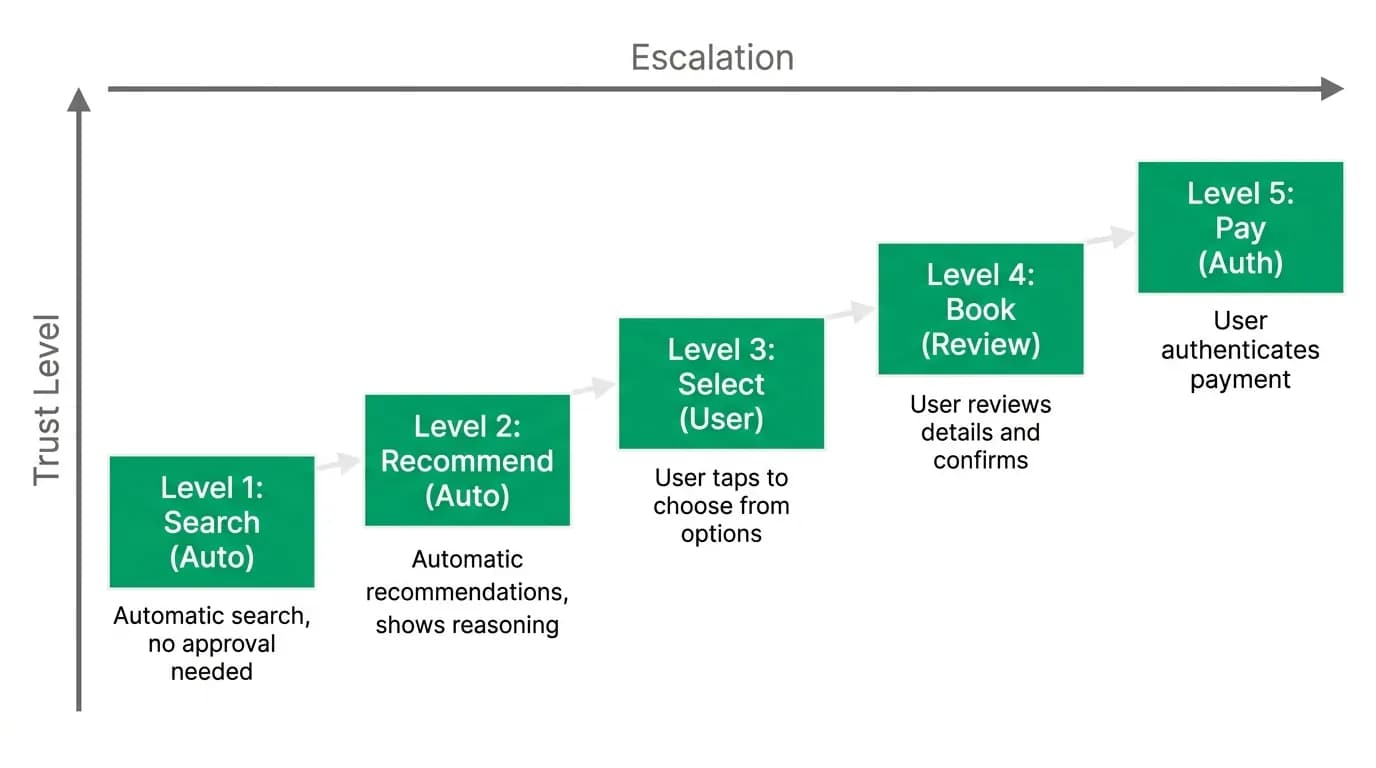
Not every action needs the same level of user approval. Searching for flights is low-stakes and reversible. The AI can search without asking. Selecting a flight is medium-stakes. The AI can recommend but should not select without the user's input. Booking a flight is high-stakes and potentially irreversible. The AI must get explicit confirmation. Processing payment is the highest stakes. The AI must get authentication.
This creates a trust escalation ladder. At the bottom, the AI acts autonomously for low-stakes, reversible actions. At the top, the AI requires explicit human approval for high-stakes, irreversible actions. Each rung on the ladder requires a different design pattern.
For autonomous actions, the interface shows what the AI did after the fact. "I searched for flights to Tokyo and found three options." No approval was needed. The user sees the results.
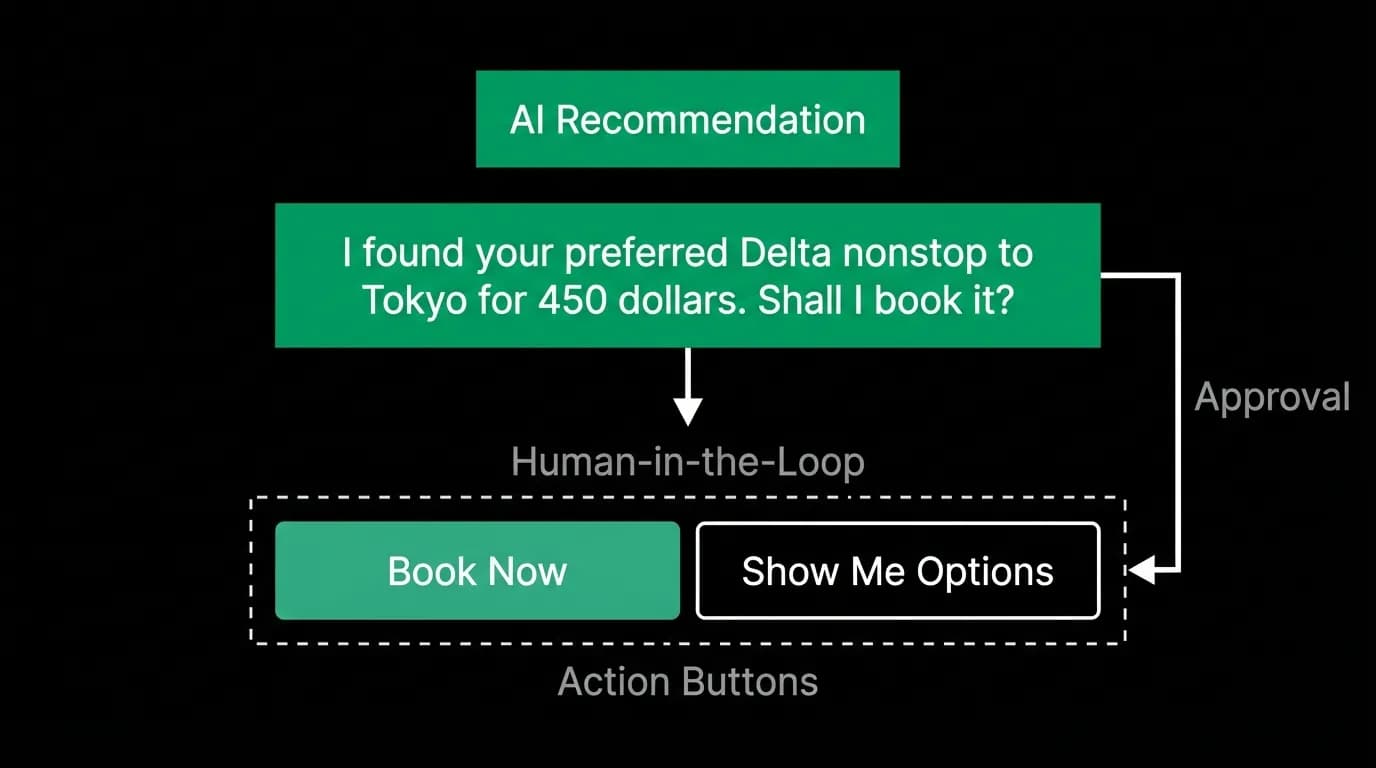
For recommended actions, the interface shows what the AI suggests before executing. "I found your preferred nonstop flight for $450. Should I book it?" The user approves or asks for alternatives.
For explicit-approval actions, the interface presents full details and requires deliberate confirmation. The booking review screen with fare breakdown, traveler information verification, and a distinct "Confirm booking" button. This is where we are today for every booking.
For authentication-required actions, the platform's native payment authentication (biometric or pin) adds an additional layer. The user's body confirms what their tap initiated.
Action summaries: what the AI did
When the AI acts autonomously, the action summary becomes a critical trust mechanism. The user needs to understand what happened, why, and what the implications are.
A good action summary is specific and complete. "I booked an aisle seat on the nonstop flight departing at 10 AM, arriving at 2:45 PM, for $450 including taxes. Your confirmation number is ABC123." This tells the user everything they need to know to evaluate whether the AI made the right choice.
A bad action summary is vague and incomplete. "Your flight is booked." This tells the user nothing. Was it the right flight? The right seat? The right price? The lack of detail creates anxiety rather than confidence.
Action summaries should mirror the information that a review screen would have shown if the user had gone through the manual flow. The user skipped the review by trusting the AI to choose well. The summary proves that trust was warranted.
Undo patterns: the safety net for autonomy
The more autonomous the AI becomes, the more important undo capability is. If the AI can book a flight without step-by-step approval, the user must be able to undo that booking quickly and easily.
The undo window is the time period after an autonomous action during which the user can reverse it. For bookings, this maps to the free cancellation window that many providers offer. The AI should know whether a free cancellation period applies and communicate it clearly: "You can cancel this booking for free within 24 hours."
The undo action itself should be as simple as possible. Not "navigate to trip details, find the booking, tap the menu, find the cancel option, confirm the cancellation." Just "Cancel this booking" in the same conversation where the booking was made. The AI handles the cancellation flow.
Trust escalation: earning the right to act
Users do not start by trusting an AI to book autonomously. Trust is earned through repeated positive experiences at lower autonomy levels.
The progression looks like this. First, the user searches through conversation and books through the manual review flow. They experience the AI's recommendation quality and learn to trust its judgment. Next, the user starts accepting the AI's first recommendation more often, spending less time comparing alternatives. The AI's track record has earned confidence.
Eventually, the user might say "just book it" for a routine trip they take regularly. The AI has demonstrated enough accuracy and understanding of preferences that the user trusts it to execute without step-by-step oversight.
The interface should adapt to this progression. For new users, every booking goes through the full review flow. For experienced users who have demonstrated high acceptance rates, the AI can offer a shortcut: "I found your usual flight for $450. Book it now?" with a single-tap confirmation instead of the full review screen.
Guardrails: boundaries for autonomous action
Even with full trust, the AI needs guardrails. Configurable spending limits prevent the AI from making expensive bookings without enhanced approval. Destination restrictions can prevent bookings to places the user has blacklisted. Time-of-day rules can prevent the AI from making bookings during sleeping hours.
Guardrails are not a lack of trust. They are a mature trust architecture that acknowledges the AI will occasionally make mistakes or encounter unusual situations. The guardrails catch those cases before they become problems.
The design for guardrails is visibility. The user should know what limits are in place and be able to adjust them. A settings screen that shows current autonomy rules gives the user a sense of control over the AI's capabilities, which paradoxically increases their willingness to grant more autonomy.
Designing an approval framework
If you are building toward AI autonomy, design the approval framework early. Categorize every action by risk level. Define the approval requirement for each level. Build the action summary format for autonomous actions. Design the undo flow. And create the trust progression that moves users from full manual control to comfortable autonomy over time.
The goal is not to remove the human from the loop. It is to make the loop efficient. The human makes fewer decisions, but the decisions they make are well-informed and the actions they delegate are well-supervised.
Nowah is an AI travel agent that searches and books real flights and hotels through conversation — no filters, no thirty open tabs. Plan your next trip.